#Weaving
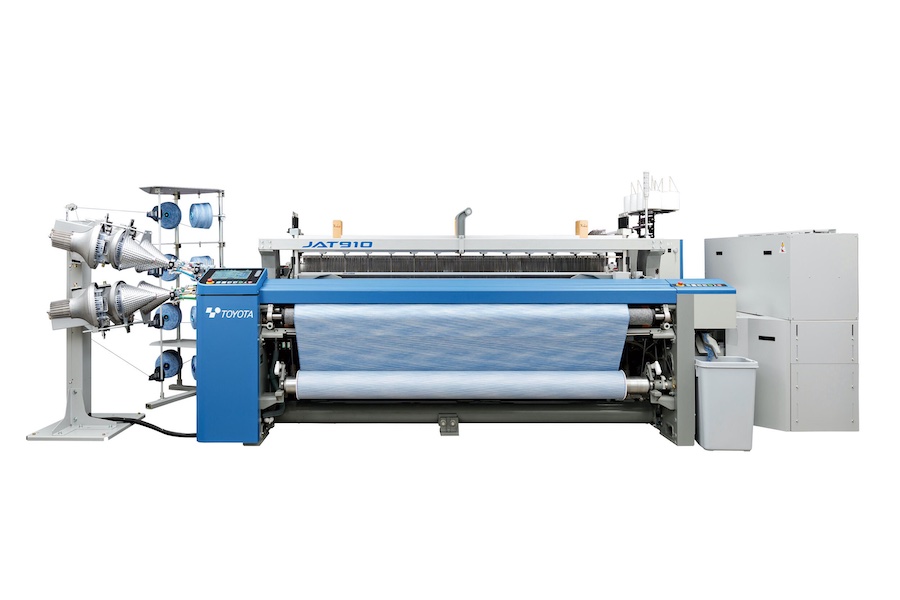
Toyota releases the new JAT910 air-jet loom
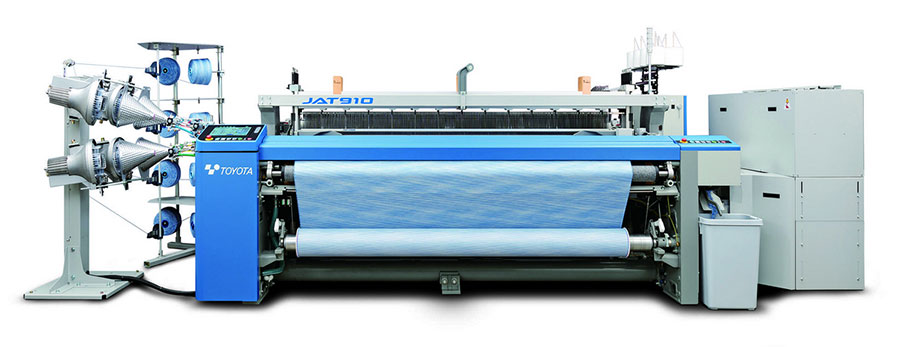
Equipped with cutting-edge technology that improves environmental performance and supports efficient factory management
The product is a successor to the previous model, the JAT810, which has been widely used by customers around the world since its release in 2013 and boasts the world's top market share*1. Inheriting high-speed/low-vibration technology and superior weaving capabilities, the JAT910 attains further improvements in environmental performance and contributes a more efficient factory management for customers.
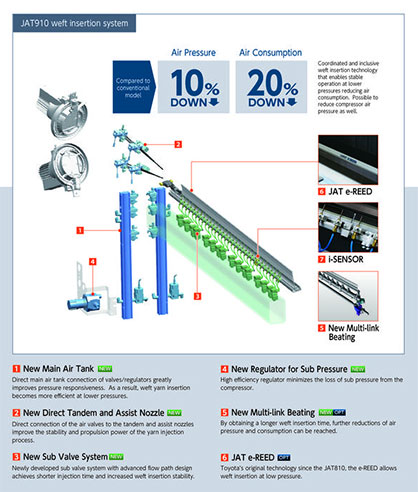
Amid the recent global rise in environmental awareness and soaring energy prices, saving energy is imperative in the textile industry as well. For the JAT910, the mechanism of the air injection system for inserting the weft yarn has been improved. As a result, the air pressure and the air consumption are reduced by 10% and 20%, respectively, compared with the JAT810. In addition, by employing a new main motor and inverter, the new product achieves a 10% reduction*2 in power consumption.
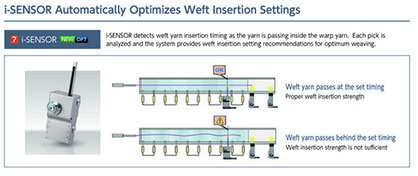
Aside from such improvements, the use of i-SENSOR, the world's first*3 sensor that detects weft yarn insertion timing as the yarn is passing inside the warp yarn, enables the optimum air pressure and weft insertion requirements to be automatically calculated based on Toyota Industries' proprietary algorithm, thereby supporting improved efficiency.
Moreover, the JAT810's FACT*4 (Toyota FACTory Management System) has garnered high acclaim from numerous customers as they faced the need to reduce operating losses that accompany high-mix, low-volume production. With the JAT910, the functionality has been expanded to include IoT sensor technology attached to the machine that measure multiple items including air pressure and sends optimal pressure settings to a compressor that previously required manual adjustments for each fabric. Another benefit is a feature to give the operator instructions for the next machine to work on. Combined with many other functions, it has evolved into the FACT-Plus that contributes to improving the productivity of the customer's factory through the use of IoT technology.
For nearly 100 years since founder Sakichi Toyoda completed the Type G automatic loom, Toyota Industries has continued to develop products that meet the needs of the times and responded to customer demand in a wide range of fields, from clothing and home textiles to medical and industrial materials. Through its long-cultivated technological capabilities and global service network, Toyota Industries will contribute to the development of the textile industry by providing products that give consideration to not only the environment but also the workplace.
*1: Survey by Toyota Industries Corporation (Based on actual unit sales)
*2: Value under Toyota Industries Corporation's test conditions with a machine of equivalent specifications
*3: Survey by Toyota Industries Corporation
*4: A system that collects information on operations, such as the production volume and causes of stoppages of each machine, and supports the customer's factory management