[pageLogInLogOut]

#Weaving

Data-based success for fabric manufacturers

© 2022 Uster
Producing quality fabrics is much easier with automated inspection. Uster EVS Fabriq Vision gathers quality data and presents it in an album, which is used to certify the quality of each fabric roll, with total traceability. It combines quality assurance and process optimization – automatically – in a solution which is already popular in technical textiles.

Automated fabric inspection delivers quality and optimization along the process chain

In a survey, customers reported that data from the Uster fabric inspection system was useful in quality assessment of the final product, as well as reports for customers. Traceability data was viewed as a particularly strong point for customers serving the automotive industry. Suppliers to this sector, and to other sensitive applications, value Uster EVS Fabriq Vision as a solution which meets the high standards of traceability, they need throughout the production chain.

Smooth and fast

Fabric producers need to guarantee reliable quality, which demands a consistently high rate of defect detection. Uster EVS Fabriq Vision ensures this is by using automated control during intermediate and final inspection, removing the need for manual inspection.

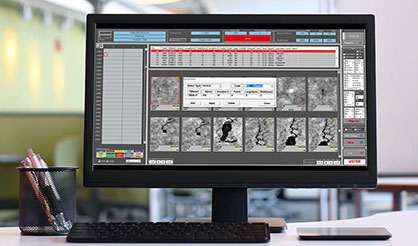
Multiple spectroscopes inspect the material. Unique image processing algorithms identify all defects automatically, recording them in a dataset for each produced roll – which is also used for traceability. A defect map is automatically generated, to help operators understand the allocation of defects in the fabric roll. This information is also available at an offline PC in the Fabriq Album software, which is a valuable tool for optimizing data for final cutting or further processing steps.

Effective – and people-friendly

A good investment shows up in spreadsheets for performance and sales – but it’s also confirmed by feedback from shopfloor personnel, as with Uster EVS Fabriq Vision.

Staff working daily with this fabric inspection system soon recognize that it’s a game-changer, because the inspection routine is increasingly automated. It works smoothly and quickly, in real time, checking every roll and locating every defect, at line running speeds.

Fabriq Album has even more people-friendly tools to make life easier for users. With manual classification, defects can be given customer-specific codes to identify each defect clearly. Unwanted images, or defects which can be ignored, can be removed automatically from the dataset, but are then retained in a hidden layer, for completeness of the dataset.


The future starts

The Fabriq Album software ensures optimum inspection efficiency and throughput. Machine learning capabilities and the implementation of AI-assisted defect classification extend the use of quality data generated by Fabriq Vision. Uster Fabric Inspection solutions bring the added benefit of helping customers to prepare for a digital future.
© 2022 Uster
© 2022 Uster


Uster’s use of Artificial Intelligence for automated fabric inspection was the subject of Michelle Salg’s talk at Techtextil Frankfurt. The Uster Product Manager for Fabric Inspection spoke in the Digitalization and Artificial Intelligence session, on June 22. Anyone who missed it can see all the details from her white paper available at uster.com/adc.

Data-based delivers

Leaders in fabric manufacturing – including knitters – can use Fabriq Vision to help make their own customers more successful. The key is the Fabriq Album. The whole finishing process contains different steps, sometimes executed by various companies. The dataset in Fabriq Album, generated by automated fabric inspection, is effectively a quality status report of process inputs, allowing manufacturers to manage all process steps for optimal output. Therefore, Fabriq Album empowers quality control and optimized end-products along the production chain.

The quality report, automatically created by Fabriq Album, can be provided to customers as an add-on, to give full transparency for every meter of the fabric. In technical textiles, and everywhere fabric inspection is needed – or should be – Uster Fabriq Vision can tap the potential to deliver major benefits for business.

More News from Uster Technologies AG

#ITMA Asia + CITME Singapore 2025

Uster presents novelties at ITMA Asia + CITME 2025

There’s news from Uster Technologies to be announced for the industry’s upcoming event in Singapore. The Uster 360Q universe is growing with new products, solutions and services. Innovation developments can also be recorded in the fields of man-made fiber testing and fabric inspection. Uster innovations address the industry’s trending topics as mill management and process control, optimization of delivered fabric quality and yield.

#Spinning

Uster Technologies marks 150 years of empowering quality excellence

Uster Technologies marks 150 years of excellence – a milestone that reflects continuous adaptation to customer needs and industry change. Over the decades, Uster has evolved from manufacturing quality testing instruments into a trusted partner shaping the future of textile production.

#Recycling / Circular Economy

Challenges of making yarn from recycled fibers

What does it take to spin quality yarn from recycled fibers? Uster Technologies brought textile industry leaders together to discuss the role of technology, data and automation – as well as the current challenges in using recycled raw material. Experts from Rieter, Säntis Textiles, Otto Yarns, and TVU commented on the current situation and looked into the future of spinning in a panel discussion organized at Uster headquarters.

#Spinning

Uster Technologies wins another infringement lawsuit

In a ‘victory for innovation in China’ Uster Technologies has secured a decisive judgment in a patent infringement lawsuit against a competitor. The final ruling by the Supreme People’s Court of PR China confirms that the competitor’s actions in copying the patented yarn feeder of the Uster Tester 6 constitute unlawful infringement.

More News on Weaving

#Weaving

Lindauer Dornier announces leadership transition in weaving machine business

After more than ten successful years at Lindauer DORNIER GmbH, Mr Wolfgang Schöffl will leave the family-owned company at the end of the year to enter well-deserved retirement.

#Research & Development

More safety and comfort for protective clothing thanks to auxetic fabrics

When everyday materials are pulled, they stretch or elongate in the direction of the pull and become narrower in cross-section. We can also observe this property in two-dimensional textiles. Auxetic structures behave differently here. They have the striking property of not changing under tensile stress or even increasing their width or thickness. These properties are advantageous, for example, in protective textiles or textile filter media. The DITF are researching auxetic fabrics for various applications.

#Weaving

Itema announces strategic partnership with Ivy Decarb to accelerate decarbonization in weaving process

Itema is pleased to announce the strategic partnership with Ivy Decarb, the digital platform helping textile companies measure and reduce their carbon footprint.

#Exhibitions & Events

Groz-Beckert showcases textile innovation at ShanghaiTex 2025

From December 16 to 19, 2025, the global textile industry will gather at ShanghaiTex at the Shanghai New International Expo Center (SNIEC), where Groz-Beckert will present its latest highlights and innovations across its five product areas – Knitting, Weaving, Nonwovens, Sewing, and Spinning – at Hall N3, Booth A05.

Latest News

#Heimtextil 2026

Eastman Naia™ expands All-Night Comfort at Heimtextil 2026

New fill solutions and the debut of sleepwear highlight the versatility and performance of Naia™ Renew, its circular fiber, for home textile applications.

#Heimtextil 2026

Stability in volatile markets: Heimtextil 2026 launches with 3,000 exhibitors and design expertise from Patricia Urquiola

Heimtextil opens the new season with 3,000 exhibitors from 66 countries – maintaining stability while becoming even more international. The new hall layout increases visibility and connects supply and demand even more efficiently. At the opening, architect and designer Patricia Urquiola and Rosa Bertoli, Global Design Director of Wallpaper magazine, talk about AI, innovative materials and future-oriented design for modern living environments.

#Research & Development

Innovation center for textile circular economy inaugurated

Just over eight months after the foundation stone was laid, the new Innovation Center for Textile Circular Economy was officially inaugurated today at TITK Rudolstadt. Thuringia's Minister President Mario Voigt, TITK Director Benjamin Redlingshöfer, and other guests of honor cut the ribbon to the modern building complex and viewed the premises, which are now ready for occupancy. The “DICE – Demonstration and Innovation Center for Textile Circular Economy” is TITK's largest single investment to date. The Free State of Thuringia supported the total cost of €11.5 million with €8 million in GRW and FTI funding.

#Research & Development

Sustainable design of Geosynthetics and roof underlayments made from recyclates

Is it possible to recover plastic recyclates from previously unused waste streams in order to produce high-quality fibers and films? How can bio-based polymer fibers be manufactured so as to allow adjustable biodegradability? These are the questions being addressed by researchers from the Fraunhofer Cluster of Excellence Circular Plastics Economy CCPE in the Zirk-Tex project.

TOP