[pageLogInLogOut]
CONNECTED BY NARROW FABRICS.

#Weaving

Christo's last work of art: a connection between Germany and France
© 2021 Lindauer DORNIER
Christo planned to cover the Arc de Triomphe in Paris in 2020. But COVID-19 intervened and shortly afterwards the internationally renowned artist died. His nephew now has accomplished posthumously Christo's last work. The woven fabric for this oeuvre was provided by a German customer of Lindauer DORNIER GmbH.

Christo and his wife Jeanne-Claude (1935-2009) had the idea for this mammoth project as early as the 1960s: The Arc de Triomphe, one of the most historic monuments of the French capital, located in the middle of the famous roundabout at the Place de l'Etoile, was to be transformed into one of those spectacular wrapping artworks through which Christo achieved world fame. In May 2020, however, the "Master of wrapping", as the German radio station Deutschlandfunk called him in an obituary, died. His nephew, Vladimir Yavachev, has now accomplished the final artwork of his famous uncle according to Christo’s original plans.

Christo - Arc de Triomphe © 2021 Lindauer DORNIER


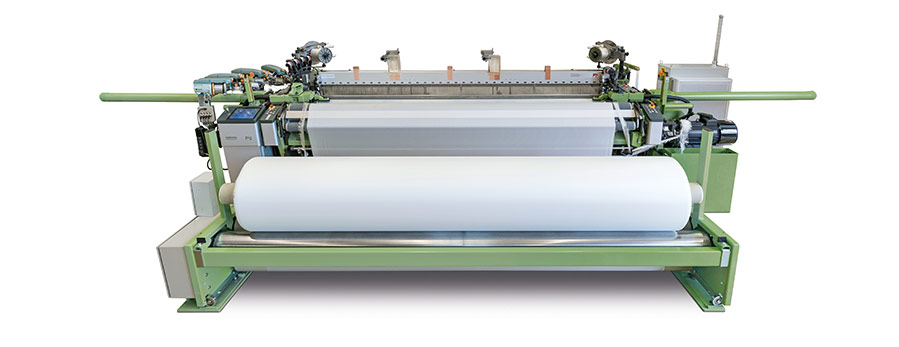
The DORNIER P2 rapier weaving machine – a flexible tool, not only for artists

From 18 September to 3 October 2021, 25,000 square metres of silver-blue fabric cover the 50 meter-high Arc de Triomphe, commissioned by Napoleon in 1806 in honour of his victories, completed in 1836. The coated fabric used, made from recycled polypropylene, was provided by the traditional weaving mill SETEX Textil in Greven, Germany. It took one year to produce this fabric especially for this work of art on a DORNIER P2 rapier weaving machine. “Only one weaving machine came into question for this demanding fabric” reports Konrad Schröer, owner and managing director of the North Rhine-Westphalian family business. Schröer continues „The ideal solution is the P2 with its new shed geometry and increased performance in combination with our experienced weavers and their textile know-how”.

Furthermore, SETEX manufactures on the P2 fabrics of the highest quality made of glass, polyester and polypropylene fibers – used as coating carriers as well as for filtration.

Christo‘s masterpieces: Eye-catchers on a high-tech basis

Technology from Lindau on Lake Constance played already a part in earlier works by Christo, who always chose his “wrapping materials” very carefully. Thus, the polypropylene fabric that spectacularly covered the Reichstag in Berlin in 1995 and the material for Christo's project "The Gates" in Manhattan's Central Park were also produced on rapier weaving machines from DORNIER.


For almost 60 years, these machines have been the industry standard for processing high-performance fabrics and their latest generation – the P2 – successfully continues this tradition.

The technical properties of the textiles used for these art performances are anything but trivial: In addition to sufficient resistance to wind loads, artistic criteria such as light reflection or fall of the folds are important influencing factors. The fabric developed for this purpose must therefore have a texture optimized in terms of lightness and stability. Economic and recycling aspects also play a role. The former is particularly important because all of Christo's projects do without public funding.

A glorious past with a promising future

The last work by the artist, who lived in Paris for a long time and, in 1985, wrapped the city's oldest bridge in fabric, the famous Pont Neuf, also recalls the impressive weaving history in France.

Christo - Arc de Triomphe © 2021 Lindauer DORNIER


In 1805, Joseph-Marie Jacquard, the son of a weaver in the silk metropolis of Lyon, invented the punch card-controlled loom. In doing so, he not only revolutionized global textile production, but at the same time, with the loom as the first "programmable" production machine, he laid a foundation stone for today's automation and digitization of processes. Using the basic weaving principle developed by Jacquard more than 200 years ago, DORNIER's customers today produce, among other things, high-quality clothing, home textiles and components for the aircraft industry from silk or carbon fibers.

Those who cannot make it to Paris in person by the third of October can admire Christo's last work in a livestream on the artist's website.

Hyperlink: https://christojeanneclaude.net/timeline/


More News from Lindauer DORNIER GmbH

#Weaving

Lindauer Dornier announces leadership transition in weaving machine business

After more than ten successful years at Lindauer DORNIER GmbH, Mr Wolfgang Schöffl will leave the family-owned company at the end of the year to enter well-deserved retirement.

#ITMA Asia + CITME Singapore 2025

DORNIER celebrates its anniversary at ITMA Asia + CITME

To mark its 75th anniversary, machine and plant manufacturer Lindauer DORNIER will be presenting the latest developments in its rapier and air-jet weaving machines at ITMA Asia + CITME in Singapore (Hall 2, Stand B401) from 28 to 31 October 2025. The focus will be on energy-efficient weaving technologies, new IoT solutions for networked textile production and systems for the series production of modern fibre composite components.

#Weaving

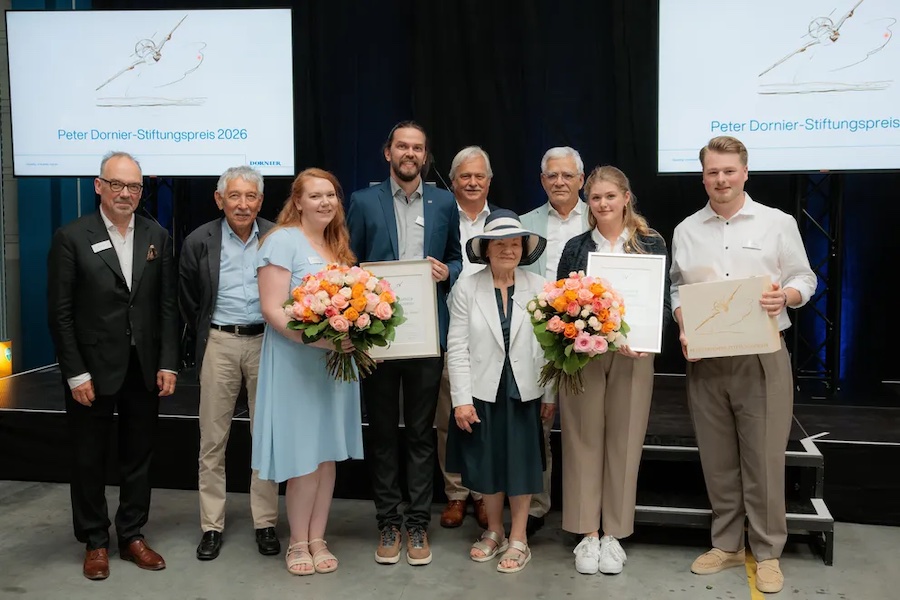
From the Venus flytrap to foldable aircraft wings: Peter Dornier Foundation Prize 2025 honours bionic research on 3D weaving technology

Long wings with foldable tips have the potential to reduce aircraft fuel consumption and make aviation more sustainable. An interdisciplinary research team has now developed a new solution based on the Venus flytrap: Freely movable wingtips made of fibre composites which are produced using innovative 3D weaving technology. For this pioneering combination of textile technology, aviation and bionics, researchers Patrick Meyer (TU Braunschweig) and Michael Vorhof (TU Dresden) were awarded the Peter Dornier Foundation Prize 2025 in mid-July.

#Weaving

Pattern-controlled “pic-a-pic” setting of rapier release timing on right-hand side

DORNIER PIRO enables the operator to set the timing of the rapier release on the right-hand side of the machine “pic-a-pic” and pattern-controlled. For applications with weft yarns of different fineness or elasticity, the optimum timing can be set for each weft channel. This offers great potential for reducing weft waste on the right-hand side.

More News on Weaving

#Techtextil 2026

Groz-Beckert showcases cross-segment innovations for technical textiles in Frankfurt

From April 21 to 24, 2026, Groz-Beckert will present its latest innovations and solutions across the product areas of knitting, weaving, nonwovens and sewing at Techtextil 2026 in Frankfurt (Hall 12, Booth B90).

#Techtextil 2026

Crealet to showcase electronic warp feeding solutions at techtextil 2026

Crealet AG will present its latest developments in electronic warp yarn feeding at Techtextil 2026 in Frankfurt. The company will exhibit at the Swiss Pavilion (Hall 12.0, Booth B01), organised by Swiss Textile Machinery.

#Techtextil 2026

From preparation to 3D weaving: Stäubli’s solutions at Techtextil 2026

Stäubli, a global leader in high performance weaving technologies, is pleased to announce its participation at Techtextil 2026 in Frankfurt, Germany, the leading international trade fair for technical textiles and nonwovens. As technical textiles continue their rapid expansion across demanding markets such as defense, mobility, aerospace, construction, energy… Stäubli will showcase innovative solutions designed to empower mills to produce the next generation of advanced fabrics. Stäubli will exhibit its trend-setting technologies at the Swiss Pavilion Booth B01.6 in Hall 12.0.

#Weaving

Itema America acquires Palmetto Loom Reed, strengthening local manufacturing and service in the U.S.

Itema America, the U.S. subsidiary of Italy-based Itema Group, has acquired – through an Assets Purchase Agreement – Palmetto Loom Reed, a Greenville, South Carolina-based manufacturer of weaving reeds and one of the last remaining domestic producers of these precision components in the United States.

Latest News

#Raw Materials

New study shows low environmental impact by Cotton made in Africa Organic Cotton from Tanzania

Today, the Aid by Trade Foundation (AbTF) is announcing the results of a comprehensive life-cycle analysis (LCA) for cotton produced in Tanzania under the Cotton made in Africa Organic (CmiA Organic) standard. The study emphasises the small ecological footprint of CmiA Organic verified cotton. This can largely be traced back to the absence of synthetic pesticides, artificial fertilisers, and artificial irrigation. Consequently, CmiA Organic cotton can help the textile industry meet regulatory requirements as well as science-based targets. The results also show that the consequences of climate change threaten the livelihoods of these cotton farmers, even though the type of agriculture they practise barely contributes to climate change.

#Raw Materials

Better Cotton Initiative strengthens regenerative focus in standard update

The Better Cotton Initiative (BCI) has strengthened the regenerative focus of its field-level standard with the launch of a new version of its Principles & Criteria (P&C), which marks the next step in the organisation’s journey to becoming a regenerative standards system.

#Man-Made Fibers

Selenis and Kintra Fibers partner to scale 100% bio-based synthetic fiber technology

Selenis, a leading global specialty polyester manufacturer, today announced a strategic manufacturing partnership with materials science company Kintra Fibers to scale Kintra’s patented fiber-grade PBS resin - a 100% bio-based and biodegradable material designed for textile applications.

#Functional Fabrics

PERFORMANCE DAYS proves its relevance as the industry’s key meeting point

Held on March 18–19, 2026, PERFORMANCE DAYS once again confirmed its position as a leading international platform for functional textiles. A total of 3.366 trade visitors and around 560 exhibitors gathered in Munich, with the event already kicking off successfully on DAY 0, which received highly positive feedback for its interactive format. Despite challenging conditions caused by the public transport strike in Munich, the event saw strong attendance and a consistently high level of activity across both exhibition days.

TOP