[pageLogInLogOut]

#Weaving

Starlinger rounds off portfolio with new circular loom RX 8.1
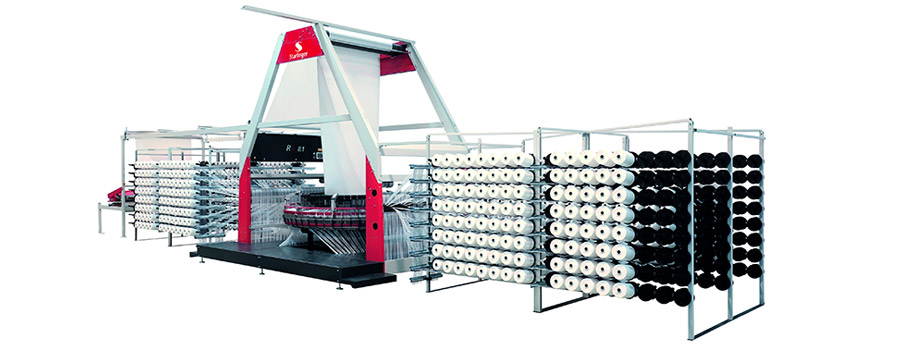
The new Starlinger circular loom RX 8.1. (c) 2020 Starlinger
The RX circular loom series is produced at the Starlinger plant in Taicang/China specifically for the Southeast Asian market. This series is now extended with the RX 8.1, a circular loom that is particularly suited to the production of lightweight fabrics for 1-loop FIBCs, tarpaulins as well as geo- and agrotextiles made of PP, HDPE, and PET. In combination with the RX 6.0, RX 6.1, and RX 8.2, Starlinger Taicang now offers the ideal circular loom for every fabric width.

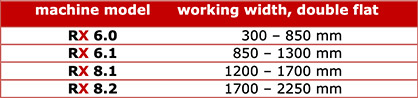
The new Starlinger circular loom RX 8.1 produces fabric with a width of 1,200 – 1,700 mm, which is an ideal match for 1-loop FIBCs, tarpaulin fabrics as well as geo- and agrotextiles. The model completes the RX series, which now covers every working width between 300 and 2,250 mm.

Like all models of the RX series, the RX 8.1 is equipped with numerous technological advantages. Due to its special reed and shuttle design, the machine does not have any sliding parts that would require lubrication, and thus leaves no traces of oil on the fabric. This property allows for the optimal adherence of the coating to the fabric and eliminates concerns regarding the use of the fabric in food applications. 
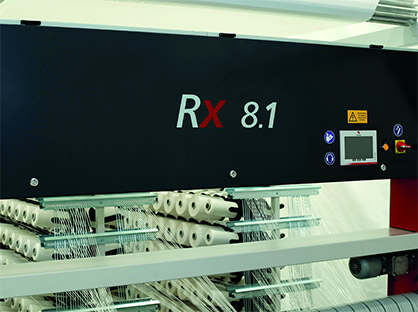
The new Starlinger circular loom RX 8.1. (c) 2020 Starlinger


Moreover, the RX 8.1 produces fabric of highest quality at lowest production cost per square meter, as the production speed of 800 picks/minute is high while the number of warp breaks is low. Other advantages are the machine’s user-friendliness, the energy-saving motors as well as a low noise level.

The machine will give its official debut at the plastics exhibition Chinaplas in 2021, as this year’s event has been cancelled due to COVID-19. In the meantime, prospective clients will have the opportunity to visit the Starlinger factory in Taicang for live demonstrations of the RX 8.1. The standard execution of the machine with single inlet will show the production of tarpaulin fabric with a double flat width of 1,500 mm and a weight of 70 g/m². A second machine will be equipped with double inlet and a gusseting device, which are available as options, and will produce fabric for 1-loop FIBCs with the same width, but twice the fabric weight (140 g).Another attraction in Taicang is the RX 6.0 L:   On this 6-shuttle circular loom, a PE liner is inserted into the woven fabric tube and attached to the plastic fabric. This process is performed fully automatically in the production process and allows the use of the fabric in sensitive applications such as food packaging.
More News from Starlinger & Co GmbH

More News on Weaving

#Weaving

Lindauer Dornier announces leadership transition in weaving machine business

After more than ten successful years at Lindauer DORNIER GmbH, Mr Wolfgang Schöffl will leave the family-owned company at the end of the year to enter well-deserved retirement.

#Research & Development

More safety and comfort for protective clothing thanks to auxetic fabrics

When everyday materials are pulled, they stretch or elongate in the direction of the pull and become narrower in cross-section. We can also observe this property in two-dimensional textiles. Auxetic structures behave differently here. They have the striking property of not changing under tensile stress or even increasing their width or thickness. These properties are advantageous, for example, in protective textiles or textile filter media. The DITF are researching auxetic fabrics for various applications.

#Weaving

Itema announces strategic partnership with Ivy Decarb to accelerate decarbonization in weaving process

Itema is pleased to announce the strategic partnership with Ivy Decarb, the digital platform helping textile companies measure and reduce their carbon footprint.

#Exhibitions & Events

Groz-Beckert showcases textile innovation at ShanghaiTex 2025

From December 16 to 19, 2025, the global textile industry will gather at ShanghaiTex at the Shanghai New International Expo Center (SNIEC), where Groz-Beckert will present its latest highlights and innovations across its five product areas – Knitting, Weaving, Nonwovens, Sewing, and Spinning – at Hall N3, Booth A05.

Latest News

#Heimtextil 2026

Eastman Naia™ expands All-Night Comfort at Heimtextil 2026

New fill solutions and the debut of sleepwear highlight the versatility and performance of Naia™ Renew, its circular fiber, for home textile applications.

#Heimtextil 2026

Stability in volatile markets: Heimtextil 2026 launches with 3,000 exhibitors and design expertise from Patricia Urquiola

Heimtextil opens the new season with 3,000 exhibitors from 66 countries – maintaining stability while becoming even more international. The new hall layout increases visibility and connects supply and demand even more efficiently. At the opening, architect and designer Patricia Urquiola and Rosa Bertoli, Global Design Director of Wallpaper magazine, talk about AI, innovative materials and future-oriented design for modern living environments.

#Research & Development

Innovation center for textile circular economy inaugurated

Just over eight months after the foundation stone was laid, the new Innovation Center for Textile Circular Economy was officially inaugurated today at TITK Rudolstadt. Thuringia's Minister President Mario Voigt, TITK Director Benjamin Redlingshöfer, and other guests of honor cut the ribbon to the modern building complex and viewed the premises, which are now ready for occupancy. The “DICE – Demonstration and Innovation Center for Textile Circular Economy” is TITK's largest single investment to date. The Free State of Thuringia supported the total cost of €11.5 million with €8 million in GRW and FTI funding.

#Research & Development

Sustainable design of Geosynthetics and roof underlayments made from recyclates

Is it possible to recover plastic recyclates from previously unused waste streams in order to produce high-quality fibers and films? How can bio-based polymer fibers be manufactured so as to allow adjustable biodegradability? These are the questions being addressed by researchers from the Fraunhofer Cluster of Excellence Circular Plastics Economy CCPE in the Zirk-Tex project.

TOP