[pageLogInLogOut]

#Textiles & Apparel / Garment

Sustainable, protective masks from Forster Rohner with Schoeller fabrics

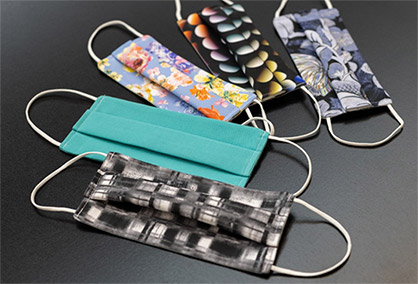
Switzerland is pulling together: Swiss textile companies forming a consortium with research and test institutes to collaborate on the development of a washable, protective mask for community members. These high-quality masks are both sustainable and economical with recycled functional fabric that can also be recycled at the end of its lifespan.

Sustainable, protective masks from Forster Rohner with Schoeller fabrics

The Covid-19 crisis has shattered the status quo and created new priorities, with protection as a top focus. Switzerland has come up with its own practical textile solution for Swiss citizens that does not require long transport routes or reliance on international supply chains. Two textile companies from Eastern Switzerland, Schoeller Textil AG and Forster Rohner AG, are launching a washable mask for community members that complies with the recommendations of the Swiss National COVID-19 Science Task Force.

Recyclable fabric made of 60 percent recycled fibers

The high-quality fabric components of the mask have been developed by the innovative Rhine Valley company Schoeller Textil AG. Schoeller has brought its expertise in fabric development, as well as its experience in textile finishing technologies for increased comfort and protection to the project. The two-layer polyester weave is hydrophilic (water-receptive) on the inside and hydrophobic (water-repellent) on the outside. Thanks to outstanding air permeability and the use of special yarns that feel like cotton, the resulting textile is extremely comfortable to wear. For many years Schoeller has also been focused on sustainable solutions – the basic fabric was developed within the framework of the wear2wear recycling collaboration (www.wear2wear.org), consists of more than 60 percent recycled fibres, and can be recycled again at the end of its lifespan.

Forster Rohner AG is manufacturing the reusable masks in St. Gallen and has been perfecting the industrial manufacturing process with embroidery machines and sophisticated sewing technology. The wearing comfort of the mask was fine-tuned by employees conducting extensive wear testing in their daily work routine. The result is a washable mask for community members with an optimum fit, it can be worn daily for up to 7 days without washing.
(c) 2020 Schoeller
(c) 2020 Schoeller


With this practice, the mask score highly in terms of its ecological credentials and is also far more economical than a disposable product. Forster Rohner is also adding a fashionable element to the technically highly innovative mask. Its subsidiary, Jakob Schlaepfer AG, well-known for its Haute Couture and Prêt-à-Porter establishments around the world, is creating its own prints for the masks. Alongside white and plain colors, the masks will also be available in a Limited Edition series of beautiful print designs consumers can choose from.

In accordance with Swiss National COVID-19 Science Task Force Guidelines

The Swiss masks have been tested by the EMPA in St. Gallen. They have passed the spray and filter tests, as well as the breathing activity test. The masks are available immediately and can be procured by Swiss enterprises, transport companies, etc., for their staffs. It is also possible to order customer-specific colors or prints. Swiss end consumers can also obtain the masks from various online shops of the partners involved.


More News from Schoeller GmbH & CoKG

More News on Textiles & Apparel / Garment

#Textiles & Apparel / Garment

VIATT 2026 to debut German Pavilion, strengthening European participation alongside key Asian textile hubs

Vietnam’s textile and garment sector continues to be a major contributor to the country’s economic growth, with export revenues expected to reach USD 46 billion in 2025, a 5.6% increase from 2024 . From 26 – 28 February, the Vietnam International Trade Fair for Apparel, Textiles and Textile Technologies (VIATT) is set to contribute to economic growth opportunities by accelerating digital transformation and green transition across the entire textile value chain. The upcoming edition will respond to the rising demand for advanced technologies and sustainable materials with the introduction of the German Pavilion, alongside strong exhibitor participation from key Asian sectors, as well as several high-profile fringe events.

#Sustainability

Ying McGuire becomes new CEO of Cascale

Cascale today announced the appointment of Ying McGuire as Chief Executive Officer, effective June 1, 2026.

#Europe

Antwerp Declaration community urges EU leaders to deliver emergency measures as Europe’s competitiveness crisis deepens

EURATEX, representing the European textile and fashion industry, joins the Antwerp Declaration Community’s call on EU Heads of State and Government to adopt emergency measures that restore industrial competitiveness and deliver tangible results for Europe’s manufacturing base in 2026.

#Textiles & Apparel / Garment

Pets in fashion: functional and sustainable textiles find new market at Intertextile Apparel

China’s pet economy is booming, especially amongst younger generations, and pet apparel – from designer outfits to functional garments – was a RMB 3.5 billion (over USD 500 million) market in 2024, growing more than 20% annually¹. To help exhibitors harness this trend, Intertextile Shanghai Apparel Fabrics – Spring Edition 2026 will launch the Pet Boutique, presenting a range of innovative, sustainable materials that prioritise both functionality and comfort for pets.

Latest News

#Technical Textiles

Sustainable, lightweight, and sound absorbing: Polyester-based front trunk solution for BEVs

As car manufacturers look to further reduce their carbon footprint, Autoneum has developed an innovative front trunk solution for battery electric vehicles (BEVs), made entirely from polyester-based textile. The Ultra-Silent Frunk offers significant weight reduction, improved acoustic and thermal insulation, and uses up to 70 percent recycled material, supporting sustainable and efficient vehicle design. Autoneum, global technology leader in acoustic and thermal management for vehicles, has already received orders for the new frunk from three major OEMs in Asia and Europe to be built in three BEV models. Series production for two BEVs has been underway in China and Germany since last year.

#Raw Materials

Modern testing methods for raw cotton

The 38th International Cotton Conference Bremen will take place from 25 to 27 March 2026 at the Bremen Parliament. This conference has traditionally stood for in-depth expertise and international exchange. The program will focus on technical innovations, market trends, and regulatory frameworks across the entire value chain – from agriculture to the circular economy. With high-profile speakers, the conference is regarded as the key meeting point for the global cotton industry. Today’s focus: Cotton quality and testing methods.

#Spinning

Rieter responds to higher raw material prices

Global political and economic developments have been leading to rising raw material and energy costs for some time. The textile machinery industry is also affected by this trend. Rieter machines and components consist to a large extent of steel, copper, aluminum and electronics. These materials in particular have seen higher demand and higher prices in recent months.

#Weaving

Stäubli demonstrates how innovation translates into real benefits for weaving mills at SITEX 2026

One of India’s most prominent textile industry events, SITEX 2026, is held from February 21 to 23 in Surat. Committed to empowering Indian weaving mills with state‑of‑the‑art solutions tailored to regional needs, Stäubli will present a selection of solutions designed for performance, reliability, and power efficiency. Through its weaving preparation, cam and dobby shedding solutions and Jacquard technologies, Stäubli highlights its global expertise tailored to the specific needs of the local market.

TOP