[pageLogInLogOut]

#Textile chemistry

A flagship for chemical production: BASF inaugurates world-scale Verbund site in China
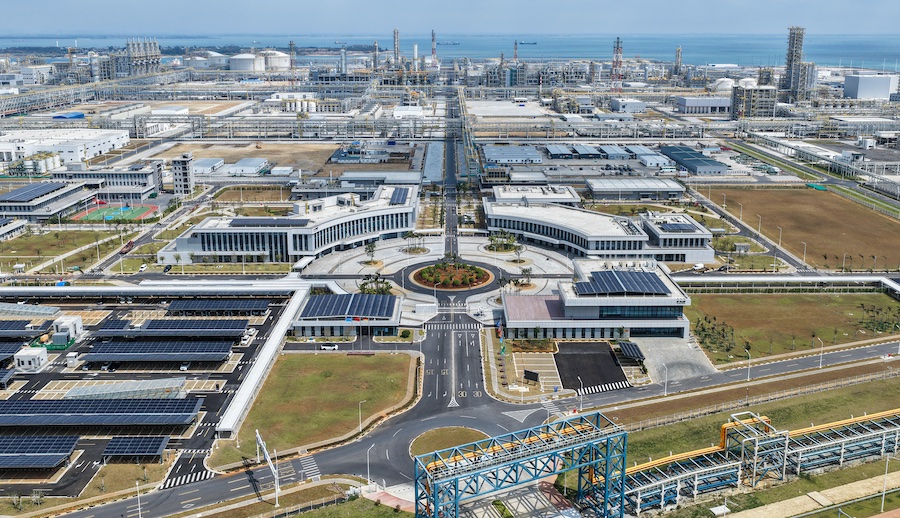
Aerial view of the BASF production site in Zhanjiang © 2026 Photo: BASF
BASF today (March 26, 2026) celebrated the official inauguration of its newly built, world-scale Verbund site in Zhanjiang, Guangdong Province in southern China. Covering an area of around four square kilometers, it is more than a major BASF project in the chemical growth market of China. “Zhanjiang shows what the future of chemistry looks like: efficient, digital and sustainable by design. The site showcases a smart integrated Verbund structure on an industrial scale,” said Dr. Markus Kamieth, CEO of BASF, at the ceremony attended by representatives from government, customers, business partners and employees.

At the Zhanjiang site, BASF employs over 2,000 people and will produce a diversified portfolio that includes basic chemicals, intermediates and specialty chemicals for the transportation, consumer goods, electronics, home care and personal care industries.

“Bringing this site to life took real ownership, speed and an exceptional level of commitment from our BASF team. Completing a project of this magnitude and complexity on time and under budget is remarkable. I want to thank everyone involved both at the site and worldwide who made this possible,” Kamieth said. “This investment shows confidence in the world’s largest chemical market in the long run and will be an important element of our ‘Winning Ways’ strategy,” he added. The majority of the products manufactured in Zhanjiang will directly serve customers in China, fully aligning with BASF’s global “local‑for‑local” approach. The project was completed on schedule and well below the original budget, with an investment of around €8.7 billion.

“I am proud of BASF’s innovative strength as the basis for the start-up of the most sustainable integrated chemical site in China, and the successful ramp-up of the steam-cracker in record time,” emphasized Dr. Stephan Kothrade, member of the Board and Chief Technology Officer of BASF SE, who is responsible for the Asia Pacific region. “It sets new benchmarks for sustainable chemical production in China and worldwide,” Kothrade added.

By using Verbund integration, process innovations and renewable energy, CO₂ emissions at the site can be reduced by up to 50 percent compared with a conventional petrochemical site. Long-term green power purchase agreements and investments in an offshore wind farm enable the site’s electricity supply to be 100 percent renewable. “Innovative technologies are also being used for the steam cracker – the starting point of various value chains at the Verbund site,” Kothrade said. It has a capacity of 1 million tons of ethylene per year and is the world’s first cracker equipped with main compressors (e-drives) powered by 100 percent renewable energy, supporting the production of high-quality, low-CO2 products. The world-scale flex-feed steam cracker is designed to process multiple types of feedstocks, such as naphtha and butane.

BASF has successfully started up 18 plants, 32 production lines, and is producing more than 70 products. With the proven Verbund concept with long value chains, BASF offers a broad, highly diversified product portfolio from the segments Chemicals, Materials and Nutrition & Care. This integration and scale enable competitive cost positions, significantly lower CO₂ emissions and reliable supply to serve multiple end‑markets. “This makes us an attractive partner for our customers in China,” said Haryono Lim, President, Mega Projects Asia, BASF. “Together with customers and partners, we will drive innovation and transformation forward in one of China’s most economically dynamic regions,” he added. Thus, the site provides an important platform for BASF’s future growth in China.

BASF announced the Zhanjiang project in 2018 and laid the foundation stone the following year. The first production plant to begin operation at the Zhanjiang site was for engineering plastics in 2022; it was followed by a thermoplastic polyurethane plant in 2024. At the turn of 2025/2026, BASF began production in the first value chains in the Verbund and successfully ramped up the steam cracker in record time.

The Zhanjiang integrated site is BASF’s seventh Verbund site worldwide and the third largest after Ludwigshafen, Germany, and Antwerp, Belgium. It will be operated solely under BASF’s responsibility.

BASF has been active in Greater China for over 140 years. Today, BASF serves almost all key industries in the region. In China, BASF has a strong production, sales and innovation footprint with large sites in Shanghai, Nanjing, Chongqing and Zhanjiang as well as numerous smaller sites across the country. In 2025, BASF achieved sales of around €8.2 billion with customers in Greater China and employed almost 13,000 people.

More News from BASF Aktiengesellschaft
Performance Chemicals for Textiles Europe

#Textile processing

trinamiX mobile NIR spectroscopy: New applications for the footwear and textile industry

trinamiX GmbH expands its solution portfolio for the circular economy, now enabling the identification of materials used in the footwear and textile industries. With its mobile near-infrared (NIR) spectroscopy solutions, trinamiX supports manufacturers, sorters, recyclers, and brand owners in reliably identifying materials and improving transparency across increasingly complex value chains.

#Techtextil 2026

BASF at Techtextil 2026: Helping to shape the future of the textile industry with tangible solutions

At the leading international trade fair for technical textiles and nonwovens from April 21 to 24, 2026 at the Messe Frankfurt, BASF will present numerous solutions and new projects in the textile sector to customers and partners at booth B 68 in hall 11.0. The focus is on product innovations and future-oriented technologies.

#Recycling / Circular Economy

trinamiX with new management

BASF is examining strategic options for its subsidiary trinamiX GmbH. trinamiX specializes in biometric imaging and mobile material analysis. These activities are not part of BASF’s core business, on which the company is focusing as part of the implementation of its new strategy.

#Research & Development

How innovations drive BASF’s success

“Innovation has always been part of BASF’s DNA. Especially in these volatile times, it is crucial to leverage our innovative strength to develop competitive solutions that differentiate us as a company in our markets and give us a competitive edge,” said Dr. Stephan Kothrade, Member of the Board of Executive Directors of BASF and Chief Technology Officer, at the company’s Research Press Briefing held today. To achieve this, BASF implemented its “Winning Ways” strategy about a year ago with the clear goal of becoming the preferred chemical company to enable its customers’ green transformation.

More News on Textile chemistry

#Sustainability

bluesign technologies introduces bluepass

bluesign technologies ag (www.bluesign.com) today announces the launch of bluepass, a new certification mark and product labeling system created to deliver clear, substantiated, and verifiable sustainability claims at scale.

#Textile chemistry

Officina39 expands in South Asia with dual trade show presence and new low-impact dyeing innovation

Officina39 reinforces its strategic expansion in South Asia by announcing its participation in two key textile industry events in Bangladesh and India, alongside the launch of a new solution designed to reduce the environmental impact of reactive dyeing.

#Techtextil 2026

Speed and connectivity: Techtextil and Texprocess provided market-ready solutions for industries under pressure

With more than 36,000 visitors and 1,700 exhibitors from a total of 112 countries, Techtextil and Texprocess 2026 demonstrated how innovation comes into industrial use. The convergence of research, industry and application proved to be a breeding ground for new material solutions, manufacturing and processing technologies. Natural fibres, performance apparel, connected systems and AI-driven processing technologies emerged as key growth and future markets.

#Techtextil 2026

RUDOLF is pioneering the future of technical textiles by developing innovative, functional solutions

At Techtextil 2026, RUDOLF presents its latest innovations for textile auxiliaries, textile care and construction chemicals. Based in Geretsried, Bavaria, the company draws on more than 100 years of experience and continues to position itself as a global technology partner focused on quality, innovation and sustainability.

Latest News

#Techtextil 2026

Techtextil 2026: KARL MAYER impresses as an innovative sector partner

KARL MAYER looks back with satisfaction on its participation in Techtextil 2026. From April 21 to 24, the international industry leader used the trade show in Frankfurt to meet with numerous key customers at its booth and, at the same time, establish many new contacts. Most visitors came from Germany, followed by major markets such as Poland, the United Kingdom, Turkey, France, and Portugal.

#Associations

BTMA backs global growth while investing in future UK leaders

As one of a number of new initiatives launched this year, the British Textile Machinery Association (BTMA) is launching the UK-India Textile Machinery Coalition. The UK-India Free Trade Agreement, signed in July 2025, has implications that extend across sourcing, competitiveness and long-term trade dynamics, believes BTMA CEO Jason Kent.

#Raw Materials

China projected to increase cotton production, yields, and imports in 2026/27

World cotton production in the 2026/27 season is projected at 25.9 million tonnes, exceeding global consumption of 25.2 million tonnes, according to the May 2026 issue of Cotton This Month. That means both production and consumption are expected to remain close to current season levels, while global cotton trade is projected to decline by 2.7% to approximately 9.6-9.7 million tonnes.

#Raw Materials

ICAC launches Carbon Credits Initiative to deliver new income streams to cotton farmers

The International Cotton Advisory Committee (ICAC) has announced a new initiative designed to unlock additional income streams for cotton farmers through participation in carbon credit markets, linking sustainable production practices directly to financial returns.

TOP