[pageLogInLogOut]

#Textile chemistry

Golden wedding for molecules

Artistic rendering of the 3+3-cycloaddition discovered at Empa's "nanotech@surfaces" laboratory. Image: Empa
Chemical syntheses in liquids and gases take place in three-dimensional space. Random collisions between molecules have to result in something new in an extremely short time. But there is another way: on a gold surface under ultrahigh vacuum conditions, molecules lying still next to each other can be made to combine - even those that would never want to react with each other in a liquid. Researchers at Empa have now discovered such a reaction. Best of all, the experts can "take pictures" and watch every step of the reaction.

In chemistry, there are structures that are particularly stable, such as the so-called "benzene ring" consisting of six interconnected carbon atoms. Such rings form the structural basis for graphite and graphene, but they also occur in many dyes - such as the jeans dye indigo and in many drugs such as aspirin.
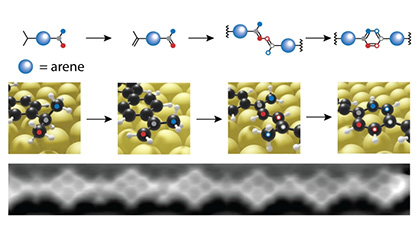
Chemical synthesis on a gold surface: a hydrogen is abstracted from saturated isopropyl groups. At 200 degrees Celsius, the carbon atoms (red and blue in the picture above) combine to form a new benzene ring. In this way, individual molecular building blocks link into a polymer chain, as is seen with the atomic force microscope (bottom). Image: Empa


When chemists wanted to build such rings in a targeted manner, they used so-called coupling reactions, which usually bear the name of their inventors: for example, the Diels-Alder reaction, the Ullmann reaction, the Bergman cyclization or the Suzuki coupling. Now there is another one that does not yet have a name. It was discovered by a team from Empa together with the Max Planck Institute for Polymer Research in Mainz.

Everything in the dry

The Empa researchers omitted liquids in their chemical synthesis and instead attached the starting materials to a gold surface in an ultra-high vacuum. The starting material (diisopropyl-p-terphenyl) can be observed resting calmly in the cooled-down scanning tunneling microscope before the researchers turn up the heat.

Turn up the heating - movement on the dance floor

At room temperature, nothing happens yet, but at about 200 degrees Celsius, an amazing reaction occurs that would never happen in liquids: the two isopropyl groups – which are normally completely inactive from a chemical point of view – combine to form a benzene ring. The reason: due to the firm  "adhesion" on the gold surface, a hydrogen atom is first loosened and then released from the molecule. This creates carbon radicals that are waiting for new partners. And there are many partners on the gold surface. At 200 degrees Celsius, the molecules vibrate and perform rapid pirouettes - there is a lot of movement on the golden dance floor. So what belongs together soon gets together.


And once again everything in slow motion

Matchmaking on the golden surface has two advantages. First, there is no need for coercion: the reaction takes place without mediating boric acids or halogen atoms flying away. It is a coupling involving only saturated hydrocarbons. The starting materials are cheap and easy to obtain, and there are no toxic byproducts.

The second advantage is that the researchers can watch every step of the reaction – another thing that is not possible with classical, "liquid" chemistry. The Empa team simply turns up the heating of the gold surface gradually. At 180 degrees Celsius, the molecules have only connected one arm with their neighbors, the second still protrudes freely into the dance floor. If one now cools down the gold surface inside a scanning tunneling microscope, one can view and "photograph" the molecules just before they are "married off." This is exactly what the researchers did. Thus, the reaction mechanism can been followed in the form of "snapshots."

Opportunities for a "new" chemistry

The researchers and their colleagues expect two kinds of effects to emerge from the current work. First, the "snapshot method" could also be suitable for elucidating completely different reaction mechanisms. At Empa, instruments are being developed that use ultrashort laser pulses in a scanning tunneling microscope to elucidate such chemical reactions step by step. This could provide additional insights into chemical reactions and soon shake up many an old theory.

However, the research results "from the dry" could also be useful to further develop "liquid" chemistry. So far, most of the reactions documented in the literature have come from classical liquid chemistry, and scanning probe researchers have been able to recreate these experiments. In the future, certain reactions could also be designed in the scanning tunneling microscope and later transferred to liquid or gaseous chemistry.




More News from TEXDATA International

#Recycling / Circular Economy

textile.4U publishes special edition “Top 100 Textile Recycling Companies 2025”

With a comprehensive 176-page special edition, textile.4U is dedicating its latest issue entirely to one of the most dynamic and influential topics in today’s textile industry: textile recycling. The new issue, published exclusively in high-quality print, presents the Top 100 textile recycling companies researched and selected by TexData – organizations that already play a key role in the transition to circular textiles or are expected to have a significant impact in the near future.

#Recycling / Circular Economy

Responsible Textile Recovery Act of 2024 signed by Governor

Senator Josh Newman (D-Fullerton) is proud to announce that Senate Bill 707 (SB 707), the Responsible Textile Recovery Act of 2024, has been signed into law by the Governor of California, Gavin Newsom. This groundbreaking legislation establishes the country’s first Extended Producer Responsibility (EPR) textile recycling program, marking a significant step forward in the state’s efforts to combat waste and promote sustainability.

#Textiles & Apparel / Garment

Modtissimo promotes sustainability with 28 coordinates in the Green Circle

Modtissimo is proving more and more to be a textile and clothing show that delivers the latest innovations in the area of sustainability, with the iTechStyle Green Circle being the main showcase for companies' creations. In this 60+4 edition, taking place on 12 and 13 September, 28 coordinates will be exhibited in a section organised by CITEVE and curated by Paulo Gomes.

#Europe

The EU and Egypt team up to mobilise private sector investments at Investment Conference and sign a Memorandum of Understanding underpinning €1 billion in macro-financial assistance for Egypt

At the EU-Egypt Investment Conference, co-organised by the EU and the Government of Egypt on 29-30 June, the EU and Egypt are teaming up to intensify private sector investments in Egypt. They are also signing a Memorandum of Understanding (MoU) for the disbursement to Egypt of up to €1 billion in Macro-Financial Assistance.

More News on Textile chemistry

#Textile chemistry

PIGMENTURA by CHT wins the German Sustainability Award in the Products category

On Thursday, December 4, 2025, the German Sustainability Award was granted in Düsseldorf for the CHT Group's state-of-the-art pigment dyeing process PIGMENTURA.

#Textile chemistry

Archroma and Lilienweiss join forces to deliver faster and localized color management services in Europe

Archroma, a global leader in specialty chemicals focused on sustainable solutions, today announced its partnership with Lilienweiss, who will begin offering Archroma Color Management solutions across Europe starting January 2026.

#Man-Made Fibers

Ascend Performance Materials secures court approval for restructuring and appoints new CEO

Ascend Performance Materials has reached a major milestone in its Chapter 11 process: the U.S. Bankruptcy Court for the Southern District of Texas has confirmed the company’s Plan of Reorganization. Ascend expects to emerge from Chapter 11 by year’s end with a significantly improved capital structure. In parallel with the restructuring progress, Ascend announced a leadership change.

#Textile chemistry

Indorama Ventures ranks first globally in ChemScore 2025 for excellence in chemicals management and environmental performance

Indorama Ventures Public Company Limited (IVL), a global sustainable chemicals company, has been ranked first globally with a green card in ChemScore 2025, the internationally recognized benchmark developed by ChemSec, assessing the environmental performance and chemical management of the world’s 40 largest chemical companies. The company has consistently found itself in the top three ChemScore companies and scored twice as high on average as the Asia-based companies taken together.

Latest News

#Heimtextil 2026

Mimaki demonstrates versatile, simple TRAPIS textile printing at Heimtextil 2026

Mimaki’s textile pigment transfer printing system, TRAPIS, is able to print on a diverse range of fabrics - unlike traditional processes - including natural fibres and synthetic fabrics. The full solution will be shown on Mimaki’s booth (Hall 3.0 Stand A97), as the company returns to Heimtextil to showcase its advancements in sustainable, high quality and efficient textile printing.

#ITM 2026

The Technology Hub for global denim trends: ITM 2026

The ITM 2026 International Textile Machinery Exhibition, to be held at the Tüyap Fair and Congress Center in Istanbul from June 9–13, 2026, brings together groundbreaking technologies in denim production. From smart production systems to eco-friendly raw materials, from digital washing solutions to laser effect technologies, innovations that will shape the future of denim will be showcased for the first time at ITM 2026.

#Natural Fibers

38th International Cotton Conference Bremen: Let´s Talk about Cotton!

The 38th International Cotton Conference Bremen, to be held on 25-27 March 2026 in Bremen’s parliament building on market square, once again sends a powerful signal for professional excellence and international dialogue. The focus is on the latest market trends and technical innovations throughout the entire value chain – from agriculture and quality assurance to processing and the circular economy. With its high-calibre speakers, the conference remains an indispensable forum for anyone involved in shaping the cotton industry scientifically, technically, or economically.

#Recycled_Fibers

Leading fashion brands step up to unlock the next chapter of Circulose

Since 2024, under new ownership and leadership, Circulose has set a renewed strategic direction focused on securing long-term commitments with partner brands to bring CIRCULOSE® back to market at scale. This strategy has proven successful.

TOP