[pageLogInLogOut]

#Textile chemistry

RUDOLF HUB1922 : Innovation rooted into aspirational chemistry
© 2020 Rudolf
The textile industry, one of the major industrial sectors worldwide, is going through a significant revolution, with changes taking place in various sections of textile processing. Biotechnology and biomimicry, for example, are continuously playing an important role in redefining the influence of the textile industry on society, and so is progress made in auxiliary chemistry, with advances investigated and then applied in almost every section of textile processing. The outcome is amazingly promising.

Modern, real science is inextricably intertwined with environmental consciousness and they are definitely not mutually exclusive.

At RUDOLF GROUP modern, real science means pushing R&D so to constantly explore new technology and innovations that help transform the textile and fashion industries. We work to reduce the overall dependency on traditional and virgin resources. Getting textile manufacturers as well as brand and retailers on board is key to achieve real change. By 2030 we aim for a significant fraction of our products to be either sourced through paths alternative to the traditional petrochemicals, or by upcycling waste and/or byproducts from other industries.

“This is the kind of genuine, tangible, environmental consciousness that truly defines us and that entails that RUDOLF GROUP has a responsibility for the needs of society as a whole.” Said Alberto De Conti, Head of Rudolf Fashion Division “We have a maniacal attention to the environmental impact of our operations and products. We have truly embedded in ourselves the notion that “sustainability” is a key issue and critical to the long-term survival of our company and of society at large. “

The combination of modern, real science and environmental consciousness leads to what RUDOLF GROUP call aspirational chemistry something unique and something that positions us as shining example and guiding light throughout the industry. That is, in fact, BETTER CHEMISTRY.

Two are the innovations rooted in aspirational chemistry that RUDOLF HUB1922 presents. The first one is our WASHLESS technology and the second one is a brand new launch: LASER SMOOTHER, which supports laser technology and helps creating much better denim looks.

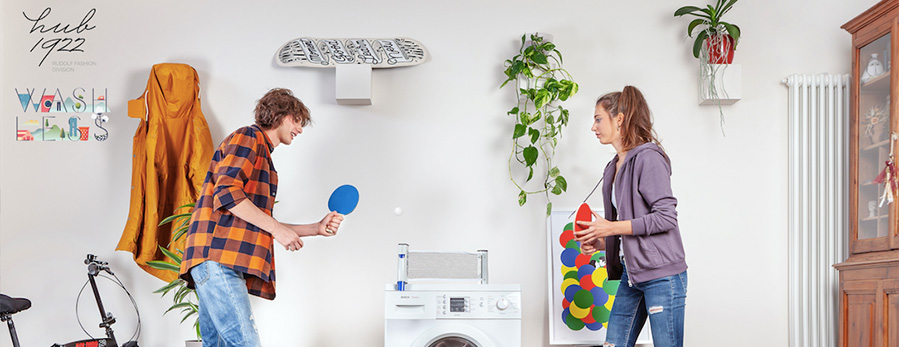
WASHLESS

HUB1922 WASHLESS, which can be applied to both denim and non-denim, is the simultaneous application of

  • proprietary fluorine-free DWR (Durable Water Resistance) based on biomimicry to repel dirt
  • anti-microbial, anti-bacteria and anti-viral, non-migrating chemistry to stop body odour.

The combination of the 2 translates into garments that don’t require to be washed as much.

Life cycle assessment studies on clothes, detergents and washing machines show that home laundering is always the most energy-demanding period during these products' life cycle, even higher than production or transportation phases.
© 2020 RUDOLF GROUP
© 2020 RUDOLF GROUP


“WASHLESS aims at changing consumer habits in clothing maintenance to a more environmentally friendly direction and represents a change that is the most feasible and efficient. Making washing machines obsolete is impossible, but even though the technologies in clothes cleaning have improved greatly, the washing frequency has not been reduced. We own more and more clothing and wash it more frequently. This increased amount of washing counteracts the technological improvements in home laundry. “ said De Conti.

© 2020 RUDOLF GROUP
© 2020 RUDOLF GROUP


It is only by understanding the climate change impact associated with home laundering that product innovations and consumer education can be explored. Studies consistently show that a carbon dioxide reduction of 105 MT and electricity savings of 142 thousand GWh can be obtained by reducing home laundering, on average, by 1/3. This is roughly equivalent to removing 12% of the 140 M passenger cars in the US, or taking 23 coal power plants off the grid.

In addition, more than 60% of water consumed while laundering (2,000 billion liters) can be reduced through these strategies.

© 2020 RUDOLF GROUP
© 2020 RUDOLF GROUP


LASER SMOOTHER

Laser denim is the current dominant technology available to the denim industry to create locally abraded areas, vintage effects, whiskers, patterns, patches, and even intentional holes and tears in a garment. Laser technology uses less water, harmful chemicals (such as potassium permanganate) and energy to create a wide variety of denim looks.

However, laser is not always able to produce the desired look, on the desired fabric, in the desired time. Therefore, chemical companies have been developing laser boosters that can be pre-applied to the garments in order to intensify the effect of the laser to mimic heavier bleaching applications. Unfortunately, laser boosters can create blurred images where the definition is lower and the overall image less natural.
© 2020 RUDOLF GROUP
© 2020 RUDOLF GROUP


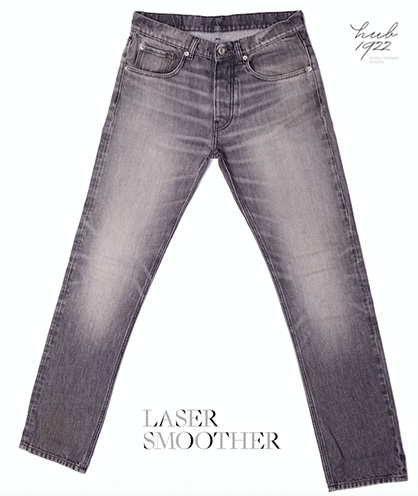
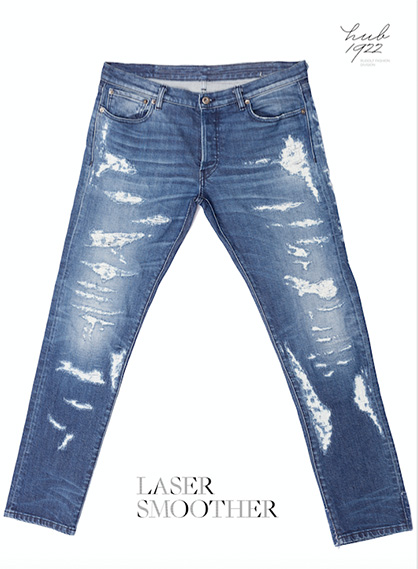
The brand new RUDOLF HUB1922 LASER SMOOTHER is an all-in-one formulation, very easy to pre-apply to garments before laser burning and that return a very natural image which is very similar to the highly desirable hand scraping. Laser smoother can be applied by traditional exhaust or through nebulization and it dries at normal temperature in normal tumble driers.  Advantages of LASER PRIMER are:

  • Remarkable enhancement of the fabric’s characteristics (heightening of material)
  • Overall effect much more natural and similar to manual scraping (craftsmanship dimension)
  • Reduced required laser power to achieve the wanted effect (conspicuous energy saving)
  • A faster laser burning process (significant time saving, depending on the final effect)
  • Any other chemical spray is not required (environmental friendliness) 
  • Reduced cost compared to other solution (financial viability)



More News from TEXDATA International

#Recycling / Circular Economy

textile.4U publishes special edition “Top 100 Textile Recycling Companies 2025”

With a comprehensive 176-page special edition, textile.4U is dedicating its latest issue entirely to one of the most dynamic and influential topics in today’s textile industry: textile recycling. The new issue, published exclusively in high-quality print, presents the Top 100 textile recycling companies researched and selected by TexData – organizations that already play a key role in the transition to circular textiles or are expected to have a significant impact in the near future.

#Recycling / Circular Economy

Responsible Textile Recovery Act of 2024 signed by Governor

Senator Josh Newman (D-Fullerton) is proud to announce that Senate Bill 707 (SB 707), the Responsible Textile Recovery Act of 2024, has been signed into law by the Governor of California, Gavin Newsom. This groundbreaking legislation establishes the country’s first Extended Producer Responsibility (EPR) textile recycling program, marking a significant step forward in the state’s efforts to combat waste and promote sustainability.

#Textiles & Apparel / Garment

Modtissimo promotes sustainability with 28 coordinates in the Green Circle

Modtissimo is proving more and more to be a textile and clothing show that delivers the latest innovations in the area of sustainability, with the iTechStyle Green Circle being the main showcase for companies' creations. In this 60+4 edition, taking place on 12 and 13 September, 28 coordinates will be exhibited in a section organised by CITEVE and curated by Paulo Gomes.

#Europe

The EU and Egypt team up to mobilise private sector investments at Investment Conference and sign a Memorandum of Understanding underpinning €1 billion in macro-financial assistance for Egypt

At the EU-Egypt Investment Conference, co-organised by the EU and the Government of Egypt on 29-30 June, the EU and Egypt are teaming up to intensify private sector investments in Egypt. They are also signing a Memorandum of Understanding (MoU) for the disbursement to Egypt of up to €1 billion in Macro-Financial Assistance.

More News on Textile chemistry

#Denim

organIQ seek: smart alternative to potassium permanganate

CHT Group announces new technical findings within its organIQ seek platform that significantly advance the transition toward permanganate-free denim bleaching. Through extensive industrial testing and application research, CHT confirms that organIQ seek can now be used with remarkable effectiveness as a substitute for potassium permanganate in spray bleach, while remaining aligned with sustainability expectations and cost realities in the European market. At the COLOMBIATEX in Medellín as well as at the Exintex in Puebla and the Kingpins Show in Amsterdam the CHT Group will present organIQ seek as an alternative to potassium permanganate.

#Textile chemistry

Archroma brings high-impact textile innovations to Colombiatex 2026

Archroma, a global leader in specialty chemicals towards sustainable solutions, is proud to announce its participation in Colombiatex 2026, one of the most influential textile and apparel industry events in the Americas. The event will take place in Medellín, Colombia, from January 27 to 29, where Archroma will welcome visitors at Booth PC006.

#Textile chemistry

Devan unveils innovative textile solutions to enhance comfort during sleep at Heimtextil 2026

From 13 to 16 January 2026, Devan was exhibiting at Heimtextil in Frankfurt, the world’s leading international trade fair for home and contract textiles. The event brought together key players from across the global textile value chain, providing the ideal platform for Devan to present its latest innovations.

#Textile chemistry

Archroma and HeiQ partner to bring revolutionary antimicrobial and odor-control solutions to textile industry

Archroma, a global leader in specialty chemicals towards sustainable solutions, and HeiQ, a Swiss deeptech materials innovator active in functional textiles and sustainable fibers, have entered into a co-marketing agreement that combines their complementary strengths to deliver advanced, planet-conscious anti-odor and antimicrobial technologies to brands, retailers, and textile mills worldwide.

Latest News

#Digital Printing

Epson launches SureColor G9000: high-production Direct-To-Film printer delivering greater productivity and reliability

Epson today announces the launch of the SureColor G9000, a new high-production Direct-To-Film (DTFilm) printer designed to meet growing global demand for flexible and efficient textile transfer printing. Expanding Epson’s DTFilm line-up alongside the SC-G6000, the SC-G9000 introduces enhanced speed, reliability and ease of maintenance for commercial garment decorators and textile producers.

#Nonwoven machines

Three ANDRITZ spunlace lines start operating at Alar Silk Road New Materials in China

Alar Silk Road New Materials and ANDRITZ have successfully commissioned three spunlace lines in crosslapped configuration at Alar’s facility in Aral City, Xinjiang, China.

#Raw Materials

Better Cotton Initiative opens enrollment in the US with promising opportunities for producers

Producer enrollment for the US Program of the Better Cotton Initiative (BCI) is open until May 15 for the 2026-2027 season. With over 2,600 members spanning the cotton supply chain and more than 11,000 users of its Better Cotton Platform (BCP) as of 2025, BCI’s standard is implemented in 15 countries and covers one fifth of global cotton production.

#Knitting & Hosiery

SHIMA SEIKI to exhibit at GMMSA Expo India

Leading Japanese computerized flat knitting technologist SHIMA SEIKI MFG., LTD. of Wakayama, Japan, together with its Indian sales representative Universal MEP Projects & Engineering Services, Ltd., will participate in the upcoming Garments Machinery Manufacturers & Suppliers Association (GMMSA) Expo India 2026 exhibition to be held in Ludhiana, India next month. Through its lineup at GMMSA, SHIMA SEIKI aims to further strengthen its presence within the Indian market with an exhibit that caters to diverse needs, consisting of seam-free WHOLEGARMENT® knitting technology as well as a brand-new shaping machine with high productivity and excellent cost performance.

TOP