[pageLogInLogOut]

#Textile chemistry

HeiQ calls for textile industry’s united effort by offering proprietary “Viroblock” to CHT, JINTEX and Piedmont

HeiQ announces that it offers proprietary formulation technology, HeiQ Viroblock NPJ03, an antimicrobial textile treatment tested effective against coronavirus, to its peers, calling for a united effort to help fight the global pandemic.

Striving to help advance the global fight against coronavirus on textiles, HeiQ recently launched HeiQ Viroblock NPJ03, an antimicrobial textile treatment proven effective against human coronavirus (229E) in face mask testing, significantly enhancing the antiviral log reduction from 2.90 of untreated face masks to 4.5, a 30 times improvement with over 99.99% reduction of virus infectivity in minutes. It is tested to last at least 30 washes. Since its launch the company has been utilizing its full capacity of 145 tons per day in its four manufacturing sites on three continents.

In his interview with CNN, HeiQ co-founder and Group CEO Carlo Centonze expressed the urgent need to maximize the impact of the international textile industry in fighting the global pandemic, even if that meant sharing HeiQ’s proprietary technology. HeiQ has since offered to share its HeiQ Viroblock NPJ03 technology to textile industry peers via a free licence. Sharing the formula, manufacturing protocol and technical guidance will permit the manufacture and commercialization of HeiQ Viroblock NPJ03 to meet the regulatory compliance and performance requirement. Licensees will be required to test their treated fabrics with licensed third-party testing institutes to establish efficacy and quality as per HeiQ’s standards. Use of the “HeiQ Viroblock” trademark in relation to treated articles will require trademark authorization directly by HeiQ to ensure truthful and compliant claims.

“There is not a moment to lose. We must act now and act fast to produce textiles for hospitals and every frontline healthcare worker that are more resistant to pathogenic viruses and bacteria. The international textile industry must do our part and work together in a united effort to protect textiles and help in the struggle to reduce the risk and speed of contamination and transmission around the world”, says Carlo Centonze, HeiQ Group CEO. “Reducing transmission and infection rates is the only way to re-open our economies swiftly and maintain jobs in the textile industry,” he added.
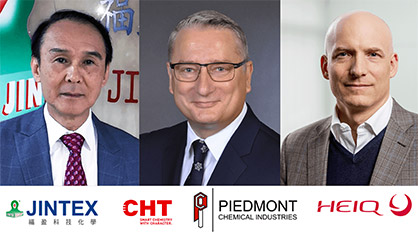
Ralf Kattanek, Group Vice President Textiles of CHT Group said, “We believe by using CHT’s textile expertise and production capacities globally that we can play a key role in mitigating the impact for the healthcare workers and our industry partners by maximizing our reach swiftly.”


(c) 2020 HeiQ
(c) 2020 HeiQ


David Juang, Chairman of Taiwanese textile chemicals manufacturer JINTEX Group adds “We want to show leadership in taking decisive action in a coordinated effort.”

“HeiQ has enlisted the Piedmont Chemical Group to help support its North American production and distribution, in order to assure maximum product availability during the crisis. We are here to join the fight and support HeiQ and our textile industry with all we have” says Rick Wilson, CEO of US based Piedmont Chemical Industries.

HeiQ Viroblock NPJ03 is a combination of vesicle and silver technologies using HeiQ’s registered silver technologies for antiviral and antibacterial (together antimicrobial) effect. This is accomplished through binding permanently to viral sulfur groups and using HeiQ’s fatty vesicle technology (Liposomes) as a booster that helps deplete swiftly the virus membrane (pericapsis) of its protective cholesterol layer, thereby destroying the enveloped virus. HeiQ Viroblock NPJ03 can be applied to many textile surfaces including face masks, air filters, medical gowns, curtains, mattresses, bed linens, drapes and more.
More News from TEXDATA International

#Texprocess 2026

Texprocess 2026: Automation, digitalisation and AI redefine textile processing

Making investment decisions in textile processing has become significantly more demanding. Increasing energy costs, a shortage of skilled labour and ongoing geopolitical uncertainties are compelling companies to focus on technologies that deliver clear gains in efficiency and process reliability. This applies equally to apparel manufacturing and to the processing of technical textiles and high-performance materials. As a result, modernisation initiatives are assessed more carefully – even as the need to upgrade production systems continues to intensify.

#Techtextil 2026

Techtextil 2026: Between innovation pressure & market reality

From 21 to 24 April 2026, Techtextil in Frankfurt am Main will once again become the central meeting point for the international technical textiles and nonwovens industry. Running in parallel, Texprocess will focus on the industrial implementation of textile processing technologies as the leading platform in this field. Together, the two trade fairs form a closely integrated presentation and working platform along the entire textile value chain – from material development to finished applications.

#Techtextil 2026

Between geopolitical pressure and industrial resilience

In this interview, Dr. Janpeter Horn (VDMA) discusses the current challenges facing textile machinery manufacturers, shaped by geopolitical tensions, regulatory developments and subdued investment. He also outlines why innovation strength, integrated solutions and strategic positioning remain key to global competitiveness.

#Texprocess 2026

Between investment restraint and modernization pressure

Texprocess 2026 takes place in a complex market environment shaped by uncertainty and innovation pressure. In this interview, Elgar Straub (VDMA) explains why the trade fair is particularly relevant this year and which technologies are driving efficiency and competitiveness.

More News on Textile chemistry

#Sustainability

bluesign technologies introduces bluepass

bluesign technologies ag (www.bluesign.com) today announces the launch of bluepass, a new certification mark and product labeling system created to deliver clear, substantiated, and verifiable sustainability claims at scale.

#Textile chemistry

Officina39 expands in South Asia with dual trade show presence and new low-impact dyeing innovation

Officina39 reinforces its strategic expansion in South Asia by announcing its participation in two key textile industry events in Bangladesh and India, alongside the launch of a new solution designed to reduce the environmental impact of reactive dyeing.

#Techtextil 2026

Speed and connectivity: Techtextil and Texprocess provided market-ready solutions for industries under pressure

With more than 36,000 visitors and 1,700 exhibitors from a total of 112 countries, Techtextil and Texprocess 2026 demonstrated how innovation comes into industrial use. The convergence of research, industry and application proved to be a breeding ground for new material solutions, manufacturing and processing technologies. Natural fibres, performance apparel, connected systems and AI-driven processing technologies emerged as key growth and future markets.

#Techtextil 2026

RUDOLF is pioneering the future of technical textiles by developing innovative, functional solutions

At Techtextil 2026, RUDOLF presents its latest innovations for textile auxiliaries, textile care and construction chemicals. Based in Geretsried, Bavaria, the company draws on more than 100 years of experience and continues to position itself as a global technology partner focused on quality, innovation and sustainability.

Latest News

#INDEX 2026

“We clearly see that reliability, flexibility, service and total cost of ownership are becoming increasingly important again.”

The nonwovens industry continues to face a challenging market environment. Nevertheless, AUTEFA Solutions reports successful projects, new line sales and growing demand for energy-efficient and flexible solutions. In this interview, André Imhof of AUTEFA Solutions talks about competitiveness against Chinese suppliers, new service and recycling concepts, the growing importance of application development and the opportunities created by countercyclical investments.

#INDEX 2026

“Needle punching technology is more universal and sustainable than ever!”

Needle punching technology was long regarded as a rather traditional and comparatively slow technology within the nonwovens industry. In this interview, Johann Philipp Dilo explains why needle punching is more relevant than ever today – ranging from energy efficiency and resource conservation to hygiene applications, new machine concepts and design-oriented nonwoven solutions.

#Research & Development

Textile climate control system in workwear – exhibition at the 2026 SME Innovation Day!

Conventional protective workwear often reaches its limits during strenuous physical activity. In particular, the transport of sweat and excess body heat poses a problem. The German Institutes of Textile and Fiber Research (DITF) conducted research on flow-optimized, air-conducting textile structures that enable targeted climate control directly on the body. These structures can be integrated straight into protective work garments. The textile climate control system supports the body’s natural thermoregulation. This contributes to improved workplace safety and comfort.

#Nonwovens

PET spunbond from China – EDANA welcomes imposition of provisional anti-dumping measures

On 13 May 2026, after eight months of investigation, the European Commission imposed provisional anti-dumping duties of 45.6-50.0% on imports of PET spunbond from China. EDANA welcomes this expression of the Commission’s clear determination to protect EU industries from the unfair trade practices of Chinese producers.

TOP