[pageLogInLogOut]
techtextil 21.-24.4.2026 FRANKFURT/MAIN Peter Chance. The most important guest at the fair - besides you.

#Techtextil 2026

Gebr. Otto highlights versatility at Techtextil with regional supply chains, yarn innovations and new hygiene segment
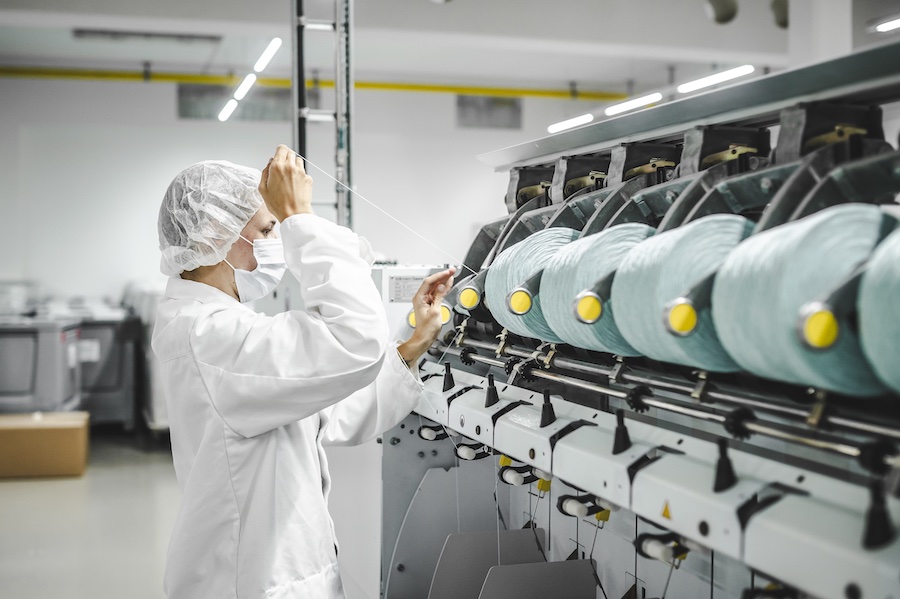
Under strictly controlled conditions, yarns for hygiene products are produced in Gebr. Otto’s hygiene area. © 2026 Gebr. Otto
At this year’s Techtextil, Gebr. Otto places its versatility at the center of its presentation. In addition to spinning, twisting and dyeing – traditionally focused on fine cotton – textile processors will also find a competent development partner for technical specialty solutions. The Dietenheim-based spinning mill has now built up a decade of experience in the production of technical yarns, particularly from aramids. A new hygiene segment has also been established, where yarns for medical and hygiene products are currently being produced. In the future, this department could also develop textile products for the food sector. Gebr. Otto will once again be present at the BW-i joint stand, booth D81, hall 12.1. What is wound onto the spool is determined by the customer: Gebr. Otto develops according to specific customer requirements and transforms its own ideas into yarn innovations.

A future rooted in tradition

“The name Gebr. Otto has stood for fine cotton products since 1901,” says Andreas Merkel, Managing Director of Gebr. Otto. The company will celebrate its 125th anniversary in July this year.

Alongside cotton yarns and threads, the company has continuously expanded its product portfolio. Today, a key focus lies on technical yarns, particularly those made from aramids and other flame-retardant fibers.

Processing these fibers is highly demanding. Their extremely high tensile strength combined with low elasticity requires very precise spinning processes, as even minor irregularities in the drafting system can lead to fiber breakage. In addition, aramid fibers are stiff and exhibit lower fiber-to-fiber friction, making specific process adjustments necessary to achieve the desired yarn strength.

“We operate within a very narrow process window when working with aramids,” explains Oliver Kächler, long-standing plant manager and authorized signatory at Gebr. Otto. These yarns are used, for example, in flame-retardant underwear for firefighters.

Room to spin ideas into innovation

Gebr. Otto has been operating its technical spinning mill in Balzheim for almost ten years. Its development illustrates the company’s ability to adapt and evolve: in the mid-1990s, Spinning Mill I (built in 1958) was shut down, and cotton yarn production was relocated to the newly built, modern Spinning Mill II.

The freed-up space continued to serve as a place for innovation: products such as absorbent kapok pads, tampons with kapok cores and cotton swabs were developed there, although without lasting market success. Nevertheless, the experience gained proved valuable. In 2004, Gebr. Otto became the first spinning mill to successfully process kapok fibers in combination with cotton into a yarn.

Another forward-looking development is recot2, a cotton yarn consisting of 25% recycled process waste and 75% virgin cotton. The company developed its own spinning process for this yarn, which was launched in 2008. “We were perhaps a bit ahead of our time,” says Andreas Merkel with a smile. “Circular economy has only become truly relevant in recent years.”

Initial trials with aramid fibers began in the 2000s. The company’s broad material expertise enabled the “Otto Engineering Team” to achieve strong results early on – and gave Spinning Mill I its current purpose.

“We are never satisfied with the status quo, but continuously search for new products, more sustainable solutions and new market segments,” Merkel adds.
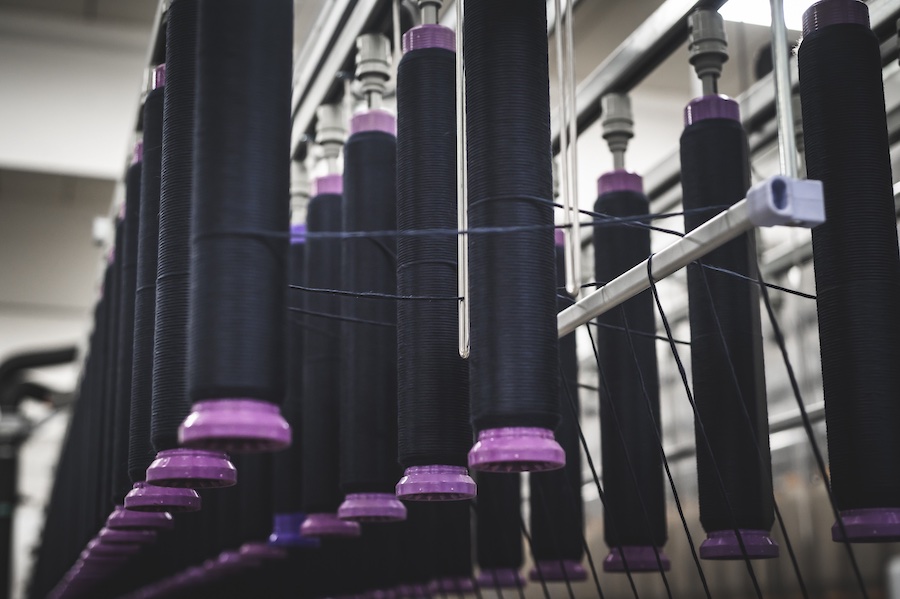
Aramid fibers place high demands on the spinning process: the combination of extremely high tensile strength and low elasticity requires maximum precision in processing. © 2026 Gebr. Otto


Hygiene segment: potential for medical and food applications

In line with its corporate philosophy, Gebr. Otto has operated its own hygiene area since early 2025. Under strictly controlled conditions, yarns for medical and hygiene applications are produced here. This includes dedicated pest monitoring, protective equipment for personnel and changing facilities with black/white separation. Access to the hygiene area is only possible via airlock systems.

“We are confident that this setup will allow us to address additional customers from the food and medical sectors in the future,” says Merkel.

Ongoing developments

One recently completed project is “Eco Yarn”, a collaboration with the Recycling Atelier Augsburg of the Institute of Textile Technology Augsburg (ITA), Augsburg University of Applied Sciences, and industry partners Schwob and Weseta.

The project team succeeded in breaking down used rental textiles into fibers, reprocessing them and spinning them into a new yarn blended with 70% virgin cotton.

Currently under development is the “Innocell” project in cooperation with the German Institutes of Textile and Fiber Research (DITF).
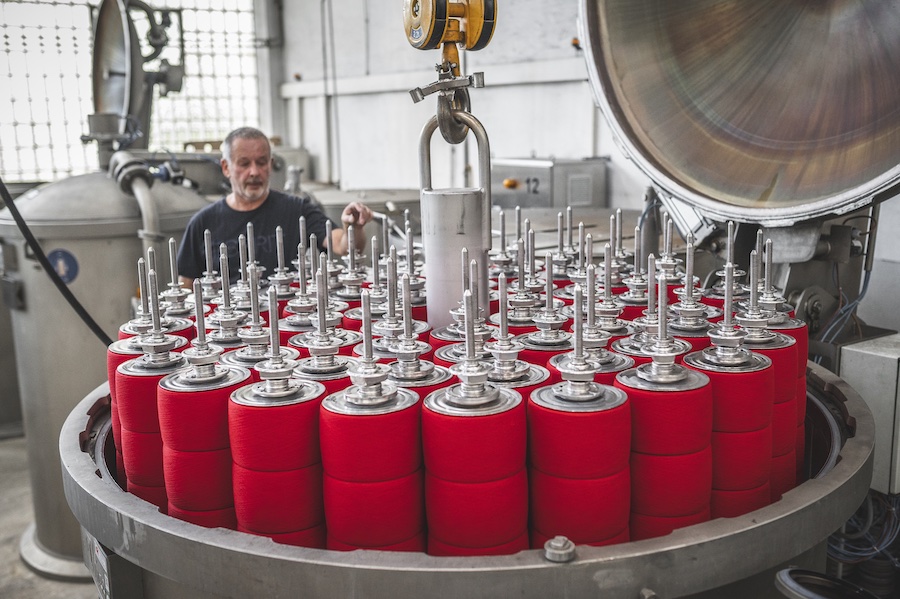
At its state-of-the-art dyeing facility, Gebr. Otto brings color to yarn – and to life. © 2026 Gebr. Otto


Cotton remains the core

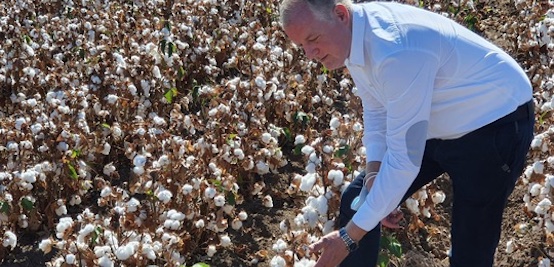
Alongside technical innovations, cotton remains central to Gebr. Otto’s business. Since spring 2025, the company has offered cotton yarns certified with the EUCOTTON label. The fibers originate from Greece and Spain and stand for short, transparent supply chains within Europe.

Another example of regional value creation is the “Lokalstoffmacher” project. “It is often assumed that regional products are automatically more expensive,” says Merkel. “However, when considering transport, duties, taxes and improved planning reliability, the price difference is often significantly reduced.” Project partners Edelweiss Jersey, Textilveredlung Keller and Gebr. Otto are considering expanding their cooperation beyond cotton yarns.

The company is also working on a yarn made from organic cotton and native hemp grown in Germany. The regionally cultivated winter hemp is processed by a project partner and then spun together with cotton or TENCEL. Hemp requires significantly less water than cotton and is therefore considered particularly resource-efficient. A special processing method enables the fibers to be prepared for spinning with cotton.

“We are looking forward to this year’s Techtextil – and to demonstrating our versatility to visitors,” concludes Merkel.
More News from Gebr. Otto Baumwollfeinzwirnerei GmbH + Co. KG

More News on Techtextil 2026

#Techtextil 2026

SAHM Winding Solutions and Vandewiele Automation present integrated automation solution for winding processes

For the first time at the Techtextil trade fair in Frankfurt am Main, Germany (21 - 26 April), SAHM Winding Solutions (Hallo 12.0. / Booth 95) and Vandewiele Automation will be showcasing their combined automation expertise for industrial winding processes. Under the motto “Combining Automation. Maximizing Flow”, the two companies will demonstrate how automated package handling and robot-assisted yarn knotting can be integrated into a continuous production flow.

#Techtextil 2026

ASGLAWO group with new products at Techtextil 2026 in Frankfurt

The ASGLAWO group, with its two companies ASGLAWO technnofibre GmbH and Form- und Technik engineering GmbH, is pleased to present its latest developments in the field of technical textiles and nonwovens at the leading international trade fair Techtextil 2026. The fair, taking place from April 21 to 24, 2026, is the international meeting place for innovations in the textile industry.

#Techtextil 2026

iNTERSPARE presents latest developments and upgrade solutions for technical textile finishing at Techtextil

iNTERSPARE Textilmaschinen GmbH will present its latest solutions for technical textile finishing at Techtextil 2026 in Frankfurt (VDMA joint stand, Hall 12 / Stand C55A). The focus will be on further developments within the Krantz, Artos and Babcock (BTM) product lines, in particular the Krantz K30 stenter as well as the reintroduction of the Artos Vari-Flex foulard. The presentation will be complemented by modular solutions for upgrading existing installations and new approaches in automation and digitalization.

Latest News

#Recycled Fibers

UNIFI celebrates recycled and circular Innovation with ninth annual REPREVE® Champions of Sustainability Awards

Unifi, Inc. (NYSE: UFI), the makers of REPREVE® and one of the world’s leading innovators in recycled and synthetic yarns, today announced the winners of its ninth annual REPREVE Champions of Sustainability Awards, recognizing brands and mills that are advancing circularity and responsible manufacturing across the global textile industry.

#Man-Made Fibers

Teijin Frontier announces new Stretch Polyester yarn offering exceptional compatibility with high-performance Polyester materials

Teijin Frontier Co., Ltd. announced today that it has developed a new stretch polyester yarn that offers new opportunities to create comfortable, all- polyester fabrics for sports and outdoor wear. The new polyester yarn demonstrates exceptional compatibility with high-performance polyester materials. Further, Teijin Frontier’s proprietary polymer design and spinning technology impart excellent elasticity to the new yarn. In turn, this yarn adds stretchability and recovery to the advanced functionality and excellent texture of high-performance polyester materials.

#Man-Made Fibers

Lenzing commissions 14 MW power‑to‑heat facility, strengthening grid stability and heat management

The Lenzing Group has successfully commissioned a new power‑to‑heat (P2H) facility with an electrical capacity of 14 megawatts. The installation converts renewable electricity directly into process heat, is fully integrated into the existing heat network at the industrial site, and represents a key building block for a fossil‑free heat supply. As project partner, VERBUND was responsible for the energy‑market integration and will operate the facility for balancing energy marketing, enabling it to respond flexibly to short‑term fluctuations in the power grid.

#Raw Materials

Kraig Biocraft reaches next step in production growth

Kraig Biocraft Laboratories, Inc. (OTCQB: KBLB) (“the Company”, “Kraig Labs”, or “Kraig’s”), a world leader in spider silk technology*, today announced that it has produced more than 1.3 metric tons of recombinant spider silk cocoons in a single month. This is a new world record and shatters the Company’s previous production record by a factor of five. Today marks a pivotal step forward in the transition of spider silk from laboratory innovation to an industrial-scale material platform.

HEBERLEIN TECHNOLOGY FOR PROFESSIONALS  - Techtextil Hall 12.0 Booth B01!
TOP