[pageLogInLogOut]

#Sustainability

New paper sets out considerations for the responsible use of LCA data across the fashion, textile, and apparel industry

Textile Exchange has released a comprehensive new position paper outlining best practice for the responsible use of Life Cycle Assessment (LCA) data in the fashion, textile, and apparel industry. LCA is widely used by the industry to measure a product’s environmental impact at different stages of its journey—from raw material production to manufacturing, transportation to end-of-life.


This paper, Ensuring Integrity in the Use of Life Cycle Assessment Data, provides guidance on how to use LCA data, and—equally importantly—how it should not be used.

It also promotes the need to move beyond what is currently covered in LCA methodology to capture a more holistic view, including nature, animal welfare, and social impacts.

The paper is intended for anyone looking to develop a greater understanding of the use of LCA data in the textile industry—particularly for brands using LCA data directly or those who rely on it for their impact modeling or progress tracking.

The paper includes a call for industry-wide integrity in the use of LCA data, listing key recommendations, such as:

+ Only using LCA data when there is a full understanding of the key assumptions, methods, and use cases. To help, all assumptions, methodological decisions, limitations, and underlying datasets should be fully documented in studies.

+ Not comparing LCA data between:

   + +  Fiber or material categories or geographies, for example between natural and synthetic fibers.

   + +  Separate LCA studies, or within a study, unless it is specifically a comparative LCA study.

   + +  Different industry databases, which collect and store LCA data, as each of these databases applies differing methodologies and assumptions.

+ Consideration of an LCA+ approach that includes measuring impact areas such as biodiversity, soil health, animal welfare, and livelihoods.

The paper also includes sections on:

+ Understanding Life Cycle Assessment, including a definition of what it is, why it’s used, and the steps to follow to conduct an LCA study.

+ The challenges and limitations of using LCA in the textile industry.

+ Textile Exchange’s work with LCA studies.

The paper forms part of Textile Exchange’s commitment to convening actors across the supply chain to improve the impact data available for the industry. The paper is complimentary to other work and guidance being developed across the fashion, apparel and textile industry on the responsible use of LCA data. Currently, Textile Exchange is running seven LCA studies across different material types and diverse geographies globally to help fill some of the significant data gaps. Where relevant and possible, the studies will include an LCA+ approach.

These will be released between the end of the year and 2027 in the following order:

+ Cotton (organic, conventional, regenerative practices, and recycled), Q4 2025

+ Cashmere, Q4 2025

+ Responsible Mohair Standard (RMS) mohair, Q4 2025

+ Polyester (recycled and virgin), Q4 2025

+ Responsible Wool Standard (RWS) wool, Q2 2026

+ Leather (bovine, ovine, and caprine), Q5 2026


More News from Textile Exchange

#Sustainability

Textile Exchange evolves its membership structure to unlock the next stage of collective action for climate and nature

Textile Exchange is excited to announce that it is evolving its membership structure to a more action-oriented, impact-driven model designed to provide clearly defined pathways that help organizations respond to the climate and nature crisis.

#Sustainability

Key takeaways from the 2025 Textile Exchange conference

Brands and retailers, suppliers, innovators, recyclers, farmers, non-profit organizations, and academics convened at Textile Exchange’s Annual Conference, held in the Lisbon Conference Centre.

#Sustainability

Textile Exchange announces the winners of the 2025 Climate and Nature Impact Awards

Textile Exchange is pleased to announce the winners of the 2025 Climate and Nature Impact Awards. These awards recognize individuals and partnerships making progress toward a regenerative and equitable raw materials economy.

#Sustainability

Textile Exchange Conference 2025: Setting the course for systemic change

The 2025 Textile Exchange Conference brought together more than 1,600 participants on site in Lisbon and online, marking two days of intense dialogue on the future of sustainable and regenerative material systems. With a focus on collaboration, data-driven progress, and systemic transformation, the sessions highlighted both the challenges and the opportunities in building a truly resilient textile industry.

More News on Sustainability

#Sustainability

YKK recognized with Top ‘A’ rating by CDP for climate change leadership for third consecutive year

YKK Corporation announced its achievement of the highest “A List” rating in the 2025 Climate Change survey conducted by the global environmental disclosure nonprofit, CDP . This marks the third consecutive year YKK has received this prestigious recognition.

#Weaving

Itema announces strategic partnership with Ivy Decarb to accelerate decarbonization in weaving process

Itema is pleased to announce the strategic partnership with Ivy Decarb, the digital platform helping textile companies measure and reduce their carbon footprint.

#Man-Made Fibers

Teijin Carbon Europe receives EcoVadis Silver status – ranked among the top 15% of evaluated companies

Teijin Carbon Europe (TCE) has been recognized for its sustainability performance and has been awarded the EcoVadis Silver Medal in the latest assessment. In its first-ever EcoVadis evaluation, the company achieved a notable 72 out of 100 points, ranking among the top 15% of all companies evaluated worldwide, within the “Manufacture of Man-Made Fibres” category.

#Research & Development

The region of renewable raw materials: Central German Alliance for Bioplastics

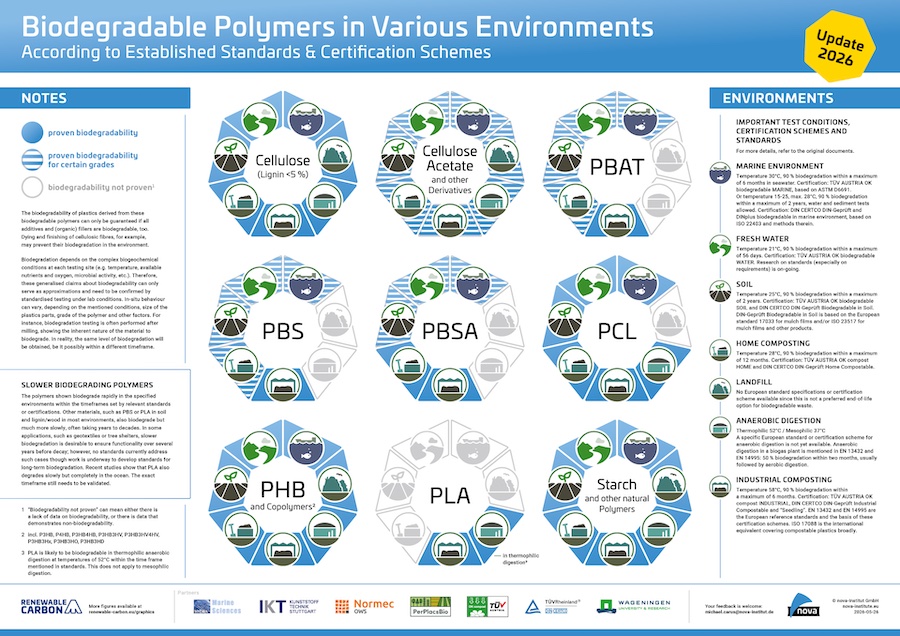
The development of sustainable plastic solutions is rapidly gaining importance in light of global environ- mental pollution, dwindling fossil resources and ambitious climate protection targets. As part of the re- gional alliance RUBIO, which brings together 18 partners from central Germany and the Berlin-Branden- burg area, the bio-based and biodegradable plastic polybutylene succinate (PBS) was comprehensively investigated, starting with the raw material, through the manufacturing process, to industrial application.

Latest News

#Research & Development

More safety and comfort for protective clothing thanks to auxetic fabrics

When everyday materials are pulled, they stretch or elongate in the direction of the pull and become narrower in cross-section. We can also observe this property in two-dimensional textiles. Auxetic structures behave differently here. They have the striking property of not changing under tensile stress or even increasing their width or thickness. These properties are advantageous, for example, in protective textiles or textile filter media. The DITF are researching auxetic fabrics for various applications.

#Recycled_Fibers

Recycling mixed-fibre garments becomes a reality: RadiciGroup, The LYCRA Company and Triumph take circular fashion a step forward

The process, which is both economically and environmentally sustainable, has enabled the production of an underwear set made from 100% recycled nylon and LYCRA® fibre in a closed-loop system.

#Spinning

First PA66 spinning plant with EvoQuench successfully commissioned

With the successful commissioning of a multi-digit PA66 spinning line for microfiber yarns, Chinese textile company Shandong Nanshan Fashion Technology Co., Ltd. has added yarn production to its textile value chain.

#Knitting & Hosiery

SHIMA SEIKI returns to ShanghaiTex

Leading flat knitting solutions provider SHIMA SEIKI MFG., LTD. of Wakayama, Japan, together with its Hong Kong and Chinese market subsidiary SHIMA SEIKI (HONG KONG) LTD., will exhibit at the ShanghaiTex 2025 exhibition (Booth No.: Hall N3, Booth A20) held in Shanghai, China this month. This marks the return of SHIMA SEIKI to ShanghaiTex after a 14-year hiatus, its last exhibit at the show having been in 2011.

TOP