[pageLogInLogOut]

#Sustainability

Groundbreaking architectural projects using natural fibres

Paris, May 19 2025 : The Alliance for European Flax-Linen & Hemp is proud to spotlight a growing wave of innovative architectural and civil engineering applications featuring flax and hemp fibres. As the global construction industry turns toward sustainable solutions, flax and hemp are emerging as high-performance, low-impact alternatives for a new generation of bio-based architecture.

Pioneering Structural Applications

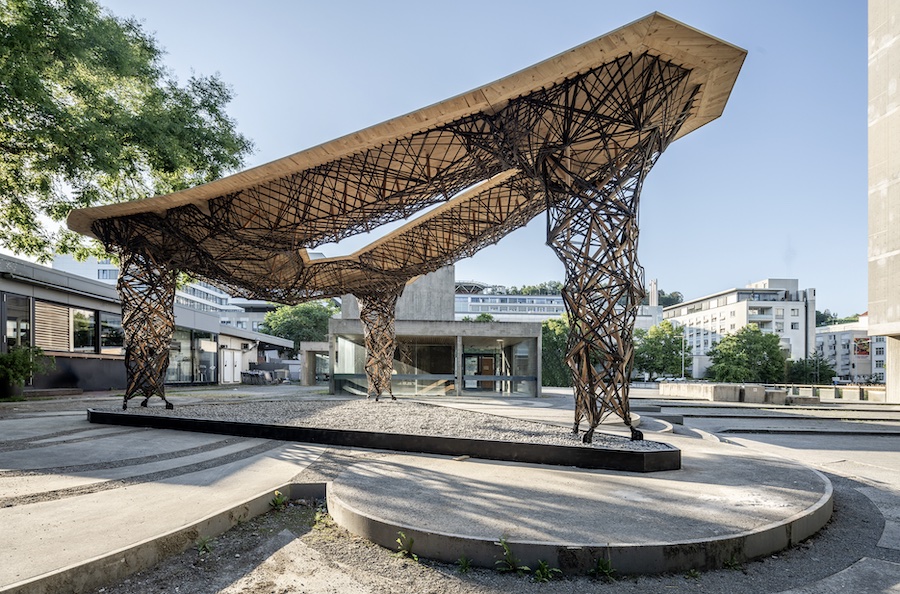
For the first time, flax is stepping beyond interior and insulation use to form key structural elements in buildings. At the forefront of this transformation is the University of Stuttgart’s ITECH Research Pavilion 2024 program in Germany. Two extraordinary lightweight structures have been created using filament-wound flax fibres, demonstrating the material’s strength and design flexibility. The main pavilion, a semi-permanent structure, features 20 flax fibre roof beams, crafted from Terre de Lin’s 100 Tex rovings and industrially processed by HA-CO Carbon GmbH. A second, smaller pavilion incorporates co-wound wood and Safilin’s 200 Tex flax fibres in its columns and roof structure. Both projects highlight coreless robotic winding technologies and deliver striking examples of sustainable construction methods.

Sustainable Façade Innovation

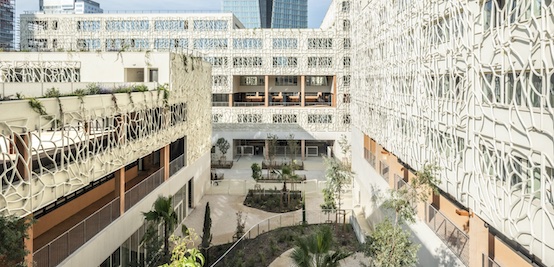
Flax is also proving its value in cladding and façade systems. French manufacturer Temca recently completed 880 lightweight shading panels using Bcomp’s ampliTex™ flax fibre material for the Cité Scolaire Internationale Jacques Chirac business school in Marseille. Designed by renowned architects Rudy Ricciotti and Roland Carta for Bouygues Bâtiment Sud-Est, the system uses RTM-moulded ampliTex™ combined with UV-resistant gelcoat and fire-rated resin, providing a nature-inspired, energy-efficient solution with drastically reduced weight and hardware requirements compared to traditional materials. Meanwhile, Dutch composite innovator NPSP continues its work integrating bio-based materials in public infrastructure. In collaboration with Alliance member Procotex and material partner Nabasco, NPSP has delivered striking façades across Europe, including the vibrant green cladding of Amsterdam’s NEMO Science Museum, designed by Renzo Piano. Nabasco® Natural panels offer both design freedom and top fire safety standards, paving the way for bio-based façades in modern urban design.

Civil Engineering and Urban Greening

DEMGY, a leader in recyclable moulded composites, has partnered with green roof experts PLANTIKA to introduce FLAXCOMP® sandwich base panels for rooftop garden modules. Replacing aluminum with perforated flax composites, the solution enhances water drainage and aeration while reducing environmental impact. If successful, the trial may lead to full flax composite construction in future urban greening projects, marking a critical advance toward circular building solutions.

“These projects reflect the growing ambition of our industry to deliver carbon-smart, beautiful, and high-performing structures using natural European fibres,” said Bruno Pech, Innovation Project Manager.

The Alliance for European Flax Linen and Hemp continues to support its members and partners in advancing bio-based innovation across architecture and civil engineering.
More News from Alliance of European Flax-Linen & Hemp

#Composites

Alliance for European Flax-Linen & Hemp expands bio-materials presence at JEC World 2026

The Alliance for European Flax-Linen & Hemp is pleased to announce its participation at JEC World 2026, featuring a significantly expanded presence and an enhanced offering for the global composites industry.

#Natural Fibers

Alliance for European Flax-Linen & Hemp expands technical capabilities with addition of CIRCULAR STRUCTURES

The Alliance for European Flax-Linen & Hemp is pleased to welcome CIRCULAR STRUCTURES, a Bremen-based platform for sustainable material development and product incubation, to its Technical Section. This addition further enhances the Alliance’s mission to accelerate the industrial adoption of European-grown flax and hemp fibres in high-performance composite applications.

#Composites

Alliance for European Flax-Linen & Hemp host Natural Fibre Composites Village at JEC World 2025

The Alliance for European Flax-Linen & Hemp will host a Natural Fibre Village at JEC World 2025 that will showcase the activities of the Alliance and nine of its members in a 250m2 area dedicated to natural fibre composites. Partnering with the JEC Group, the Alliance will lead the European flax and hemp industry exhibit where Bcomp, Demgy, Depestele, Eco-Technilin, Flipts en Dobbels, Libeco, Norafin, Safilin and Terre de Lin and, for the first time, Linificio e Canapificio Nazionale SRL, will all exhibit a wide range of flax and hemp raw materials and composite products.

#Natural Fibers

2025 is the year of acceleration for Alliance for European Flax-Linen & Hemp

The reference agro-industrial organisation for the sector, is accelerating its sustainable transformation trajectory.

More News on Sustainability

#Sustainability

A new standard to combat plastic waste in forests

With DIN SPEC 35808 “Tree Shelter for Forestry Applications,” the testing and research service provider Hohenstein, in collaboration with Rottenburg University of Forestry, as well as forestry authorities and industry partners, has established a clear framework for bio-based and fully biodegradable tree shelters. The pre-standard defines requirements and practical testing methods designed to reduce plastic waste in forests and strengthen the long-term protection of soil and the environment.

#Denim

Denim moves towards sustainability

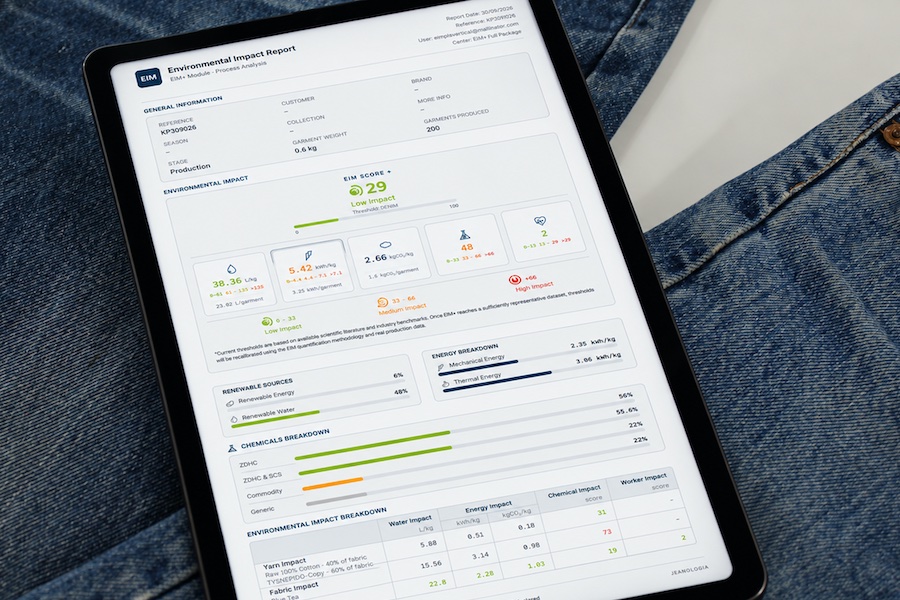
EIM (Environmental Impact Measurement), the global reference platform for measuring the environmental impact of garment finishing, presents the second edition of its annual report Denim Industry Progress & Insights 2025. The study analyses over 100,000 real denim finishing processes, providing an accurate and up-to-date view of the industry’s evolution towards more sustainable models.

#Recycling / Circular Economy

Europe’s textile future at a turning point: New 2030 Circularity Blueprint aims to scale recycling and unlock investment opportunities

The EU textile system is at a critical crossroads. Today, less than 1% of discarded garments are recycled into new garments, despite EU-wide obligations for separate collection. In response, Global Fashion Agenda (GFA) is launching the 2030 Circularity Blueprint, in partnership with ReHubs. This ambitious initiative is designed to support the transformation of the EU textile ecosystem to advance textile-to-textile recycling and drive the transition to a circular economy.

#Sustainability

Number of GOTS-certified facilities grow 15% globally as demand for credible sustainability standards continues to strengthen

Global Organic Textile Standard (GOTS) certification continued to grow in 2025, with nearly 18,000 certified facilities worldwide, despite ongoing geopolitical uncertainty and rapidly evolving regulatory requirements across global textile supply chains.

Latest News

#ITM 2026

ITM 2026: KARL MAYER presents new perspectives

KARL MAYER will once again showcase itself as a strong partner to the Turkish textile industry at ITM in Istanbul from June 9 to 13. At Booth 303 A in Hall 3 of the Tüyap Fair Convention and Congress Center, the industry leader will exhibit solutions for warp knitting, warp preparation, and technical textiles – tailored to a challenging economic environment.

#Spinning

Specialist in fine counts: New type 2777 ceramic oiler

With the new Type 2777 ceramic oiler, Barmag has added a solution for fine titers and microfilaments to its portfolio of original parts.

#INDEX 2026

STFI highlights textile circular economy and alternative fibres at INDEX™ 2026

From 19 to 22 May 2026, INDEX will invite visitors to Lake Geneva for the world's leading nonwovens trade fair. The Centre of Excellence in Nonwovens at the Sächsisches Textilforschung- sinstitut e.V. (STFI) will be in attendance to present the latest developments in nonwovens research. In the field of the textile circular economy, the STFI will present acoustically effective nonwovens made from chemical recycling residues. The range also includes innovations aimed at replacing conventional raw materials, such as the biobased and biodegradable polymer polybutylene succinate (PBS) and Kendyr as an alternative to cotton.

#Associations

Italian textile machinery sector faces weak start to 2026 despite domestic growth

In the first quarter of 2026, order intake for Italian textile machinery manufacturers recorded a decrease of 5% compared to the same period in 2025, reflecting a still challenging start to the year. The decline affected foreign markets (-7%), while the domestic market showed growth (+21%).

TOP