[pageLogInLogOut]

#Sustainability

Sustainability at Messe Frankfurt’s textile trade fairs: five core issues for the textile and fashion industry

With the new ‘Texpertise Econogy Insights’, Messe Frankfurt’s textile trade fairs are shining a spotlight on five core issues facing the textile and clothing industry as it undergoes a transformation targeted at greater sustainability. These key themes are based on the results of the sustainability check offered to exhibiting companies as part of the Texpertise Econogy textile sustainability programme and conversations with international textile experts.


Textile waste equivalent in volume to 370,000 fully-loaded Airbus aircraft, a recycling rate of one per cent and 99.7 per cent of micro, small and medium-sized enterprises: the textile and clothing industry is not just a world of superlative figures, but also an industry with one of the most complex supply chains in the world. Where the industry stands in terms of sustainability and what drivers and obstacles are playing a role in its transformation is the focus of the report ‘Texpertise Econogy Insights - five central developments for a more sustainable textile industry’, published today by Texpertise, a network of more than 60 Messe Frankfurt textile events in 13 countries. 

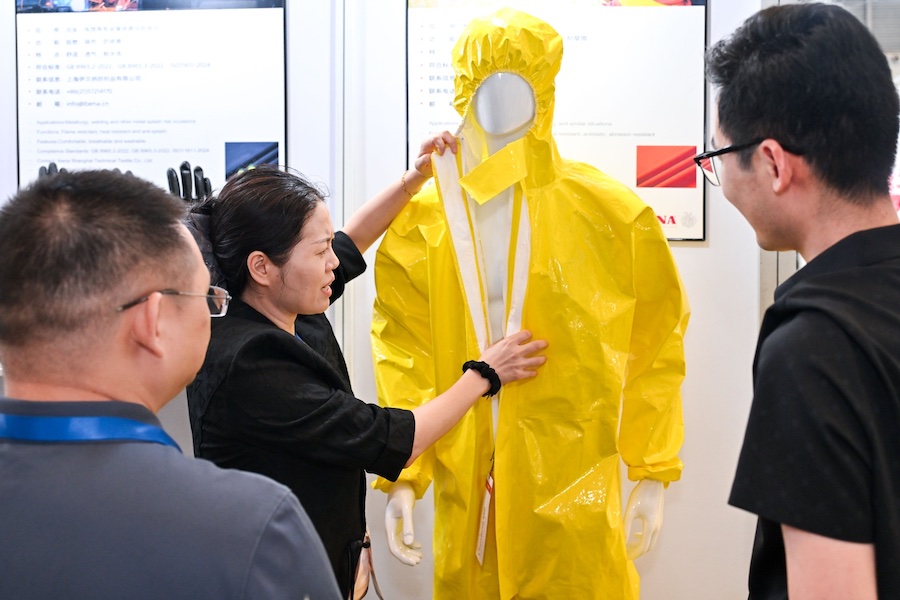
For more sustainability in the textile and clothing industry: national and international regulatory requirements are intended to bring more transparency to the industry's complex supply chains / Photo: Messe Frankfurt Exhibition GmbH

‘Transformation requires cooperation. The international textile events by Messe Frankfurt serve as key hubs for change in this process. With the international sustainability programme Texpertise Econogy, we are making developments for a more sustainable industry tangible, connecting green pioneers with companies and creating hotspots for knowledge and networking,’ says Olaf Schmidt, Vice President Textiles and Textile Technologies at Messe Frankfurt.

Together with renowned experts from textile research, business and associations, Messe Frankfurt analyses five key themes for the sustainable transformation of the international textile and clothing industry: the Sustainable Development Goals (SDGs) as an international benchmark for responsible corporate behaviour, transparency and traceability in global supply chains as well as the advantages and disadvantages of natural fibres, synthetic fibres and regenerated fibres in terms of their environmental compatibility and functionality. It also evaluates environmentally friendly process standards and innovative approaches to textile recycling. Among those interviewed for the report were representatives from Aalto University; Euratex; Fashion for Good; Hohenstein Group; IKEA; Industrial Association for Finishing, Yarns, Woven Fabrics and Technical Textiles (IVGT); Oberbadische Bettfedernfabrik (OBB); Saxon Textile Research Institute (STFI); United Nations Fashion and Lifestyle Network; VDMA Textile Care, Fabrics and Leather Technologies; German Association of Home Textiles Manufacturers and the Wuppertal Institute for Climate, Environment and Energy.

These themes are derived from the results of the Texpertise Econogy Checks, the sustainability check that exhibiting companies can now undergo at 24 of the more than 60 Messe Frankfurt textile events across the world. The check evaluates companies against a set of international sustainability standards in the areas of Sustainable Supply Chain, Materials and Processes as well as Strategy and Innovation. During the period from January 2024 to January 2025, a total of 820 companies at 17 events in Germany, France, the USA and China completed the Econogy Check.

An ongoing commitment to greater sustainability

Since 2008, Messe Frankfurt has played an active role in promoting sustainability within the global textile and fashion industry. At its international textile fairs, it developed curation tools for textile sustainability early on, as well as creating special areas for sustainable textile innovations and integrating sustainability themes into its fringe programmes. At the end of 2023, Messe Frankfurt grouped all the sustainability-related activities at its international textile events under one communications umbrella: Texpertise Econogy. The aim of this is to ensure greater visibility for sustainable textile innovations, offer better orientation in a world of increasingly complex sustainability developments and promote knowledge transfer and cooperation within the international textile industry insofar as sustainable transformation is concerned. Since it was launched, Texpertise Econogy has been rolled out to 24 of the approximately 60 Texpertise events across the world. 

Messe Frankfurt Texpertise

With a portfolio of more than 60 international textile trade fairs in 13 countries, Messe Frankfurt is the global market leader for textile trade fairs. The trade fair portfolio spans the entire textile industry value chain: Texpertise brings together these events, current issues and a global network of more than 500,000 industry representatives from all over the world. As a central communication platform, Texpertiseprovides information on the world-renowned trade fair brands and the first-class services offered by Messe Frankfurt.

‘Texpertise Econogy Insights’ is available as an accessible e-paper and in printed format.

Download the e-paper version here:

https://texpertisenetwork.messefrankfurt.com/frankfurt/en/news-stories/stories/sustainability-the-major-transformation.html#download


More News from Messe Frankfurt GmbH

#Textiles & Apparel / Garment

Connecting the ASEAN textile sector: sustainability, trends, and technology take centre stage at this week’s VIATT 2026

Opening this week Thursday, the Vietnam International Trade Fair for Apparel, Textiles, and Textile Technologies (VIATT) is set to welcome visitors from ASEAN’s dynamic textile market and beyond. From 26 to 28 February, VIATT 2026 – the fair’s third editions – will reinforce its strategic proposition with an integrated showcase of the three core sectors of the entire textile value chain. Beyond new sourcing opportunities in Apparel Fabrics & Fashion, Home & Contract Textiles, and Technical Textiles & Technologies, the fair will present an expanded fringe programme.

#Techtextil 2026

Over 1,500 exhibitors: Techtextil 2026 grows in key future sectors

Techtextil 2026 continues to grow: more than 1,500 exhibitors from 49 countries present their products and innovations in Frankfurt am Main from 21 to 24 April 2026. Over 120 of them are first-time exhibitors. Texprocess is taking place at the same time, remaining stable with around 200 exhibitors – despite challenging market conditions. Together, the two events bring more than 1,700 exhibitors to the Frankfurt exhibition grounds.

#Textiles & Apparel / Garment

How Texworld Apparel Sourcing Paris 2026 reflects shifts in global textile and apparel sourcing

From 2 to 4 February 2026, the 58th edition of the show will bring together more than 1,100 exhibitors from 33 countries at Paris–Le Bourget Exhibition Centre. As a true sourcing platform, the event stands out for its diversity, clear structure and operational efficiency, giving international buyers direct access to an offer tailored to their needs.

#Heimtextil 2026

Confidence driving the textile industry: Heimtextil 2026 sharpened its global market relevance by attracting more top-level decision-makers

With 148 participating nations, rising global relevance and a marked increase in visitor quality, Heimtextil 2026 stood for stability and reliability in a volatile market environment. Once again, 3,000 exhibitors from across the globe placed their trust in the industry’s central platform in Frankfurt, presenting current collections, materials and textile solutions for holistic interior design to over 48,000 buyers. Under the motto “Lead the Change”, Heimtextil brought evolving market dynamics, Artificial Intelligence (AI) and new business opportunities to life.

More News on Sustainability

#Textile chemistry

Jeanologia urges industry to accelerate PP Spray phase-out following ZDHC Watchlist update

Potassium permanganate has officially entered the Chemical Watchlist of the ZDHC Foundation, signaling increased scrutiny and potential phase-out of one of the most hazardous chemicals still used in denim finishing. The inclusion confirms an industry shift that Jeanologia anticipated more than a decade ago.

#Textiles & Apparel / Garment

Global Standard strengthens presence in Southeast Asia at VIATT 2026

Global Standard will participate in the Vietnam International Trade Fair for Apparel, Textiles and Textile Technologies (VIATT) 2026, organized by Messe Frankfurt, the first textile trade show in the APAC region this year. Global Standard will host a booth and Felica Shi will lead a seminar on Global Organic Textile Standard (GOTS). The trade fair will take place from February 26 to 28, 2026, in Ho Chi Minh City, Vietnam.

#Sustainability

Ying McGuire becomes new CEO of Cascale

Cascale today announced the appointment of Ying McGuire as Chief Executive Officer, effective June 1, 2026.

#Sustainability

VAUDE eliminates PFAS from all products

PFAS (per- and polyfluoroalkyl substances) are now detectable worldwide – in drinking water, soil and the human body. These so-called “forever chemicals” are considered hazardous to health and potentially carcinogenic, as they do not break down and remain in the environment permanently. Despite these risks, PFAS are still used in a wide range of products. More than 15 years ago, VAUDE made a strategic decision to gradually eliminate PFAS from all product categories.

Latest News

#Research & Development

Fabolose: Fabricating vegan and circular leather alternatives from bio-tech-derived cellulose

Fabulose is an EU funded project coordinated by the German Institutes of Textile and Fiber Research (DITF). Its consortium consists of leading research institutes, biotech innovators, and industry stakeholders who aim to create high-performance, biobased and recyclable leather-like fabrics, using efficient biotech production routes for bacterial cellulose, cyanophycin and bacterial pigments

#Spinning

Measure and control the fiber – optimize yarn quality

Producing consistent yarn quality is an everyday challenge – and a very difficult one. Detailed knowledge and understanding of the fiber raw material is absolutely critical to achieving the best possible quality in the yarn. To help spinners, Uster experts have put together guidelines for avoiding yarn irregularity claims, in a special edition of the Uster News Bulletin.

#Software

Coats Digital appoints Himanshu Mehrotra as Managing Director to lead next phase of cloud and AI-driven innovation

Coats Digital is delighted to announce the appointment of Himanshu Mehrotra as Managing Director to lead the company’s strategic direction, innovation agenda, and global growth as it accelerates the development of its cloud-native, AI-powered software solutions for the global apparel and footwear supply chain.

#Raw Materials

Esquel Group adds two new extra-long staple cotton varieties approved

Esquel Group’s Xinjiang Research & Development Center has successfully developed two new Sea Island cotton (Extra-Long-Staple cotton, ELS cotton) varieties named “Yuan Loong 37” and “Yuan Loong 42,” which have been officially approved and granted registration numbers. Both varieties have also obtained Plant Variety Rights certificates, marking another significant breakthrough for the Group in cotton breeding and commercial application.

TOP