[pageLogInLogOut]

#Sustainability

Leading the charge: bluesign(R)'s transformative partnerships redefine sustainability in the textile industry

In a time where sustainable practices are paramount to the future of fashion, bluesign® stands out as an innovator in environmental stewardship and forward-thinking innovation. Since its inception in 2000, bluesign® has led the way in transforming the textile industry by partnering with key players, manufacturers, chemical providers, and renowned labels like Patagonia, Eileen Fisher, Nike, and Adidas.

This collective endeavor to become more environmentally conscious continues to set a higher standard for sustainability, establishing bluesign® as the premier provider of eco-conscious solutions in the textile sector.

One recent notable partnership with ERCA has led to the creation of the groundbreaking REVECOL® line in collaboration with ERCA's Textile BU. This product range seamlessly combines top-notch performance with sustainability, giving priority to well-being and environmental preservation. ERCA's unwavering dedication to research and development ensures rigorous testing for factors like biodegradability and aquatic toxicity, setting a new benchmark for responsible manufacturing. The attainment of GRS certification for the REVECOL® range by ERCA Spa is a testament to their unwavering commitment, perfectly aligning with YKK's Sustainability Vision 2050 and resulting in an impressive 20% to 30% reduction in chemical usage.


bluesign® partner Madewell, a trailblazer in sustainable fashion with mainstream audiences, has joined forces with bluesign® in 2022 to revolutionize denim production. This collaboration places a strong emphasis on environmental enhancements, worker safety, and resource efficiency through a holistic approach to sustainable chemistry. The introduction of bluesign® Approved ISKO fabrics in their inaugural denim style underscores Madewell's resolute dedication to sustainable denim production. Furthermore, the introduction of the "bluesign® DENIM" concept establishes a new standard for clean chemistry and production processes, offering consumers a reliable and sustainable fashion choice.

Furthermore in November 2022, Vibram and bluesign® formed a dynamic partnership, becoming system partners and leading the charge for sustainability in the footwear industry. Vibram's steadfast commitment to durability and quality, combined with bluesign®'s expertise, has spurred remarkable progress in chemical standards. Together, they are on the verge of certifying Vibram's Component Shoe, serving as a beacon for a sustainable future in footwear production.

In a world where environmental consciousness is essential, bluesign® and its brand partners are at the forefront of driving towards a more sustainable future.

More News from TEXDATA International

#Texprocess 2026

Texprocess 2026: Automation, digitalisation and AI redefine textile processing

Making investment decisions in textile processing has become significantly more demanding. Increasing energy costs, a shortage of skilled labour and ongoing geopolitical uncertainties are compelling companies to focus on technologies that deliver clear gains in efficiency and process reliability. This applies equally to apparel manufacturing and to the processing of technical textiles and high-performance materials. As a result, modernisation initiatives are assessed more carefully – even as the need to upgrade production systems continues to intensify.

#Techtextil 2026

Techtextil 2026: Between innovation pressure & market reality

From 21 to 24 April 2026, Techtextil in Frankfurt am Main will once again become the central meeting point for the international technical textiles and nonwovens industry. Running in parallel, Texprocess will focus on the industrial implementation of textile processing technologies as the leading platform in this field. Together, the two trade fairs form a closely integrated presentation and working platform along the entire textile value chain – from material development to finished applications.

#Techtextil 2026

Between geopolitical pressure and industrial resilience

In this interview, Dr. Janpeter Horn (VDMA) discusses the current challenges facing textile machinery manufacturers, shaped by geopolitical tensions, regulatory developments and subdued investment. He also outlines why innovation strength, integrated solutions and strategic positioning remain key to global competitiveness.

#Texprocess 2026

Between investment restraint and modernization pressure

Texprocess 2026 takes place in a complex market environment shaped by uncertainty and innovation pressure. In this interview, Elgar Straub (VDMA) explains why the trade fair is particularly relevant this year and which technologies are driving efficiency and competitiveness.

More News on Sustainability

#Sustainability

A new standard to combat plastic waste in forests

With DIN SPEC 35808 “Tree Shelter for Forestry Applications,” the testing and research service provider Hohenstein, in collaboration with Rottenburg University of Forestry, as well as forestry authorities and industry partners, has established a clear framework for bio-based and fully biodegradable tree shelters. The pre-standard defines requirements and practical testing methods designed to reduce plastic waste in forests and strengthen the long-term protection of soil and the environment.

#Denim

Denim moves towards sustainability

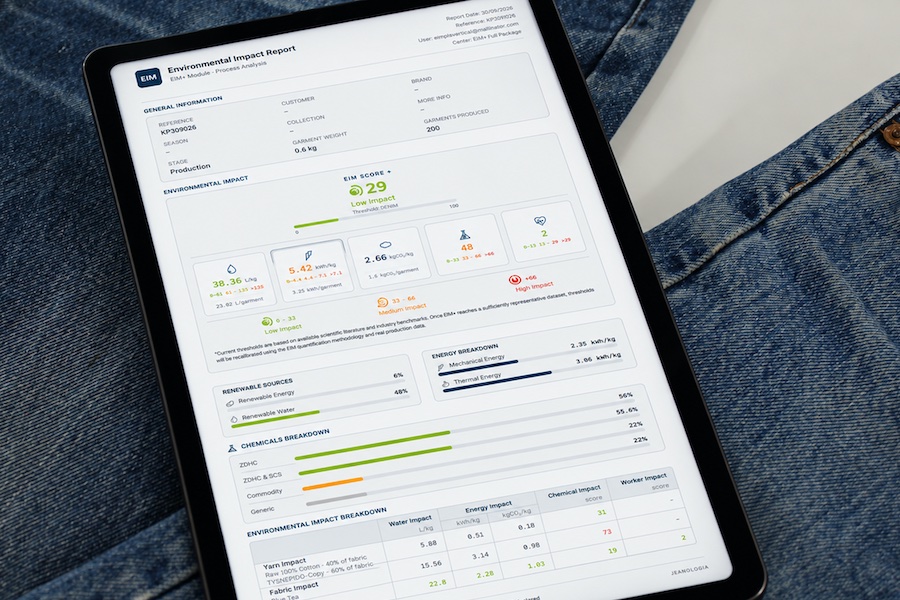
EIM (Environmental Impact Measurement), the global reference platform for measuring the environmental impact of garment finishing, presents the second edition of its annual report Denim Industry Progress & Insights 2025. The study analyses over 100,000 real denim finishing processes, providing an accurate and up-to-date view of the industry’s evolution towards more sustainable models.

#Recycling / Circular Economy

Europe’s textile future at a turning point: New 2030 Circularity Blueprint aims to scale recycling and unlock investment opportunities

The EU textile system is at a critical crossroads. Today, less than 1% of discarded garments are recycled into new garments, despite EU-wide obligations for separate collection. In response, Global Fashion Agenda (GFA) is launching the 2030 Circularity Blueprint, in partnership with ReHubs. This ambitious initiative is designed to support the transformation of the EU textile ecosystem to advance textile-to-textile recycling and drive the transition to a circular economy.

#Sustainability

Number of GOTS-certified facilities grow 15% globally as demand for credible sustainability standards continues to strengthen

Global Organic Textile Standard (GOTS) certification continued to grow in 2025, with nearly 18,000 certified facilities worldwide, despite ongoing geopolitical uncertainty and rapidly evolving regulatory requirements across global textile supply chains.

Latest News

#INDEX 2026

“We clearly see that reliability, flexibility, service and total cost of ownership are becoming increasingly important again.”

The nonwovens industry continues to face a challenging market environment. Nevertheless, AUTEFA Solutions reports successful projects, new line sales and growing demand for energy-efficient and flexible solutions. In this interview, André Imhof of AUTEFA Solutions talks about competitiveness against Chinese suppliers, new service and recycling concepts, the growing importance of application development and the opportunities created by countercyclical investments.

#INDEX 2026

“Needle punching technology is more universal and sustainable than ever!”

Needle punching technology was long regarded as a rather traditional and comparatively slow technology within the nonwovens industry. In this interview, Johann Philipp Dilo explains why needle punching is more relevant than ever today – ranging from energy efficiency and resource conservation to hygiene applications, new machine concepts and design-oriented nonwoven solutions.

#Research & Development

Textile climate control system in workwear – exhibition at the 2026 SME Innovation Day!

Conventional protective workwear often reaches its limits during strenuous physical activity. In particular, the transport of sweat and excess body heat poses a problem. The German Institutes of Textile and Fiber Research (DITF) conducted research on flow-optimized, air-conducting textile structures that enable targeted climate control directly on the body. These structures can be integrated straight into protective work garments. The textile climate control system supports the body’s natural thermoregulation. This contributes to improved workplace safety and comfort.

#Nonwovens

PET spunbond from China – EDANA welcomes imposition of provisional anti-dumping measures

On 13 May 2026, after eight months of investigation, the European Commission imposed provisional anti-dumping duties of 45.6-50.0% on imports of PET spunbond from China. EDANA welcomes this expression of the Commission’s clear determination to protect EU industries from the unfair trade practices of Chinese producers.

TOP