[pageLogInLogOut]

#Sustainability

FENC obtained NT Dollar 2 billion ESG loan to for sustainability transformation from CTBC
© 2023 FENC
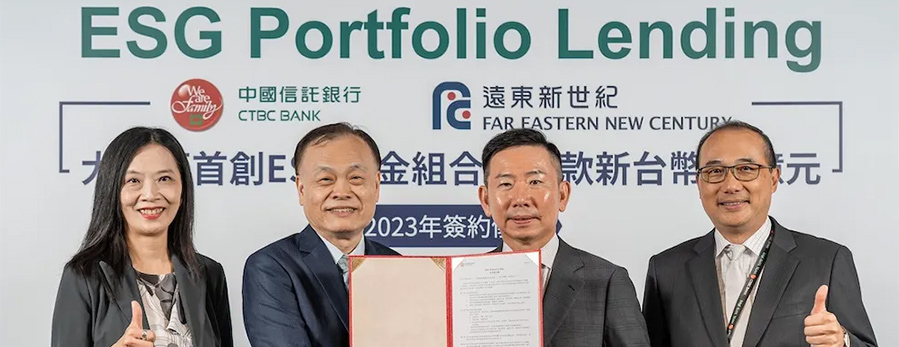
The CTBC Bank Co., Ltd signed the first NT$2 billion ESG loan agreement in the Greater China region with Far Eastern New Century Corporation (FENC) on Aug. 31, supporting FENC’s investment in sustainable development and helping the company to create a sustainable value chain.

The loan agreement was signed by CTBC Bank President Tony Yang and FENC Chief Financial Officer David Wang. President Yang stated that, with the sustainable development goal of net zero emissions in 2050, in addition to promoting sustainable operations, companies should also exert their influence on their stakeholders such as upstream and downstream suppliers, parent companies, and subsidiaries to undergo ESG sustainable transformation in order to respond to the demand from international initiatives, brand owners, consumers, and international evaluation agencies. Yang said that the CTBC Bank has helped companies achieve sustainability transformation for a long time, adding that the Bank fully engages with the clients to meet the needs of small and medium-sized enterprises in carrying out sustainability transformation by offering ESG Portfolio Lending.

The ESG Portfolio Lending obtained a patent certificate for new utility models in Taiwan this January and was approved by China in July. Currently, it is seeking to be patented in Taiwan and Hong Kong. The CTBC Bank serves as a financial intermediary for core enterprises to make green deposits, managing and utilizing ESG funds to improve efficiency. The Bank also uses the interest rate differentials between ESG deposits and ESG loans to subsidize the green loan of core enterprise stakeholders. In addition to providing green financial support for enterprises' sustainable transformation, the CTBC Bank also offers stakeholders assistance by increasing economic incentives for sustainable transformation. The Bank joins hands with core enterprises to achieve social sustainability and draw up a blueprint for a sustainable industrial value chain, with CTBC's overseas platform resources, innovative business models, and cross-device marketing, providing cross-industry, cross-field, and cross-scale ESG financial solutions for corporate customers.

FENC Chief Financial Officer David Wang said that FENC is committed to building a sustainable business model, and is the benchmark for the promotion of sustainable finance in Taiwan. With innovation as the main driving force, FENC established the Sustainable Finance Framework in alignment with the United Nations Sustainable Development Goals (SDGs) to diversify fundraising sources and encourage capital flows to ESG funds, thus realizing the company’s core values. FENC is the only enterprise in Taiwan that issues green bonds, sustainable development bonds, social responsibility bonds, and sustainability-linked bonds at the same time. It is also the only corporation in the world that has registered four types of sustainable bonds on the Sustainable Bonds Database of the International Capital Market Association (ICMA). The raised funds have been invested in sustainable projects, creating sustainable value with brand customers through vertical and horizontal integrations and advanced green technology.


FENC formally submitted its commitment letter to the Science Based Targets Initiative (SBTi), declaring that it will establish five major carbon-reduction strategies such as reaching net zero emissions to achieve the 1.5°C target and placing emphasis on green transformation. FENC, along with the Industrial Technology Research Institute and SGS Taiwan Limited, conducted a workshop for their partners based on the theme of carbon reduction with the aim of encouraging them to join in the efforts to reduce greenhouse gas emissions and achieve the net-zero emission target by 2050. CTBC Bank and FENC jointly signed the first ESG loan agreement for the purpose of creating a sustainable value chain while serving as a model to encourage their stakeholders to take action for sustainable development goals.

With the vision of becoming “Taiwan Champion, Asia Leader,” CTBC Bank adopts a sustainability strategy guided by the three pillars of "Sustainable Growth," "Responsible Operations," and "A Connected Society," actively pursuing the Sustainable Development Goals (SDGs) set forth by the United Nations and the Paris Agreement. The Bank has also unveiled its long-term development blueprint which is to reach net-zero emissions by 2050, and formally submitted the commitment to setting a science-based target by the end of 2022. It hopes to make a positive impact within the financial sector, promote a low-carbon economy, and achieve the goal of sustainable development through the capabilities of its products and services.
More News from TEXDATA International

#Texprocess 2026

Texprocess 2026: Automation, digitalisation and AI redefine textile processing

Making investment decisions in textile processing has become significantly more demanding. Increasing energy costs, a shortage of skilled labour and ongoing geopolitical uncertainties are compelling companies to focus on technologies that deliver clear gains in efficiency and process reliability. This applies equally to apparel manufacturing and to the processing of technical textiles and high-performance materials. As a result, modernisation initiatives are assessed more carefully – even as the need to upgrade production systems continues to intensify.

#Techtextil 2026

Techtextil 2026: Between innovation pressure & market reality

From 21 to 24 April 2026, Techtextil in Frankfurt am Main will once again become the central meeting point for the international technical textiles and nonwovens industry. Running in parallel, Texprocess will focus on the industrial implementation of textile processing technologies as the leading platform in this field. Together, the two trade fairs form a closely integrated presentation and working platform along the entire textile value chain – from material development to finished applications.

#Techtextil 2026

Between geopolitical pressure and industrial resilience

In this interview, Dr. Janpeter Horn (VDMA) discusses the current challenges facing textile machinery manufacturers, shaped by geopolitical tensions, regulatory developments and subdued investment. He also outlines why innovation strength, integrated solutions and strategic positioning remain key to global competitiveness.

#Texprocess 2026

Between investment restraint and modernization pressure

Texprocess 2026 takes place in a complex market environment shaped by uncertainty and innovation pressure. In this interview, Elgar Straub (VDMA) explains why the trade fair is particularly relevant this year and which technologies are driving efficiency and competitiveness.

More News on Sustainability

#Sustainability

Number of GOTS-certified facilities grow 15% globally as demand for credible sustainability standards continues to strengthen

Global Organic Textile Standard (GOTS) certification continued to grow in 2025, with nearly 18,000 certified facilities worldwide, despite ongoing geopolitical uncertainty and rapidly evolving regulatory requirements across global textile supply chains.

#Sustainability

bluesign technologies introduces bluepass

bluesign technologies ag (www.bluesign.com) today announces the launch of bluepass, a new certification mark and product labeling system created to deliver clear, substantiated, and verifiable sustainability claims at scale.

#Research & Development

Hohenstein publishes 2025 Sustainability Report

The testing and research service provider Hohenstein has published its latest sustainability report, outlining key progress and strategic initiatives. The report focuses on ambitious CO₂ reduction targets, the company’s new mission statement and the systematic expansion of sustainable services for customers worldwide.

#Natural Fibers

Global Standard gGmbH launches second public consultation for GRTS Draft 2 for the textile industry (1–30 April 2026)

Global Standard gGmbH is pleased to announce the release of Draft 2 of the Global Responsible Textile Standard (GRTS) for its second public consultation. The consultation will be open from 1 April 2026 to 30 April 2026, inviting stakeholders across the textile and apparel value chain to provide input and contribute to the further development of this new Standard.

Latest News

#Digital Printing

Kornit Digital launches Konnections 365

Kornit Digital (NASDAQ: KRNT) (“Kornit” or the “Company”), a global pioneer in sustainable, on-demand digital fashion and textile production today announced the launch of Konnections 365 - a year-round movement designed for the people moving the apparel, print, and retail industries forward. The strategy is built on the overwhelming success of Konnections 2026 held in Hollywood, Florida, featuring more than 500 customers, partners, and collaborators who together are driving the future of apparel and textiles.

#Techtextil 2026

Techtextil 2026: KARL MAYER impresses as an innovative sector partner

KARL MAYER looks back with satisfaction on its participation in Techtextil 2026. From April 21 to 24, the international industry leader used the trade show in Frankfurt to meet with numerous key customers at its booth and, at the same time, establish many new contacts. Most visitors came from Germany, followed by major markets such as Poland, the United Kingdom, Turkey, France, and Portugal.

#Associations

BTMA backs global growth while investing in future UK leaders

As one of a number of new initiatives launched this year, the British Textile Machinery Association (BTMA) is launching the UK-India Textile Machinery Coalition. The UK-India Free Trade Agreement, signed in July 2025, has implications that extend across sourcing, competitiveness and long-term trade dynamics, believes BTMA CEO Jason Kent.

#Raw Materials

China projected to increase cotton production, yields, and imports in 2026/27

World cotton production in the 2026/27 season is projected at 25.9 million tonnes, exceeding global consumption of 25.2 million tonnes, according to the May 2026 issue of Cotton This Month. That means both production and consumption are expected to remain close to current season levels, while global cotton trade is projected to decline by 2.7% to approximately 9.6-9.7 million tonnes.

TOP