[pageLogInLogOut]

#Sustainability

Ascend focuses on reducing product carbon footprint
© 2022 Ascend
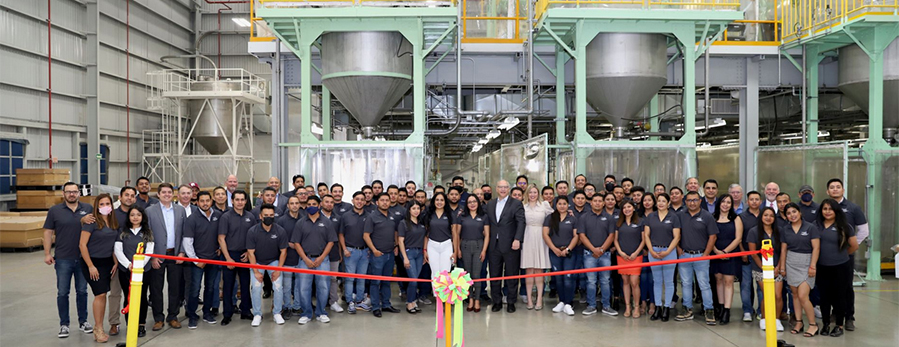
Ascend Performance Materials announced today two efforts to reduce the carbon footprint of its products. The company has made its global compounding operations carbon neutral, making it the first integrated polyamide producer to decarbonize a substantial part of its operations, and it has secured ISCC+ certification for the use of bio-based materials.

Ascend’s seven compounding sites in North America, Europe and Asia produce the company’s Vydyne®, Starflam® and HiDura™ engineered materials used in EVs, batteries, renewable energy systems and countless other applications.

Carbon neutrality for the sites’ scope 1 and 2 emissions was accomplished through a mix of process improvements, and renewable energy and carbon offsets. Annually, this achievement is equivalent to eliminating the emissions from 4,000 passenger vehicles.

On the other end of the company’s fully integrated production, Ascend is now certified to use bio-based feedstocks to produce acrylonitrile, adiponitrile, hexamethylene diamine and polyamide 66 utilizing a mass-balanced approach. With this certification, Ascend’s PA66 polymer can now be made with up to 40% bio-based materials.

“Reducing our carbon footprint is a major part of our sustainability effort,” said Chris Johnson, Ascend’s director of sustainability. “We are focused on meaningful, long-lasting improvements that balance environmental and product performance, and benefit our people, neighbors, customers and consumers.”


Ascend, a fully integrated producer of durable materials, has committed to an 80% reduction of its GHG emissions by 2030. Toward that goal, the company has invested in emissions abatement technology at its Pensacola, Florida, nylon plant and cogeneration units at its Decatur, Alabama, adiponitrile plant. And 30% of the energy used at Ascend’s acrylonitrile plant in Alvin, Texas, is derived from a utility-scale solar farm through a power purchase agreement.

“We remain committed to leading the industry in sustainability, even as we grow to meet the needs of our customers globally,” said Phil McDivitt, Ascend’s president and CEO. “These milestones are a big step toward ensuring that every pound of our product, whether made in Suzhou or Pensacola is made with the smallest environmental impact possible.”

Ascend will be showcasing its sustainability efforts, including its low-carbon-footprint products, under its Advancing Together theme at K 2022 from 19-26 October in Hall 6 Stand A07.




More News from TEXDATA International

#ITM 2026

ITM 2026: The new geography of textile production

New production hubs are emerging across North Africa and Central Asia, while Türkiye is accelerating its transformation toward higher-value, technology-driven and more sustainable textile manufacturing.

#Research & Development

“Production is a product”

From technical textiles and AI-driven robotics to the limitations of textile circularity: Professor Dr Thomas Gries looks back on more than two decades of development at ITA Aachen. In the interview, he explains why production technology remains a decisive success factor, discusses international collaborations and innovation ecosystems, and shares his views on the transformation of production landscapes and the challenges facing an increasingly regulated industry.

#Knitting & Hosiery

“We need to move away from the price trap and return to a value-driven mindset.”

With its new Textile Innovation Center, KARL MAYER is sending a strong signal for innovation, collaboration, and the future of textile applications. In this interview, Karl Josef Mayer discusses new opportunities in warp knitting, the processing of staple fibres, recycling, the changing role of machinery manufacturers, and why the textile industry must once again focus more strongly on the value of textiles. by Oliver Schmidt

#Associations

“Innovation, resilience and international experience remain the great strengths of the Swiss textile machinery industry”

Geopolitical uncertainty, growing competitive pressure from China, new free trade agreements and the shift towards a circular economy are currently reshaping the global textile industry. In this interview, Cornelia Buchwalder discusses the current mood within the Swiss textile machinery sector, the industry’s distinctive innovative strength, new market opportunities in India and Asia, and the technological trends that could shape the upcoming trade fair cycle leading up to ITMA 2027.

More News on Sustainability

#Sustainability

Closing the Footwear Loop reveals challenges and opportunities for circular footwear

The footwear industry faces one of the most complex circularity challenges in the fashion sector. A new Phase 1 report from the Fashion for Good initiative Closing the Footwear Loop, developed together with Circle Economy, provides new insights into the composition, condition and recycling potential of post-consumer footwear waste.

#Man-Made Fibers

The updated poster on biodegradable Polymers in various environments has been released

As part of the PerPlacsBio project, nova-Institute has updated its popular poster on the biodegradability of polymers in different environments. The updated version reflects current standards, certifications and the latest scientific findings. The poster can be used to assess biodegradable alternatives for use in agriculture and forestry, and it is now available in German for the first time.

#Sustainability

A new standard to combat plastic waste in forests

With DIN SPEC 35808 “Tree Shelter for Forestry Applications,” the testing and research service provider Hohenstein, in collaboration with Rottenburg University of Forestry, as well as forestry authorities and industry partners, has established a clear framework for bio-based and fully biodegradable tree shelters. The pre-standard defines requirements and practical testing methods designed to reduce plastic waste in forests and strengthen the long-term protection of soil and the environment.

#Denim

Denim moves towards sustainability

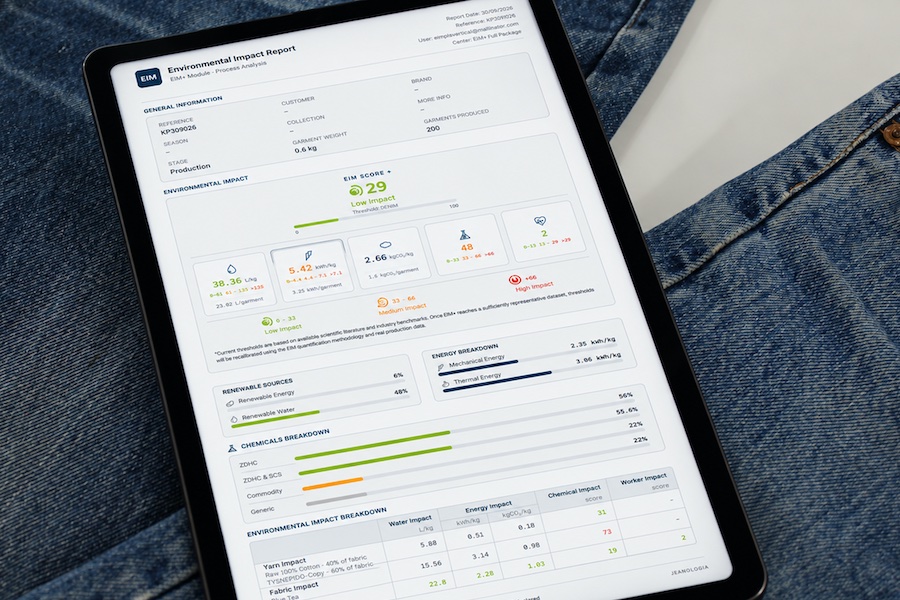
EIM (Environmental Impact Measurement), the global reference platform for measuring the environmental impact of garment finishing, presents the second edition of its annual report Denim Industry Progress & Insights 2025. The study analyses over 100,000 real denim finishing processes, providing an accurate and up-to-date view of the industry’s evolution towards more sustainable models.

Latest News

#Spinning

Barmag and Hitech Automation enter into partnership for an auto-doff system for texturing machines

Barmag (Suzhou) Technology Co., Ltd. and Hitech Automation Solutions PVT LTD. of Surat, India, have agreed to an exclusive partnership to jointly market Hitech’s Doffmatic automation solution for Barmag’s proven manual eFK texturing machines. In many texturing facilities, manual doffing processes remain heavily operator-dependent – resulting in issues such as increased scrap, inconsistent quality, and limited productivity.

#ITM 2026

Uster’s new Recycling Opening Index guides spinners to the perfect blend

Uster AFIS 6 now offers the key data for better decisions when blending recycled fibers. Process control is decisive in determining the quality and economic outcome. The new R Recycling Module of AFIS 6 introduces the Recycling Opening Index (ROI), so spinners can optimize their circularity credentials. It was officially launched at ITM 2026 in Istanbul, Türkiye.

#HIGHTEX 2026

The heart of the technical textiles and nonwovens world will beat in Istanbul

Only 1 day remains until HIGHTEX 2026 International Technical Textiles and Nonwovens Exhibition opens its doors. Bringing together manufacturers, technology developers, investors, and industry professionals from around the world, HIGHTEX 2026 is preparing to showcase the innovations shaping the future of the industry. As the countdown to this major event continues, Istanbul is once again getting ready to become the meeting point of the global technical textiles industry.

#Man-Made Fibers

Grasim Industries announces fresh investment of ₹3094 Crore to expand Lyocell capacity

Grasim Industries Limited, the flagship company of the Aditya Birla Group and a global leader in cellulosic fibres, today announced an investment of ₹3,094 crore, for Phase II Lyocell capacity of 110K TPA at Harihar, Karnataka. This expansion will consist of 2 lines of 55K TPA (150 Tons per day) each. The first line is expected to be commissioned by 2028, and the second line is expected to be commissioned by 2030.

TOP