[pageLogInLogOut]

#Sustainability

Guidelines to strengthen current certification schemes for bio-based feedstock
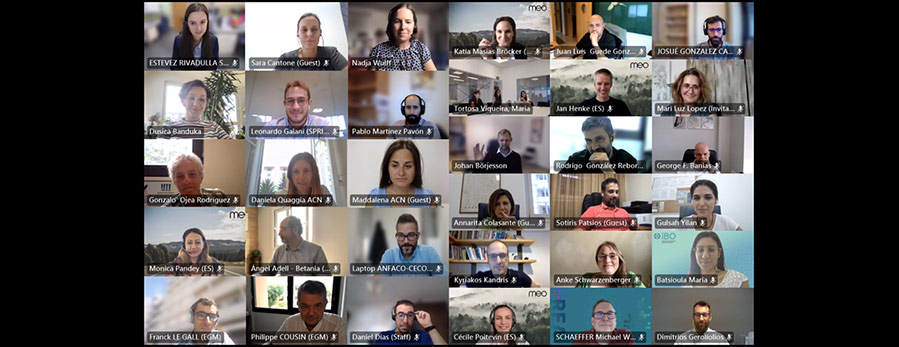
22-09-14 BIORECER kick-off meeting participants screenshot / Source: nova-Institut GmbH
Starting in September 2022, the new HORIZON Europe research project BIORECER aims to ensure the best possible environmental performance and traceability of biological feedstock used by bio-based industries. BIORECER will also assess the impact of current and adapted certification schemes on consumers and bio-based industry stakeholders along with their acceptance of new bio-value chains from biological feedstocks, including residual feedstock and waste.

Biomasses and biowastes present valuable secondary raw materials that require proper evaluation and certification as well as suitable and increasing traceability and transparency to increase their value and use in the bio-based value chains. The evaluation and certification approaches should consider key aspects including environmental performance and trade. The current landscape of certification schemes shows various inhomogeneous approaches and hereby causes a lack of traceability with regard to relevant information on the origin of bio-based products. Therefore, it hinders the availability, effective use and profitability of bio-based industries.

The BIORECER project aims to tackle these issues by developing guidelines for the advancement of current certification schemes, encouraging the establishment of new bio-based value chains and promoting the use of biological feedstocks to replace fossil-based raw materials. It hereby actively supports the goals of achieving a climate-neutral Europe by 2050. Based on these guidelines and within the framework of the project, 10 certification schemes are expected to be adapted in Europe and two non-European countries.

Three main technological pillars

The BIORECER research consortium thrives to realise three main technological pillars:

Development of a multidimensional assessment framework for an aggregated analysis of biological feedstocks and their associated supply chains.

Creation of a BIORECER Innovation Ecosystem living lab (BRIE) with a multi-agent approach in order to test the framework in four case studies with different biological feedstock origins and regional value chains in Spain, Italy, Greece and Sweden.

Making use of all generated knowledge to complement current certification schemes including new criteria for certifying sustainability, origin, and traceability of biological resources, and ensure applicability at EU and global scale.


Two levels of interaction: BioResources Stakeholders Platform and BIORECER Information Communication Technology tool

In order to amplify the reach and scope of BIORECER, the research team will establish two levels of interaction: The BioResources Stakeholders Platform (BRSP) and the BIORECER Information Communication Technology tool “BIT”. While the BioResources Stakeholders Platform will serve as a mobilisation, networking and feedback tool involving a group of representative stakeholders in each case study, the digital BIORECER Information Communication Technology tool “BIT” will analyse incorporated data via machine learning to provide stakeholders with additional insight on biomass key indicators and to enable analytic exploitation of feedstock data. The project consortium anticipates that 10% of the regional bioindustry in Spain, Italy, Greece and Sweden, through the clusters involved, and two more that will be afterwards selected for replication will use the BIORECER platform, which would mean a total of more than 1,000 customers.


International expertise in innovative certification schemes

The BIORECER project combines international expertise from all over Europe. Under the lead of Cetaqua Galicia from Spain, a consortium including Easy Global Market SAS from France, Meo Carbon Solutions GmbH, and nova-Institut für politische und ökologische Innovation GmbH from Germany, Ethniko Kentro Erevnas Kai Technologikis Anaptyxis from Greece, Associazione Cittadinanzattiva Onlus, Cap Holding, UNI – Ente Italiano di Normazione, Universita Politecnica delle Marche, Spring Sustainable Processes and Resources for Innovation and National Growth and Universita degli Studi di Roma Unitelma Sapienza from Italy, Asociacion Nacional de Fabricantes de Conservas de Pescados y Mariscos – Centro Tecnico Nacional de Conservacion de Productos de la Pesca, Betania Legio SL and Universidad de Santiago de Compostela from Spain, Rise Processum AB from Sweden and the Brunel University London from UK will develop innovative certification schemes for bio-based feedstock.

The BIORECER Project receives funding from the Horizon Europe Framework Programme under Grant Agreement Number 101060684.

More information about the project will soon be available at:

http://www.biorecer.eu



More News from TEXDATA International

#Texprocess 2026

Texprocess 2026: Automation, digitalisation and AI redefine textile processing

Making investment decisions in textile processing has become significantly more demanding. Increasing energy costs, a shortage of skilled labour and ongoing geopolitical uncertainties are compelling companies to focus on technologies that deliver clear gains in efficiency and process reliability. This applies equally to apparel manufacturing and to the processing of technical textiles and high-performance materials. As a result, modernisation initiatives are assessed more carefully – even as the need to upgrade production systems continues to intensify.

#Techtextil 2026

Techtextil 2026: Between innovation pressure & market reality

From 21 to 24 April 2026, Techtextil in Frankfurt am Main will once again become the central meeting point for the international technical textiles and nonwovens industry. Running in parallel, Texprocess will focus on the industrial implementation of textile processing technologies as the leading platform in this field. Together, the two trade fairs form a closely integrated presentation and working platform along the entire textile value chain – from material development to finished applications.

#Techtextil 2026

Between geopolitical pressure and industrial resilience

In this interview, Dr. Janpeter Horn (VDMA) discusses the current challenges facing textile machinery manufacturers, shaped by geopolitical tensions, regulatory developments and subdued investment. He also outlines why innovation strength, integrated solutions and strategic positioning remain key to global competitiveness.

#Texprocess 2026

Between investment restraint and modernization pressure

Texprocess 2026 takes place in a complex market environment shaped by uncertainty and innovation pressure. In this interview, Elgar Straub (VDMA) explains why the trade fair is particularly relevant this year and which technologies are driving efficiency and competitiveness.

More News on Sustainability

#Sustainability

Number of GOTS-certified facilities grow 15% globally as demand for credible sustainability standards continues to strengthen

Global Organic Textile Standard (GOTS) certification continued to grow in 2025, with nearly 18,000 certified facilities worldwide, despite ongoing geopolitical uncertainty and rapidly evolving regulatory requirements across global textile supply chains.

#Sustainability

bluesign technologies introduces bluepass

bluesign technologies ag (www.bluesign.com) today announces the launch of bluepass, a new certification mark and product labeling system created to deliver clear, substantiated, and verifiable sustainability claims at scale.

#Research & Development

Hohenstein publishes 2025 Sustainability Report

The testing and research service provider Hohenstein has published its latest sustainability report, outlining key progress and strategic initiatives. The report focuses on ambitious CO₂ reduction targets, the company’s new mission statement and the systematic expansion of sustainable services for customers worldwide.

#Natural Fibers

Global Standard gGmbH launches second public consultation for GRTS Draft 2 for the textile industry (1–30 April 2026)

Global Standard gGmbH is pleased to announce the release of Draft 2 of the Global Responsible Textile Standard (GRTS) for its second public consultation. The consultation will be open from 1 April 2026 to 30 April 2026, inviting stakeholders across the textile and apparel value chain to provide input and contribute to the further development of this new Standard.

Latest News

#Associations

BTMA backs global growth while investing in future UK leaders

As one of a number of new initiatives launched this year, the British Textile Machinery Association (BTMA) is launching the UK-India Textile Machinery Coalition. The UK-India Free Trade Agreement, signed in July 2025, has implications that extend across sourcing, competitiveness and long-term trade dynamics, believes BTMA CEO Jason Kent.

#Raw Materials

China projected to increase cotton production, yields, and imports in 2026/27

World cotton production in the 2026/27 season is projected at 25.9 million tonnes, exceeding global consumption of 25.2 million tonnes, according to the May 2026 issue of Cotton This Month. That means both production and consumption are expected to remain close to current season levels, while global cotton trade is projected to decline by 2.7% to approximately 9.6-9.7 million tonnes.

#Raw Materials

ICAC launches Carbon Credits Initiative to deliver new income streams to cotton farmers

The International Cotton Advisory Committee (ICAC) has announced a new initiative designed to unlock additional income streams for cotton farmers through participation in carbon credit markets, linking sustainable production practices directly to financial returns.

#Raw Materials

ECCO introduces first shoe featuring innovative protein-based fibre

ECCO, in partnership with Spinnova, announces the launch of the limited edition ECCO BIOM® 720, a first-of-its-kind shoe utilising an often overlooked leather by-product, transformed into a protein-based fibre. The fibres are produced using patented technology that advances material innovation while reducing waste and supporting full resource use across the leather and textile industry.

TOP