[pageLogInLogOut]

#Sustainability

Massive new Chinese wastewater treatment plant employs Toray membrane modules

Toray Industries, Inc., announced today that an advanced facility that went on line at the Yindingzhuang Wastewater Treatment Plant in July this year employs the company’s hollow fiber ultrafiltration membrane modules. This advanced facility in Baoding, Hebei Province, is one of the largest in China using such modules, with a daily treatment capacity of 315,000 cubic meters.

Beijing-based Toray Bluestar Membrane Co., Ltd., is supplying and providing technical services for these modules at the facility. Toray will help China enhance its aquatic environment and resolve water shortages by offering products and technical support through that subsidiary.

China built the new facility as part of a key public project to safeguard the ecology of Baiyangdian, a freshwater lake near Xiong’an New Area, a fast-expanding development hub.
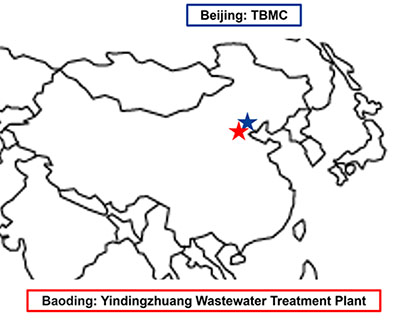
Toray Bluestar Membrane is near the Yindingzhuang Wastewater Treatment Plant © 2022 Toray


China is raising its waste water treatment standards in keeping with increasingly strict environmental regulations. Switching to an advanced process employing ultrafiltration membrane modules became imperative in view of a common activated sludge process failing to match the government’s latest water quality standards.

Toray’s membrane modules employ polyvinylidene fluoride, a non-reactive thermoplastic fluoropolymer with outstanding high chemical and physical stability. The company applied a proprietary manufacturing technique to create a composite membrane structure that ensures high water permeability and minimal fouling. The membrane module pore size of 0.01 microns is smaller than those of rival offerings, significantly enhancing the quality of filtered water. China chose Toray’s modules for this public project on the strength of their exceptional reliability, lower running costs from less frequent chemical scrubbing, and results that surpass water quality standards.
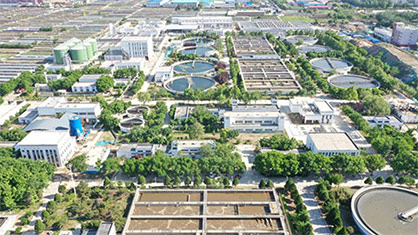
Advanced facility at Yindingzhuang Wastewater Treatment Plant Baoding, Hebei Province<br />
(photo © Hebei Construction Group Corporation Limited)
Advanced facility at Yindingzhuang Wastewater Treatment Plant Baoding, Hebei Province (photo © Hebei Construction Group Corporation Limited)


The Chinese government’s 14th Five-Year Plan for Circular Economy Development has fueled demand for membrane modules to help combat water pollution. Toray can cater to such demand by drawing on the capabilities of Toray Bluestar Membrane, as well as of two other local subsidiaries. The first is Toray Membrane (Foshan) Co., Ltd., which manufactures water treatment membranes and products in Foshan, Guangdong Province. The second is Toray Advanced Materials Research Laboratories (China) Co., Ltd., in Shanghai. Toray Group units will keep collaborating to help China resolve its water issues by providing products and services that match the requirements of local customers.

Providing access to clean water is pivotal to The Toray Group Sustainability Vision, representing a roadmap to the World as Envisioned by Toray Group in 2050 and embodying

Toray Vision 2030, through which the Group seeks to achieve sound, sustainable growth. The company will do its utmost to help reach Sustainable Development Goals and other global objectives by providing superior technology and water treatment membrane products.


Profile of new facility employing Toray membrane modules at Yindingzhuang Wastewater Treatment Plant

• Location: Baoding, Hebei Province, China

• Treatment capacity: 315,000 cubic meters daily

• Operational start: July 8, 2022

• Plant Design : North China Municipal Engineering Design & Research Institute Co., Ltd

• General Contractor : Hebei Construction Group Corporation Limited

• UF System Design: Hangzhou Water Treatment Technology Development Center Co., Ltd
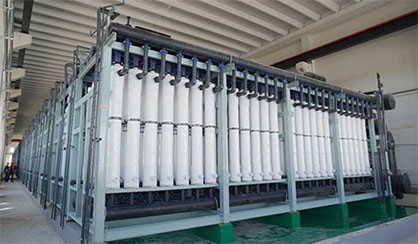

Toray hollow fiber ultrafiltration membrane modules installed at plant<br />
(photo © Hebei Construction Group Corporation Limited)
Toray hollow fiber ultrafiltration membrane modules installed at plant (photo © Hebei Construction Group Corporation Limited)


Toray membrane products website

https://www.water.toray/


More News from Toray Engineering Co. Ltd.

#Man-Made Fibers

Toray develops AURLIST™ polyester filament fiber with luxurious luster and ultra-fine structure

Toray Industries has developed AURLIST™, a new polyester filament fiber designed to combine luxurious luster, soft loft and a subtle fibrillated surface texture. The company primarily targets applications in women’s apparel such as tops, bottoms and dresses.

#Recycling / Circular Economy

Toray develops recycling technology that retains carbon fiber strength and surface quality

Toray Industries, Inc., announced today that it has developed a recycling technology that can decompose diverse carbon fiber reinforced plastics (CFRP) made from thermosetting resins while retaining the strength and surface quality of those fibers. The company drew on this technology to create a nonwoven fabric employing recycled carbon fibers.

#Composites

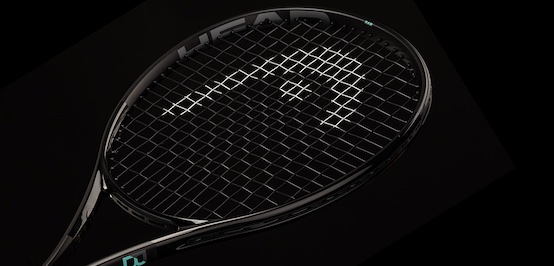
HEAD launches more sustainable(1) BOOM RAW racquet on Earth Day by using Toray’s bio-circular carbon fibers

HEAD continues to innovate with the launch of the BOOM RAW tennis racquet, an encouraging development in the search for a more sustainable future for racquet sports. All of the carbon fibers are bio-circular carbon fibers in the limited-edition and highly innovative BOOM RAW racquet, which offers the same explosive power - along with the same fun, feel and easy playability - as the regular, in-line BOOM racquet. The bio-circular carbon fibers are manufactured by Toray and its subsidiary Toray Carbon Fibers Europe.

#Recycling / Circular Economy

Companies in Japan initiate demonstration to expand the automotive recycling process

DENSO CORPORATION and other partners have been chosen by an industry-government-academia collaborative project aiming to expand the recycle content for automobile in the fiscal year 2023 supported by Ministry of the Environment, Japan.

More News on Sustainability

#Natural Fibers

Global Standard gGmbH launches second public consultation for GRTS Draft 2 for the textile industry (1–30 April 2026)

Global Standard gGmbH is pleased to announce the release of Draft 2 of the Global Responsible Textile Standard (GRTS) for its second public consultation. The consultation will be open from 1 April 2026 to 30 April 2026, inviting stakeholders across the textile and apparel value chain to provide input and contribute to the further development of this new Standard.

#Sustainability

Practical toolkit to drive coordinated climate action launched

An open-access workshop toolkit enables brands, suppliers, policymakers and investors across the textile industry to apply the System Map in their own work, identifying leverage points to halve emissions and enable a just transition.

#Raw Materials

Textile Exchange publishes cotton Life Cycle Assessment study to strengthen impact data

Textile Exchange has published the first in a series of seven Life Cycle Assessment (LCA) studies designed to improve the quality and robustness of environmental impact data for raw material production across the fashion, textile, and apparel industry. The first LCA study focuses on cotton and addresses critical data gaps and methodology variability through new high-quality data across key producing countries. The study includes organic, regenerative, recycled, and country averages for conventional cotton production systems, providing a clearer picture of the associated environmental impact.

#Sustainability

Experts publish APAC policy priorities

Cascale today announced the publication of its APAC Policy Priorities Paper, developed by the Asia-Pacific (APAC) Policy Member Expert Team (MET) to identify key regional sustainability challenges and provide practical, aligned recommendations for policymakers and industry stakeholders across Asia-Pacific.

Latest News

#Raw Materials

New study shows low environmental impact by Cotton made in Africa Organic Cotton from Tanzania

Today, the Aid by Trade Foundation (AbTF) is announcing the results of a comprehensive life-cycle analysis (LCA) for cotton produced in Tanzania under the Cotton made in Africa Organic (CmiA Organic) standard. The study emphasises the small ecological footprint of CmiA Organic verified cotton. This can largely be traced back to the absence of synthetic pesticides, artificial fertilisers, and artificial irrigation. Consequently, CmiA Organic cotton can help the textile industry meet regulatory requirements as well as science-based targets. The results also show that the consequences of climate change threaten the livelihoods of these cotton farmers, even though the type of agriculture they practise barely contributes to climate change.

#Raw Materials

Better Cotton Initiative strengthens regenerative focus in standard update

The Better Cotton Initiative (BCI) has strengthened the regenerative focus of its field-level standard with the launch of a new version of its Principles & Criteria (P&C), which marks the next step in the organisation’s journey to becoming a regenerative standards system.

#Man-Made Fibers

Selenis and Kintra Fibers partner to scale 100% bio-based synthetic fiber technology

Selenis, a leading global specialty polyester manufacturer, today announced a strategic manufacturing partnership with materials science company Kintra Fibers to scale Kintra’s patented fiber-grade PBS resin - a 100% bio-based and biodegradable material designed for textile applications.

#Functional Fabrics

PERFORMANCE DAYS proves its relevance as the industry’s key meeting point

Held on March 18–19, 2026, PERFORMANCE DAYS once again confirmed its position as a leading international platform for functional textiles. A total of 3.366 trade visitors and around 560 exhibitors gathered in Munich, with the event already kicking off successfully on DAY 0, which received highly positive feedback for its interactive format. Despite challenging conditions caused by the public transport strike in Munich, the event saw strong attendance and a consistently high level of activity across both exhibition days.

TOP