[pageLogInLogOut]

#Textile chemistry

Bluesign announces partnership with SCTI to create the first comprehensive sustainable chemistry index for the textile industry
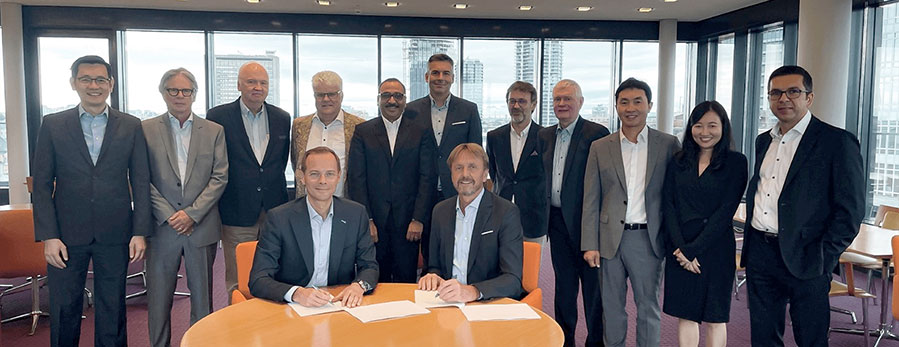
Seated from left: Wolfgang Anton Schumann, Chairman of SCTI and Kurt Schläpfer, Head of Customer Relation Management of Bluesign at the signing ceremony. Standing from left: Kin Keong Chan, Peter Waeber, Dennis Dalton, Thomas Schäfer, Rohit Aggarwal, Benoit Moutault, Marcos Furrer, Simon Collinson, Sung Yong Cho, Marilyn Chua, Ümit Yaldiz © 2022 Bluesign
Bluesign has teamed up with Sustainable Chemistry for the Textile Industry (SCTI™) to develop a sustainable chemistry index that will provide a standard communication guide for chemical suppliers, manufacturers, brands, and NGOs

The first-of-its-kind index is intended to inspire change in the industry by making it easier for stakeholders to assess the sustainability of textile chemical products against the highest standards while safeguarding the intellectual property (IP) of participating chemical companies. IP protection is critical to ensuring ongoing investment in sustainable solutions.

SCTI™ is an alliance of leading chemical companies that strives to empower the textile and leather industries to apply sustainable, state-of-the-art chemistry solutions that protect factory workers, local communities, consumers and the environment.

Bluesign will implement and manage the sustainable chemistry index as an independent authority with a holistic approach to help companies throughout the textile supply chain improve their sustainability performance.

Chemical products, such as dyes and textile auxiliaries, are often characterized with the attribute of “free of a certain substance”. Rather than prioritizing ingredients only, the bluesign® SYSTEM already goes beyond this. The chemicals and the production site where they were created must meet certain criteria regarding environmental performance, occupational health and safety, and product stewardship performance to be bluesign® APPROVED.

The sustainable chemistry index will be reserved for substances that offer transparency on a number of additional indicators including the chemical’s circularity viability, greenhouse gas emissions during production, and the source of the raw materials. The sustainable chemistry index will also require that the downstream use of the chemical is optimized, meaning, for example, that it promotes resource saving in textile finishing. Additionally, excellent corporate governance paired with well-defined environmental and social (ESG) goals will be a pre-condition.


Dr. Wolfgang Anton Schumann, SCTI™ Chairman, said: “Through its independent position, Bluesign has earned the industry’s trust to provide sustainable chemical solutions and impact reductions across the supply chain for the past two decades.This partnership exemplifies our organizations’ joint expertise and how collaboration creates solutions that can drive meaningful change across an industry to reduce impact on people and our planet.”

Daniel Rüfenacht, Bluesign CEO, added: “SCTI™ offers deep sustainability knowledge in the chemical industry. The new sustainable chemistry index will help the industry progress beyond current regulations and realize the EU Chemicals Strategy for Sustainability by providing textile chemical users a clear rating on a substance’s environmental and social impact to advance decision-making”.

The mission for the joint partnership between Bluesign and SCTI™, and the sustainable chemistry index in particular, is to drive transformational change through sustainable chemical solutions. Providing textile and apparel industry players with a verified inventory of sustainable chemical products is a first step on this shared journey.
More News from TEXDATA International

#Texprocess 2026

Texprocess 2026: Automation, digitalisation and AI redefine textile processing

Making investment decisions in textile processing has become significantly more demanding. Increasing energy costs, a shortage of skilled labour and ongoing geopolitical uncertainties are compelling companies to focus on technologies that deliver clear gains in efficiency and process reliability. This applies equally to apparel manufacturing and to the processing of technical textiles and high-performance materials. As a result, modernisation initiatives are assessed more carefully – even as the need to upgrade production systems continues to intensify.

#Techtextil 2026

Techtextil 2026: Between innovation pressure & market reality

From 21 to 24 April 2026, Techtextil in Frankfurt am Main will once again become the central meeting point for the international technical textiles and nonwovens industry. Running in parallel, Texprocess will focus on the industrial implementation of textile processing technologies as the leading platform in this field. Together, the two trade fairs form a closely integrated presentation and working platform along the entire textile value chain – from material development to finished applications.

#Techtextil 2026

Between geopolitical pressure and industrial resilience

In this interview, Dr. Janpeter Horn (VDMA) discusses the current challenges facing textile machinery manufacturers, shaped by geopolitical tensions, regulatory developments and subdued investment. He also outlines why innovation strength, integrated solutions and strategic positioning remain key to global competitiveness.

#Texprocess 2026

Between investment restraint and modernization pressure

Texprocess 2026 takes place in a complex market environment shaped by uncertainty and innovation pressure. In this interview, Elgar Straub (VDMA) explains why the trade fair is particularly relevant this year and which technologies are driving efficiency and competitiveness.

More News on Textile chemistry

#Sustainability

bluesign technologies introduces bluepass

bluesign technologies ag (www.bluesign.com) today announces the launch of bluepass, a new certification mark and product labeling system created to deliver clear, substantiated, and verifiable sustainability claims at scale.

#Textile chemistry

Officina39 expands in South Asia with dual trade show presence and new low-impact dyeing innovation

Officina39 reinforces its strategic expansion in South Asia by announcing its participation in two key textile industry events in Bangladesh and India, alongside the launch of a new solution designed to reduce the environmental impact of reactive dyeing.

#Techtextil 2026

Speed and connectivity: Techtextil and Texprocess provided market-ready solutions for industries under pressure

With more than 36,000 visitors and 1,700 exhibitors from a total of 112 countries, Techtextil and Texprocess 2026 demonstrated how innovation comes into industrial use. The convergence of research, industry and application proved to be a breeding ground for new material solutions, manufacturing and processing technologies. Natural fibres, performance apparel, connected systems and AI-driven processing technologies emerged as key growth and future markets.

#Techtextil 2026

RUDOLF is pioneering the future of technical textiles by developing innovative, functional solutions

At Techtextil 2026, RUDOLF presents its latest innovations for textile auxiliaries, textile care and construction chemicals. Based in Geretsried, Bavaria, the company draws on more than 100 years of experience and continues to position itself as a global technology partner focused on quality, innovation and sustainability.

Latest News

#Associations

BTMA backs global growth while investing in future UK leaders

As one of a number of new initiatives launched this year, the British Textile Machinery Association (BTMA) is launching the UK-India Textile Machinery Coalition. The UK-India Free Trade Agreement, signed in July 2025, has implications that extend across sourcing, competitiveness and long-term trade dynamics, believes BTMA CEO Jason Kent.

#Raw Materials

China projected to increase cotton production, yields, and imports in 2026/27

World cotton production in the 2026/27 season is projected at 25.9 million tonnes, exceeding global consumption of 25.2 million tonnes, according to the May 2026 issue of Cotton This Month. That means both production and consumption are expected to remain close to current season levels, while global cotton trade is projected to decline by 2.7% to approximately 9.6-9.7 million tonnes.

#Raw Materials

ICAC launches Carbon Credits Initiative to deliver new income streams to cotton farmers

The International Cotton Advisory Committee (ICAC) has announced a new initiative designed to unlock additional income streams for cotton farmers through participation in carbon credit markets, linking sustainable production practices directly to financial returns.

#Sustainability

Number of GOTS-certified facilities grow 15% globally as demand for credible sustainability standards continues to strengthen

Global Organic Textile Standard (GOTS) certification continued to grow in 2025, with nearly 18,000 certified facilities worldwide, despite ongoing geopolitical uncertainty and rapidly evolving regulatory requirements across global textile supply chains.

TOP