[pageLogInLogOut]

#Sustainability

SAC partners with Fair Wear and the Ethical Trading Initiative to help industry achieve 45% GHG reduction target by 2030
© 2022 Sustainable Apparel coaliton
The Sustainable Apparel Coalition (SAC), a global multi-stakeholder nonprofit alliance for the consumer goods industry, is pleased to announce its partnership with Fair Wear and the Ethical Trading Initiative focused on facilitating collective action across the industry towards achieving the 45% greenhouse gas (GHG) reduction by 2030. The partnership, which falls under The Industry We Want (TIWW), is part of an initiative geared towards ensuring dignity for workers in decent jobs, thriving businesses along the supply chain, and a positive impact on the planet.

The Industry We Want is a multi-stakeholder initiative dedicated to driving industry-wide progress on key issues in the garment and footwear sector.

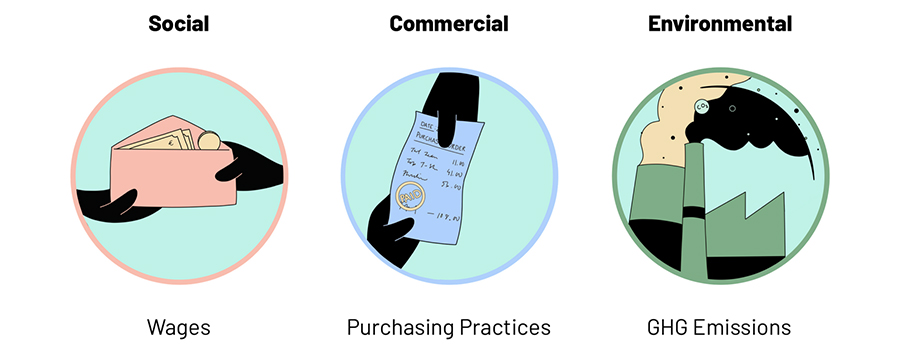
TIWW have developed a set of metrics for the garment and footwear industry to measure action across 3 pillars: social, commercial and environmental. The impact metrics will be presented in TIWW’s first ever industry dashboard, which will be updated annually and function as a “temperature check” for the sector as a whole. 

The SAC will lead TIWW’s environmental pillar and work closely with fellow Apparel Alliance member, the Apparel Impact Institute (Aii), to ensure an annual update of the dashboard data, providing a yearly check-in on the progress the industry has made to reduce emissions. The SAC will also support in the development and implementation of TIWW’s overall strategy, coordinate key partnerships, support the TIWW led events and participate in the annual evaluation of the project to identify areas for improvement as needed.

“We are honored to be partnering with the Fair Wear and the Ethical Trading Initiative on this initiative and believe it will enable us to leverage our strength in collaboration with our fellow Apparel Alliance members to achieve our vision of an industry that gives more than it takes. As an organization committed to empowering the consumer goods industry with data to understand how to improve its environmental credentials, this partnership reinforces our commitment to transforming the industry to better serve the needs of people and planet,” said Amina Razvi, Executive Director of the SAC.

The SAC will leverage TIWW’s platform to support organisations set and achieve clear science based targets (SBTs), ensuring the industry stays on track to fulfill its climate change commitments, particularly the 45% reduction target, to significantly reduce emissions and deliver on the climate goals to keep warming within planetary boundaries. 

Fair Wear and the Ethical Trading Initiative launched TIWW in early 2021, with a vision to create a garment and footwear industry that realises its full potential to ensure dignity for workers in decent jobs, thriving businesses along the supply chain and a positive impact on the planet. The first iteration of TIWW’s dashboard showcased the estimated total emissions of the apparel sector, drawing data from Aii’s & WRI’s report “Roadmap to Net Zero: Delivering Science-Based Targets in the Apparel Sector”, based on SAC’s and Textile Exchange data. The dashboard was also created in collaboration with the WageIndicator Foundation and the Better Buying Institute to present metrics on the living wage gap and purchasing practices in the sector.  


“The tumultuousness of Covid-19 and growing impacts of climate change are near daily reminders that real change is needed in the way we conduct business. The urgency is clear, yet, working on root problems in the garment and footwear sector is a challenge we have yet to overcome. Therefore, it is with great excitement that Fair Wear and ETI welcome SAC as a lead partner in The Industry We Want initiative, assuring we drive industry-wide progress on environmental impact as well as on commercial and social practices, said Alexander Kohnstamm, Director Fair Wear and Peter McAllister, Director ETI.

TIWW will be hosting a Deep Dive Session on May 12th, from 5pm – 6pm CEST, on the GHG emissions metric, which sits under its environmental pillar. The session will explore details of the TIWW’s GHG metric, which is informed by the Apparel Impact Institute (Aii) and World Resources Institute (WRI) report Roadmap to Net Zero. The event is open for interested participants to register and join other stakeholders in exploring the methodology behind the metric, and learn more about how the industry can accelerate progress towards net-zero in line with TIWW’s vision for a just and regenerative garment sector.



 

More News from TEXDATA International

#Texprocess 2026

Texprocess 2026: Automation, digitalisation and AI redefine textile processing

Making investment decisions in textile processing has become significantly more demanding. Increasing energy costs, a shortage of skilled labour and ongoing geopolitical uncertainties are compelling companies to focus on technologies that deliver clear gains in efficiency and process reliability. This applies equally to apparel manufacturing and to the processing of technical textiles and high-performance materials. As a result, modernisation initiatives are assessed more carefully – even as the need to upgrade production systems continues to intensify.

#Techtextil 2026

Techtextil 2026: Between innovation pressure & market reality

From 21 to 24 April 2026, Techtextil in Frankfurt am Main will once again become the central meeting point for the international technical textiles and nonwovens industry. Running in parallel, Texprocess will focus on the industrial implementation of textile processing technologies as the leading platform in this field. Together, the two trade fairs form a closely integrated presentation and working platform along the entire textile value chain – from material development to finished applications.

#Techtextil 2026

Between geopolitical pressure and industrial resilience

In this interview, Dr. Janpeter Horn (VDMA) discusses the current challenges facing textile machinery manufacturers, shaped by geopolitical tensions, regulatory developments and subdued investment. He also outlines why innovation strength, integrated solutions and strategic positioning remain key to global competitiveness.

#Texprocess 2026

Between investment restraint and modernization pressure

Texprocess 2026 takes place in a complex market environment shaped by uncertainty and innovation pressure. In this interview, Elgar Straub (VDMA) explains why the trade fair is particularly relevant this year and which technologies are driving efficiency and competitiveness.

More News on Sustainability

#Sustainability

Number of GOTS-certified facilities grow 15% globally as demand for credible sustainability standards continues to strengthen

Global Organic Textile Standard (GOTS) certification continued to grow in 2025, with nearly 18,000 certified facilities worldwide, despite ongoing geopolitical uncertainty and rapidly evolving regulatory requirements across global textile supply chains.

#Sustainability

bluesign technologies introduces bluepass

bluesign technologies ag (www.bluesign.com) today announces the launch of bluepass, a new certification mark and product labeling system created to deliver clear, substantiated, and verifiable sustainability claims at scale.

#Research & Development

Hohenstein publishes 2025 Sustainability Report

The testing and research service provider Hohenstein has published its latest sustainability report, outlining key progress and strategic initiatives. The report focuses on ambitious CO₂ reduction targets, the company’s new mission statement and the systematic expansion of sustainable services for customers worldwide.

#Natural Fibers

Global Standard gGmbH launches second public consultation for GRTS Draft 2 for the textile industry (1–30 April 2026)

Global Standard gGmbH is pleased to announce the release of Draft 2 of the Global Responsible Textile Standard (GRTS) for its second public consultation. The consultation will be open from 1 April 2026 to 30 April 2026, inviting stakeholders across the textile and apparel value chain to provide input and contribute to the further development of this new Standard.

Latest News

#Associations

BTMA backs global growth while investing in future UK leaders

As one of a number of new initiatives launched this year, the British Textile Machinery Association (BTMA) is launching the UK-India Textile Machinery Coalition. The UK-India Free Trade Agreement, signed in July 2025, has implications that extend across sourcing, competitiveness and long-term trade dynamics, believes BTMA CEO Jason Kent.

#Raw Materials

China projected to increase cotton production, yields, and imports in 2026/27

World cotton production in the 2026/27 season is projected at 25.9 million tonnes, exceeding global consumption of 25.2 million tonnes, according to the May 2026 issue of Cotton This Month. That means both production and consumption are expected to remain close to current season levels, while global cotton trade is projected to decline by 2.7% to approximately 9.6-9.7 million tonnes.

#Raw Materials

ICAC launches Carbon Credits Initiative to deliver new income streams to cotton farmers

The International Cotton Advisory Committee (ICAC) has announced a new initiative designed to unlock additional income streams for cotton farmers through participation in carbon credit markets, linking sustainable production practices directly to financial returns.

#Raw Materials

ECCO introduces first shoe featuring innovative protein-based fibre

ECCO, in partnership with Spinnova, announces the launch of the limited edition ECCO BIOM® 720, a first-of-its-kind shoe utilising an often overlooked leather by-product, transformed into a protein-based fibre. The fibres are produced using patented technology that advances material innovation while reducing waste and supporting full resource use across the leather and textile industry.

TOP