[pageLogInLogOut]

#Sustainability

The LYCRA Company’s Foshan, China facility earns high Higg FEM Score
© 2022 LYCRA
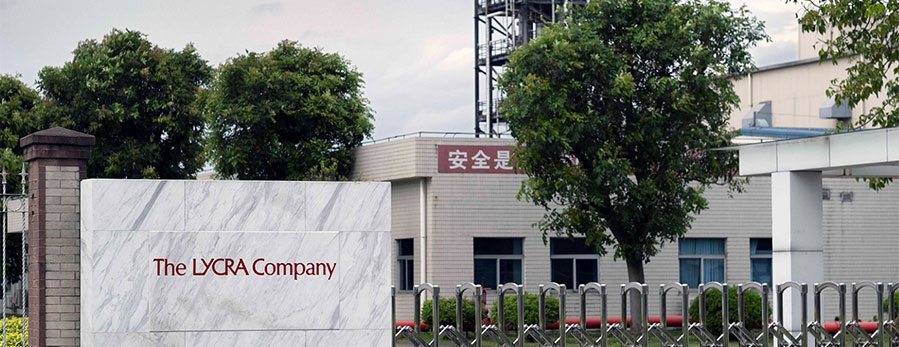
The LYCRA Company, a global leader in developing innovative fiber and technology solutions for the textile and apparel industry, announced today that its largest manufacturing site located in Foshan, China has earned a score in the upper quartile for its third-party audited Higg Facility Environmental Module (Higg FEM).

Higg FEM is a sustainability assessment tool that The LYCRA Company is using to determine the Foshan site’s environmental impact, standardize how its environmental performance is measured year over year, and identify, prioritize, and scale enhancements.

The Higg FEM score is based on the percentage of completed and verified self-assessment questions related to its environmental management systems, energy use and greenhouse gas emissions, water use, wastewater, air emissions, waste management and chemical management. The Foshan site completed the full module and had their responses confirmed by an independent verifier.

“Foshan is the first of our six global manufacturing sites to undergo Higg FEM verification. We’re thrilled to achieve such a high score in the upper quartile for our first assessment,” said Choon Hueei Beck, Foshan plant manager, The LYCRA Company. “This positive outcome not only demonstrates The LYCRA Company’s commitment to sustainability and transparency, but it will also differentiate our products in a highly competitive marketplace.”

At Foshan, the Higg FEM verification was an intensive three-day process that required months of preparation and documentation according to Beck. “Thanks to the hard work and dedication of a cross-functional team in Foshan and other locations, we now have a blueprint to repeat this successful result at other facilities, all of which have completed self-certification,” he said.


Located in Guangdong province, the Foshan plant first opened in 2005. The manufacturing site produces LYCRA® fiber for apparel and LYCRA HyFit® fiber for personal care products and employs about 500 people. A number of LYCRA® fiber products made at Foshan are Gold Level Material Health certified by the Cradle to Cradle Products Innovation Institute.

Higg FEM is part of a suite of tools developed by the Sustainable Apparel Coalition, a global, nonprofit alliance of over 270 stakeholders in the fashion industry. For more information on Higg FEM, visit this website:

https://apparelcoalition.org/higg-facility-tools/



More News from TEXDATA International

#Texprocess 2026

Texprocess 2026: Automation, digitalisation and AI redefine textile processing

Making investment decisions in textile processing has become significantly more demanding. Increasing energy costs, a shortage of skilled labour and ongoing geopolitical uncertainties are compelling companies to focus on technologies that deliver clear gains in efficiency and process reliability. This applies equally to apparel manufacturing and to the processing of technical textiles and high-performance materials. As a result, modernisation initiatives are assessed more carefully – even as the need to upgrade production systems continues to intensify.

#Techtextil 2026

Techtextil 2026: Between innovation pressure & market reality

From 21 to 24 April 2026, Techtextil in Frankfurt am Main will once again become the central meeting point for the international technical textiles and nonwovens industry. Running in parallel, Texprocess will focus on the industrial implementation of textile processing technologies as the leading platform in this field. Together, the two trade fairs form a closely integrated presentation and working platform along the entire textile value chain – from material development to finished applications.

#Techtextil 2026

Between geopolitical pressure and industrial resilience

In this interview, Dr. Janpeter Horn (VDMA) discusses the current challenges facing textile machinery manufacturers, shaped by geopolitical tensions, regulatory developments and subdued investment. He also outlines why innovation strength, integrated solutions and strategic positioning remain key to global competitiveness.

#Texprocess 2026

Between investment restraint and modernization pressure

Texprocess 2026 takes place in a complex market environment shaped by uncertainty and innovation pressure. In this interview, Elgar Straub (VDMA) explains why the trade fair is particularly relevant this year and which technologies are driving efficiency and competitiveness.

More News on Sustainability

#Research & Development

Hohenstein publishes 2025 Sustainability Report

The testing and research service provider Hohenstein has published its latest sustainability report, outlining key progress and strategic initiatives. The report focuses on ambitious CO₂ reduction targets, the company’s new mission statement and the systematic expansion of sustainable services for customers worldwide.

#Natural Fibers

Global Standard gGmbH launches second public consultation for GRTS Draft 2 for the textile industry (1–30 April 2026)

Global Standard gGmbH is pleased to announce the release of Draft 2 of the Global Responsible Textile Standard (GRTS) for its second public consultation. The consultation will be open from 1 April 2026 to 30 April 2026, inviting stakeholders across the textile and apparel value chain to provide input and contribute to the further development of this new Standard.

#Sustainability

Practical toolkit to drive coordinated climate action launched

An open-access workshop toolkit enables brands, suppliers, policymakers and investors across the textile industry to apply the System Map in their own work, identifying leverage points to halve emissions and enable a just transition.

#Raw Materials

Textile Exchange publishes cotton Life Cycle Assessment study to strengthen impact data

Textile Exchange has published the first in a series of seven Life Cycle Assessment (LCA) studies designed to improve the quality and robustness of environmental impact data for raw material production across the fashion, textile, and apparel industry. The first LCA study focuses on cotton and addresses critical data gaps and methodology variability through new high-quality data across key producing countries. The study includes organic, regenerative, recycled, and country averages for conventional cotton production systems, providing a clearer picture of the associated environmental impact.

Latest News

TOP