[pageLogInLogOut]

#Sustainability

Unlocking the Trillion-Dollar fashion decarbonisation opportunity
© 2021 Fashion For Good
Recent studies estimate more than 2% of the global greenhouse gas emissions stem from the fashion industry. With the global average temperatures projected to rise by 3 degrees Celsius this century – well beyond the 1.5 degrees Celsius goal of the Paris Agreement – disruptive solutions and unprecedented actions are needed to curb emissions and achieve net-zero by 2050.

New Report Details Financing to Drive the Industry to Net-Zero

A new report, co-authored by Fashion for Good and Apparel Impact Institute and sponsored by HSBC, for the first time charts a trajectory for the industry to meet the net-zero ambition, mapping the integral levers across existing solutions, such as renewable energy, and innovative solutions, such as next generation materials. Estimating an investment opportunity of $1 trillion to finance the transition, the report breaks down the funding needed by solution category and identifies the types of funders best placed to take advantage of the opportunity and benefit from the positive returns.

“Unlocking The Trillion-Dollar Fashion Decarbonisation Opportunity: Existing And Innovative Solutions” builds on existing research, as well as the knowledge and expertise of Fashion for Good and Apparel Impact Institute. The report estimates the emissions reduction of existing and innovative solutions, and calculates the finance needed to bring them to scale and drive the industry to net-zero by 2050; a critical step to mapping the path and actions for the fashion industry in the decades to come. The findings in the report are significant – analysis shows an estimated $1 trillion is required to finance the decarbonisation of the fashion industry by 2050.
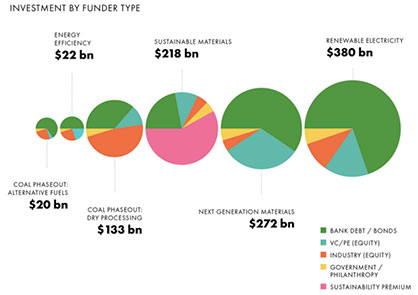
Financing mix across solution categories – Source: Aii and FFG analysis


“Reducing carbon emissions will be one of, if not the, defining challenge of our generation and indeed the fashion industry. The good news is that a strong pipeline of solutions – both disruptive and ready to be implemented – can drastically decarbonise the industry. This report highlights that not only are the opportunities plentiful and financially attractive, but they are key to getting us to a net-zero, circular industry.” – Katrin Ley – Managing Director, Fashion for Good

Though $1 trillion may appear to be substantial, the majority of this spend is allocated to projects that offer an attractive financial, as well as environmental, return on investment and can therefore be funded by financial capital. More than $35 trillion of financial capital is available globally for good return Environmental, Social, and Governance (ESG) investments, a figure expected to exceed $50 trillion by 2025 according to insights from Bloomberg Intelligence. However, critical barriers to unlocking the financial capital needed remain. With input from key industry stakeholders, the report highlights those barriers and presents examples of financing opportunities.

“This report reframes decarbonisation as an investment opportunity rather than a cost. These proven, investable solutions require a tremendous amount of capital, and we now need to create the pathways for all forms of financial capital in order to bring them to scale.” – Lewis Perkins – President, Apparel Impact Institute

The financing opportunity is multi-faceted and will require a committed and coordinated effort by brands, manufacturers, philanthropy, government, and industry organisations. The report splits up the amount of finance required per emission-reduction solution across the different financiers, appealing to different risk appetites and profiles, and providing a nuanced and detailed pathway to achieving net-zero.


“The fashion industry is becoming increasingly aware of its environmental impact and of the need to swiftly transition to net-zero. This report shows that, while there are challenges to overcome, this transition is possible and will open up new opportunities for businesses in this sector. Collective action is critical. The financial system must play its part by providing the investment to fund net-zero solutions at scale.” – Zoë Knight – Managing Director and Group Head of the HSBC Centre of Sustainable Finance

The full report, and findings can be downloaded and read here:

https://reports.fashionforgood.com/wp-content/uploads/2021/11/REPORT-Unlocking-The-Trillion-Dollar-Fashion-Decarbonisation-Opportunity-Fashion-for-Good-Aii.pdf
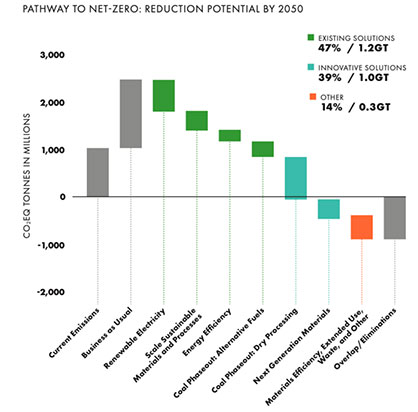

Solution Categories that enable a net-zero fashion industry – Source: Aii and FFG analysis


Some key findings from the report

• “Unlocking the Trillion-Dollar Fashion Decarbonisation Opportunity” estimates 47% of CO2 reductions come from implementing existing solutions, while 39% comes from scaling innovative solutions, and 14% from other solutions – including reducing overproduction, material efficiency improvements, and scaling circular business models.

• The report evaluates 7 solutions to reach net-zero in the fashion industry by 2050, including a shift to renewable energy, sustainable materials and processes, accelerating the development of next generation materials, and phasing out coal, amongst others.

• The total cost to implement these solutions and achieve net-zero is $1.04 trillion, including:

- $639 billion towards existing solutions (61%)

- $405 billion towards innovative solutions (39%)

• Philanthropic and government grants represent $50 billion (only 5% of the total), but are critical for catalysing industry and financial capital

• The report covers insights, key actions and recommendations to unlock the $1 trillion financing opportunity, including:

- the cost breakdown by financier groups needed to accelerate the transition to a net-zero industry.

- for governments to strengthen policy framework and mechanisms to catalyse private investment.

- for philanthropies to encourage coordination and explore blended capital approaches.

- for brands to pursue stronger engagement and commitment to innovation and suppliers

- for manufacturers to adopt a strategic capital improvement plan that is aligned with brand partners

- for banks and lenders to prioritise key production regions and innovative financing opportunities

- for equity investors to become familiar with the increasingly large array of investment opportunities.

More News from TEXDATA International

#Texprocess 2026

Texprocess 2026: Automation, digitalisation and AI redefine textile processing

Making investment decisions in textile processing has become significantly more demanding. Increasing energy costs, a shortage of skilled labour and ongoing geopolitical uncertainties are compelling companies to focus on technologies that deliver clear gains in efficiency and process reliability. This applies equally to apparel manufacturing and to the processing of technical textiles and high-performance materials. As a result, modernisation initiatives are assessed more carefully – even as the need to upgrade production systems continues to intensify.

#Techtextil 2026

Techtextil 2026: Between innovation pressure & market reality

From 21 to 24 April 2026, Techtextil in Frankfurt am Main will once again become the central meeting point for the international technical textiles and nonwovens industry. Running in parallel, Texprocess will focus on the industrial implementation of textile processing technologies as the leading platform in this field. Together, the two trade fairs form a closely integrated presentation and working platform along the entire textile value chain – from material development to finished applications.

#Techtextil 2026

Between geopolitical pressure and industrial resilience

In this interview, Dr. Janpeter Horn (VDMA) discusses the current challenges facing textile machinery manufacturers, shaped by geopolitical tensions, regulatory developments and subdued investment. He also outlines why innovation strength, integrated solutions and strategic positioning remain key to global competitiveness.

#Texprocess 2026

Between investment restraint and modernization pressure

Texprocess 2026 takes place in a complex market environment shaped by uncertainty and innovation pressure. In this interview, Elgar Straub (VDMA) explains why the trade fair is particularly relevant this year and which technologies are driving efficiency and competitiveness.

More News on Sustainability

#Sustainability

A new standard to combat plastic waste in forests

With DIN SPEC 35808 “Tree Shelter for Forestry Applications,” the testing and research service provider Hohenstein, in collaboration with Rottenburg University of Forestry, as well as forestry authorities and industry partners, has established a clear framework for bio-based and fully biodegradable tree shelters. The pre-standard defines requirements and practical testing methods designed to reduce plastic waste in forests and strengthen the long-term protection of soil and the environment.

#Recycling / Circular Economy

Europe’s textile future at a turning point: New 2030 Circularity Blueprint aims to scale recycling and unlock investment opportunities

The EU textile system is at a critical crossroads. Today, less than 1% of discarded garments are recycled into new garments, despite EU-wide obligations for separate collection. In response, Global Fashion Agenda (GFA) is launching the 2030 Circularity Blueprint, in partnership with ReHubs. This ambitious initiative is designed to support the transformation of the EU textile ecosystem to advance textile-to-textile recycling and drive the transition to a circular economy.

#Sustainability

Number of GOTS-certified facilities grow 15% globally as demand for credible sustainability standards continues to strengthen

Global Organic Textile Standard (GOTS) certification continued to grow in 2025, with nearly 18,000 certified facilities worldwide, despite ongoing geopolitical uncertainty and rapidly evolving regulatory requirements across global textile supply chains.

#Sustainability

bluesign technologies introduces bluepass

bluesign technologies ag (www.bluesign.com) today announces the launch of bluepass, a new certification mark and product labeling system created to deliver clear, substantiated, and verifiable sustainability claims at scale.

Latest News

#Research & Development

Walter Reiners Foundation Prize awarded to three ITA graduates

Sabina Dann, Lukas Balon and Annegret Storm from the Institut für Textiltechnik (ITA) of RWTH Aachen University were awarded the Walter Reiners Foundation Prize by the German Engineering Federation (VDMA) for their master’s and bachelor’s theses. Peter Dornier, Chairman of the Walter Reiners Foundation, presented the awards during Techtextil at the VDMA stand in Frankfurt am Main, Germany.

#Textiles & Apparel / Garment

New sourcing regions and sustainable solutions shape Texworld Paris 2026

From August 31 to September 2, 2026, Texworld Apparel Sourcing Paris will once again bring together all international players in textiles and apparel at the Paris-Le Bourget Exhibition Center.

#Nonwovens

FILTECH 2026: Neumag Nonwoven showcases technologies for meltblown and spunbond

Under its Neumag brand, Barmag will present its technologies for the production of nonwovens for filter media at this year’s FILTECH. From June 30 to July 2, the company will be represented at the Cologne trade fair in Hall 8, Booth E68.

#Texprocess 2026

AMANN reviews successful Texprocess 2026 and highlights innovations for circularity and performance

AMANN Group has drawn a positive conclusion following four successful days at Texprocess 2026 in Frankfurt. The company highlighted the many inspiring discussions, valuable exchanges, and new connections established with partners, customers, and industry experts during the event.

TOP