[pageLogInLogOut]

#Sustainability

Teijin Aramid reduces Twaron® carbon footprint by 28%

The recently conducted Life Cycle Analysis (LCA) shows that Teijin Aramid has improved the carbon footprint of Twaron® by 28% compared to 2014. The reduction is the result of years of focus on sustainability, process improvements and the transition to 100% renewable electricity.

For Teijin’s customers, this improvement means that the ecological footprint of their products also improves. The LCA study has been externally reviewed and conducted according to the applicable ISO standards 14040 and 14044.
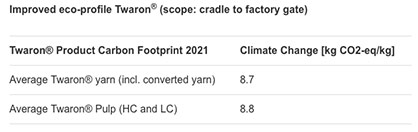

The EU product environmental footprint (PEF) version 2.0 environmental impact categories are used to determine the Climate change impact.

Twaron® intrinsically possesses sustainable properties, such as its light weight, long service life and strength. With the help of the Customer Benefit Model (CBM) developed by Teijin, the customer benefit of using Twaron in a particular application can be calculated economically and environmentally. Reducing the footprint improves this benefit even more. The CBM is a TÜV-certified calculation model in which, together with customers and supply chain partners, the financial and ecological benefits of using Twaron® are independently calculated.

Peter ter Horst, CEO Teijin Aramid: “We are convinced that we are on the right path to a zero footprint by 2050. By using Twaron®, the end product inherently becomes more sustainable because it lasts longer and is lighter. If we continue to make the production of Twaron® more sustainable, for example by consuming less energy, investing in green energy and recycling more, we will directly contribute to a better world for future generations.”


Collaboration in the chain?For decades Teijin Aramid has been recyclingT waron®. Currently, significant investments are being made into pilots to expand physical, chemical and mechanical recycling. The ambition is to recover even more material from the market to avoid incineration and landfill of waste containing aramid. Advanced recycling techniques allow the raw material to be reused, which further reduces the carbon footprint substantially over time. Teijin is committed to closing the loop with new logistical partnerships to recover the material from the market.

The 2020 sustainability report provides more information on how Teijin is living up to its commitment to ‘zero emission’.

https://www.teijinaramid.com/en/sustainability/sustainability-report-2020/


More News from Teijin Aramid

#Yarn & Fiber

Teijin Aramid: Taiichi Machida to succeed Peter ter Horst as CEO

Peter ter Horst will step down as Chief Executive Officer at the end of 2025, after 19 years of dedicated service. Effective October 1, 2025, Taiichi Machida will take over as CEO.

#Yarn & Fiber

Teijin announces availability of DPP-compliant products aligned with Europe’s ESPR Environmental Regulation

Teijin Limited announced today that it has started rolling out initiatives to enable aramid fibers and carbon fibers to be accompanied by Digital Product Passport (DPP) technology, which enhances supply chain transparency by verifying the origins of materials and supporting sustainability claims. The company is using the supply chain traceability system from Netherlands-based Circularise B.V., in which Teijin has invested since November 2024, to develop DPPs for each product.

#Composites

Teijin Carbon showcases new eco-friendly Tenax Next™ R2S 513 6mm short carbon fiber at JEC World 2025

Teijin Carbon, a leading manufacturer of carbon fiber products, is presenting its latest development in sustainable materials at JEC World 2025 (hall 6, G22). New Tenax Next™ R2S 513 6mm is a short carbon fiber product in rice-shaped form for reinforcing thermoplastic compounds that not only offers exceptional performance characteristics but also reinforces the company’s commitment to environmental responsibility and circularity.

#Recycling / Circular Economy

Teijin to invest in Circularise B.V. and adopt its supply chain traceability platform to promote the Circular Economy

Teijin Limited announced today that it will invest in Circularise B.V., a company based in The Hague, Netherlands, which develops product traceability management systems using blockchain technology. Teijin will also implement Circularise’s software to improve visibility into its global supply chain. Circularise’s proprietary “Smart Questioning”(*) solution, which utilizes Zero-Knowledge Proof (ZKP) technology, provides both anonymity and transparency to ensure a highly reliable product traceability system.

More News on Sustainability

#Sustainability

GOTS version 8.0 released: advanced supply chain accountability, from fibre to finished product

Global Standard is pleased to announce the release of GOTS Version 8.0, the latest update to the world's leading processing standard for organic textiles. The updated Standard strengthens requirements for air emissions and waste management, as well as criteria for product safety. It introduces new provisions on circularity, microfibre management and updates in residue testing. Version 8.0 also elevates due diligence obligations and formalises governance requirements, including ESG disclosure, anti-corruption policies and conflict-of-interest safeguards, to support credible, responsible business conduct.

#Sustainability

The nova-Institute establishes new Renewable Feedstock Department to lay the groundwork for industrial defossilisation

The transition from fossil-based to renewable carbon – sourced from biomass, CO₂ utilisation and recycling – is the cornerstone of a climate-neutral chemical industry. The nova-Institute’s new department is dedicated to providing the essential data, analyses and strategic roadmaps required to secure a reliable future feedstock supply and make this transition a commercial and ecological reality.

#Sustainability

Textile Exchange unveils commitment-based pathway for members to accelerate responsible raw material production

Textile Exchange has unveiled further details about its new membership structure, designed to guide the fashion, textile, and apparel industry in a collective course of action toward preferred production systems for raw materials and fibers.

#Textile chemistry

Jeanologia urges industry to accelerate PP Spray phase-out following ZDHC Watchlist update

Potassium permanganate has officially entered the Chemical Watchlist of the ZDHC Foundation, signaling increased scrutiny and potential phase-out of one of the most hazardous chemicals still used in denim finishing. The inclusion confirms an industry shift that Jeanologia anticipated more than a decade ago.

Latest News

#Techtextil 2026

Smart sensors, smart savings - Reducing energy and cost in textile finishing

As energy prices, sustainability requirements and quality expectations continue to rise, manufacturers of technical textiles face increasing pressure to optimize efficiency while ensuring process reliability. At the same time, skilled labor shortages require production systems that are intuitive, automated and easy to manage. PLEVA addresses these challenges with robust, maintenance-friendly sensor technologies combined with intelligent process control.

#Techtextil 2026

From preparation to 3D weaving: Stäubli’s solutions at Techtextil 2026

Stäubli, a global leader in high performance weaving technologies, is pleased to announce its participation at Techtextil 2026 in Frankfurt, Germany, the leading international trade fair for technical textiles and nonwovens. As technical textiles continue their rapid expansion across demanding markets such as defense, mobility, aerospace, construction, energy… Stäubli will showcase innovative solutions designed to empower mills to produce the next generation of advanced fabrics. Stäubli will exhibit its trend-setting technologies at the Swiss Pavilion Booth B01.6 in Hall 12.0.

#Associations

Azerbaijan Textile Association (ATA) becomes member of ITMF

The Azerbaijan Textile Association (ATA) has officially become a Member Association of the International Textile Manufacturers Federation (ITMF), further strengthening Azerbaijan’s integration into the global textile value chain.

#Techtextil 2026

DIENES at Techtextil 2026: Flexible pilot lines for bio-based fiber development

The growing relevance of bio-based materials in technical textiles is accompanied by increasing demands for reproducibility, high-quality data, and scalable process routes. Especially when working with cellulose and its derivatives, chitosan, lignin-based approaches, or bio-based PAN as a carbon-fiber precursor, R&D teams face variable feedstock quality, tighter process windows, and the need for reliable comparability across trials. This calls for flexible, data-driven experimental setups that can be reconfigured efficiently when recipes, solvents, and raw-material batches change.

TOP