[pageLogInLogOut]

#Sustainability

Completed product module marks a major milestone for the Higg Index
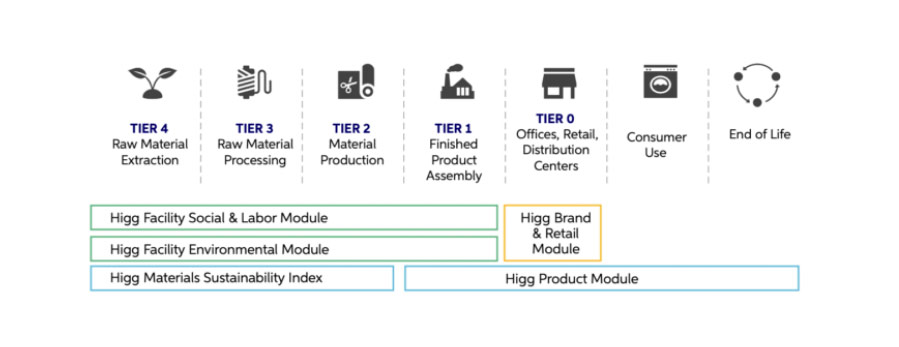
© 2021 Sustainable Apparel Coalition
The Sustainable Apparel Coalition (SAC), along with its technology partner Higg, announced the completion of a new tool that evaluates the comprehensive environmental impact of products. Brands and manufacturers can use the Higg Product Module (PM) to develop apparel, footwear, and other consumer goods products with lower sustainability impacts, from reduced water use to lower carbon emissions throughout the value chain.

Companies can also use the new tool to credibly communicate their performance, demonstrate progress towards sustainability and circularity goals, and address anticipated regulation. 

The Higg PM is one of five tools in the Higg Index suite of tools developed by the SAC for the standardized measurement of value chain sustainability. There are two product-specific tools in the suite: the Higg Materials Sustainability Index (MSI) and the Higg PM. While the Higg MSI assesses cradle to gate, the Higg PM will expand to measure cradle to grave impacts, including end-of-life, providing designers, developers, and sustainability experts directional guidance on how to improve the environmental footprint of a product they’re designing. 

“We are moving beyond a ‘materials-only’ view of product impact. Now that the Higg Product Module is complete, the tool will consider design, manufacturing, packaging, logistics, excess production, product durability, care, and end of use, delivering a full view of a product’s comprehensive environmental impacts,” explains Jeremy Lardeau, VP of Higg Index for the Sustainable Apparel Coalition.

More than 150 companies have already used the Higg PM to assess over 1,000 products. With this launch, the full Higg Index suite of tools is complete, which is central to the SAC’s mission to transform businesses for exponential impact. As companies commit to science-based corporate sustainability goals, the Higg PM will help them understand their holistic sustainability performance and enable progress towards circularity goals. 

“PEARL iZUMi couldn’t be more pleased with the tools and data provided from the Higg Index,” says Aaron Kutzer, Senior Manager, Retail Division, Pearl iZUMi. “The Higg Product Module and the detailed data it delivers inspired our new Pedal to Zero program which allows our customers to do what they love — ride bikes for fun, fitness, transportation and arguably, sanity — and now, also to purposefully offset the environmental impacts of the products they use. By scaling the Higg PM, we can achieve our evolving corporate responsibility goals and even enlist our customers to help do the same.”

As corporate sustainability goals evolve, consumers and regulatory bodies expect the consumer goods industry to become more transparent. Brands need credible data that paints a full picture of their impact from the products they design to how those products are made. The product tool was developed with these expectations in mind and can help companies prepare for anticipated legislation. For organizations with an EU presence, the Higg product tool is designed to evolve and aims to align with future EU PEF Apparel & Footwear Methodology. 

“The Product Module is a game changer for member companies and the industry at large. It gives the industry a  credible tool to assess cradle-to-grave impacts of products, supporting ambitious sustainability goals and preparing users to fulfill future regulatory requirements. It also marks an important milestone for the SAC, completion of the Higg Index, and opens a new chapter in our sustainability journey towards collective action and industry transformation,” says Amina Razvi, Executive Director of the SAC.


In response to increasing expectations, companies continue to step up climate change commitments and initiatives and need tools to accurately and credibly report on their progress. Many focus on reducing carbon emissions as a starting point, in line with global efforts such as the Paris Agreement or the Science Based Targets Initiative. Brands can use the new Higg PM to assess their supply chain Scope 3 category emissions from purchased goods and services as well as the impacts from the use of sold products and the end-of-life treatment of sold products, for a comprehensive carbon footprint assessment that can be scaled across its products.

“For any company planning to track their Scope 3 emissions, Higg MSI and Higg PM would be the best starting point to obtain high-level sources of product level, material level or yarn level emission information. The new Higg PM, now equipped with the cradle to gate data, allows companies to estimate the downstream product use level impacts. MAS uses the Higg PM because of the standardized impact measurements. Standardisation will enable direct and faster analysis and help to identify hotspots in products that need further Life Cycle Impact Analysis. With this data, we have started discussions with our customers and supply chain on how to collectively improve product criteria to mitigate climate risk and other environmental impacts. These discussions have enabled us to develop relationships with customers who seek solutions to improve the environmental performance of their product portfolio,” says Dhanujie Jayapala, Environmental Sustainability Manager for MAS Holdings.

Following today’s announcement, consumer goods industries can move beyond simply measuring disparate environmental impacts of products, an important step towards meaningful consumer-facing sustainability claims, another area the SAC is focused on in partnership with Higg, as revealed by the rollout of Sustainability Profiles scorecards last month.

“We are seeing a dramatic rise in conscious consumerism and ESG investing, paired with expanding supply chain regulation. The SAC launched the first phase of our transparency program in May 2021 to help provide shoppers with unprecedented visibility into a product’s impact on the planet and its people. With the Product Module complete, we are one step closer to transforming the industry by helping companies develop more sustainable products, prepare for future regulations, and communicate their performance credibly to consumers to help them make more informed decisions,” says Amina Razvi.

More News from TEXDATA International

#Techtextil 2026

Performance Apparels: Functional textiles drive innovation at Techtextil 2026

From high-performance fibres and advanced membranes to smart textiles and sustainable material concepts – functional apparel is becoming one of the most dynamic innovation fields in technical textiles. At Techtextil 2026, exhibitors demonstrate how new materials, finishing technologies and digital functions are shaping the next generation of protective, workwear and outdoor systems.

#Texprocess 2026

Texprocess 2026: Automation, digitalisation and AI reshape textile processing

Investment decisions in textile processing have become increasingly complex. Rising energy prices, labour shortages and geopolitical uncertainties are forcing companies to prioritise technologies that deliver measurable improvements in efficiency and process stability. This applies not only to apparel production, but also to the processing of technical textiles and high-performance materials. Modernisation projects are therefore being evaluated more selectively – but the pressure to upgrade production systems continues to grow. Texprocess 2026 reflects this tension between cautious investment behaviour and increasing technological demand.

#Techtextil 2026

Textile Chemicals & Dyes: Innovation in Textile Chemistry moves into focus at Techtextil 2026

From PFAS-free finishes and water-saving dyeing technologies to advanced coatings and recycling-compatible formulations, innovation in textile chemistry is accelerating across the industry. Reflecting this development, Techtextil 2026 introduces Textile Chemicals & Dyes as a dedicated product segment, highlighting the growing role of chemical solutions in shaping the next generation of technical textiles.

#Recycling / Circular Economy

textile.4U publishes special edition “Top 100 Textile Recycling Companies 2025”

With a comprehensive 176-page special edition, textile.4U is dedicating its latest issue entirely to one of the most dynamic and influential topics in today’s textile industry: textile recycling. The new issue, published exclusively in high-quality print, presents the Top 100 textile recycling companies researched and selected by TexData – organizations that already play a key role in the transition to circular textiles or are expected to have a significant impact in the near future.

More News on Sustainability

#Natural Fibers

Global Standard gGmbH launches second public consultation for GRTS Draft 2 for the textile industry (1–30 April 2026)

Global Standard gGmbH is pleased to announce the release of Draft 2 of the Global Responsible Textile Standard (GRTS) for its second public consultation. The consultation will be open from 1 April 2026 to 30 April 2026, inviting stakeholders across the textile and apparel value chain to provide input and contribute to the further development of this new Standard.

#Sustainability

Practical toolkit to drive coordinated climate action launched

An open-access workshop toolkit enables brands, suppliers, policymakers and investors across the textile industry to apply the System Map in their own work, identifying leverage points to halve emissions and enable a just transition.

#Raw Materials

Textile Exchange publishes cotton Life Cycle Assessment study to strengthen impact data

Textile Exchange has published the first in a series of seven Life Cycle Assessment (LCA) studies designed to improve the quality and robustness of environmental impact data for raw material production across the fashion, textile, and apparel industry. The first LCA study focuses on cotton and addresses critical data gaps and methodology variability through new high-quality data across key producing countries. The study includes organic, regenerative, recycled, and country averages for conventional cotton production systems, providing a clearer picture of the associated environmental impact.

#Sustainability

Experts publish APAC policy priorities

Cascale today announced the publication of its APAC Policy Priorities Paper, developed by the Asia-Pacific (APAC) Policy Member Expert Team (MET) to identify key regional sustainability challenges and provide practical, aligned recommendations for policymakers and industry stakeholders across Asia-Pacific.

Latest News

#Raw Materials

New study shows low environmental impact by Cotton made in Africa Organic Cotton from Tanzania

Today, the Aid by Trade Foundation (AbTF) is announcing the results of a comprehensive life-cycle analysis (LCA) for cotton produced in Tanzania under the Cotton made in Africa Organic (CmiA Organic) standard. The study emphasises the small ecological footprint of CmiA Organic verified cotton. This can largely be traced back to the absence of synthetic pesticides, artificial fertilisers, and artificial irrigation. Consequently, CmiA Organic cotton can help the textile industry meet regulatory requirements as well as science-based targets. The results also show that the consequences of climate change threaten the livelihoods of these cotton farmers, even though the type of agriculture they practise barely contributes to climate change.

#Raw Materials

Better Cotton Initiative strengthens regenerative focus in standard update

The Better Cotton Initiative (BCI) has strengthened the regenerative focus of its field-level standard with the launch of a new version of its Principles & Criteria (P&C), which marks the next step in the organisation’s journey to becoming a regenerative standards system.

#Man-Made Fibers

Selenis and Kintra Fibers partner to scale 100% bio-based synthetic fiber technology

Selenis, a leading global specialty polyester manufacturer, today announced a strategic manufacturing partnership with materials science company Kintra Fibers to scale Kintra’s patented fiber-grade PBS resin - a 100% bio-based and biodegradable material designed for textile applications.

#Functional Fabrics

PERFORMANCE DAYS proves its relevance as the industry’s key meeting point

Held on March 18–19, 2026, PERFORMANCE DAYS once again confirmed its position as a leading international platform for functional textiles. A total of 3.366 trade visitors and around 560 exhibitors gathered in Munich, with the event already kicking off successfully on DAY 0, which received highly positive feedback for its interactive format. Despite challenging conditions caused by the public transport strike in Munich, the event saw strong attendance and a consistently high level of activity across both exhibition days.

TOP