[pageLogInLogOut]

#Sustainability

Now Open: The Redress Expo at Fashion for Good
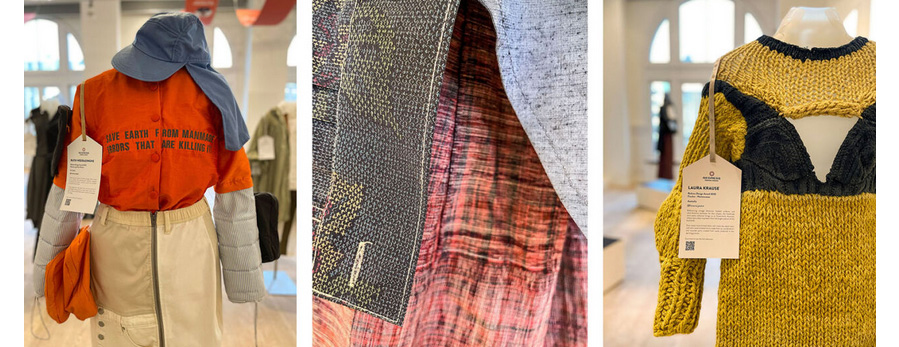
LOOKS FROM THE REDRESS 2020 FINALISTEN: RUTH WEERASINGHE, LE NGOC HA THU, LAURA KRAUSE © 2020 Fashion for Good
Last year, dozens of emerging fashion talents competed for a final spot in the world’s largest sustainable fashion design competition – Redress Design Award – and starting today, the winning looks of 2020 can be seen in a new exhibition at the Fashion for Good Museum. The competition is celebrating its tenth anniversary this year, which is why the work of a number of successful alumni has been added to the exhibition. Alumni looks and products are also sold exclusively in the Fashion for Good museum shop.

Due to the current COVID measures, the museum is physically closed, but virtually open! From today, this new exhibition can be viewed through an extensive personal digital tour.

WEBINAR

The previously communicated opening event has been moved to January 11, 2021 at 7:00 PM (CET). On this day, fashion expert Susie Lau (Stylebubble), Redress founder Christina Dean and Dutch finalist Gönül Yigit will come together to discuss the positive impact designers can have on the fashion industry. How can you change the industry by thinking (and acting) differently? And how do you combine creativity and sustainability?

TEN YEAR ANNIVERSARY OF REDRESS

The Redress Design Award is celebrating its tenth anniversary this year and in honour of this, the exhibition at the Fashion for Good Museum in Amsterdam will not only show the creations of the finalists from 2020, but also a selection of the most special works from previous years. All looks are created with zero-waste, up-cycling and reconstruction techniques and made by emerging designers from all over the world. 

IN THE GOOD SHOP

Alumni designer Pat Guzik, graduated in Fashion Design from the Krakow School of Arts and Fashion Design, where she now teaches sustainable fashion, and also holds a degree in Philosophy and Sociology from the Pedagogical University of Krakow in Poland. In 2016 she won the Redress Design Award and in 2020 the Alumni All Star Prize. Her zero-waste streetwear designs make use of unique patterns that eliminate waste, are produced locally with unique hand drawn graphics by Polish illustrator Mateusz Kolek, can be found on display and for sale in the museum shop.


Womenswear Redress 2020 winner Garcia Bello has a postgraduate degree in Sportswear from the University of Buenos Aires, Argentina and founded her own brand Garciabello. Juliana currently lives in the Netherlands and won the Fashion Makes Sense Award in 2019. On sale in the museum shop, this collection of genderless and resizable garments are made from donated and old clothing that is combined with organic cotton and uses two types of zero-waste patterns; one which creates standardised garments, while the other makes the most of fabric rolls to create elaborate, unique pieces from textile scraps. 
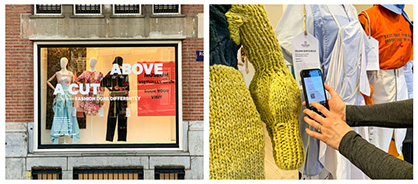
© 2020 Fashion for Good


TOURS

Virtual tours of the museum with an exclusive look at this exhibition will be available worldwide from December 17 (to February 17) and tickets can be booked at www.fashionforgood.com/tickets. These tours are conducted in English with a personal guide.

For current opening times of the Fashion for Good Museum, visit www.fashionforgood.com/experience – the building is currently closed in alignment with our local RIVM guidelines and the doors will reopen on January 19, 2021.

All the garments in the Fashion for Good Experience are carefully styled on mannequins from Mannequino, the world’s first modular mannequin designed for a circular economy.




More News from TEXDATA International

#ITM 2026

ITM 2026: The new geography of textile production

New production hubs are emerging across North Africa and Central Asia, while Türkiye is accelerating its transformation toward higher-value, technology-driven and more sustainable textile manufacturing.

#Research & Development

“Production is a product”

From technical textiles and AI-driven robotics to the limitations of textile circularity: Professor Dr Thomas Gries looks back on more than two decades of development at ITA Aachen. In the interview, he explains why production technology remains a decisive success factor, discusses international collaborations and innovation ecosystems, and shares his views on the transformation of production landscapes and the challenges facing an increasingly regulated industry.

#Knitting & Hosiery

“We need to move away from the price trap and return to a value-driven mindset.”

With its new Textile Innovation Center, KARL MAYER is sending a strong signal for innovation, collaboration, and the future of textile applications. In this interview, Karl Josef Mayer discusses new opportunities in warp knitting, the processing of staple fibres, recycling, the changing role of machinery manufacturers, and why the textile industry must once again focus more strongly on the value of textiles. by Oliver Schmidt

#Associations

“Innovation, resilience and international experience remain the great strengths of the Swiss textile machinery industry”

Geopolitical uncertainty, growing competitive pressure from China, new free trade agreements and the shift towards a circular economy are currently reshaping the global textile industry. In this interview, Cornelia Buchwalder discusses the current mood within the Swiss textile machinery sector, the industry’s distinctive innovative strength, new market opportunities in India and Asia, and the technological trends that could shape the upcoming trade fair cycle leading up to ITMA 2027.

More News on Sustainability

#Textiles & Apparel / Garment

Catalyst Club launches in Florence: Where conversations become catalysts for change

The first chapter of Catalyst Club debuted in Florence, bringing together creative directors, entrepreneurs, manufacturers, journalists and innovators from across the fashion and textile industry for an evening of dialogue, exchange and connection.

#Sustainability

Renewables lower energy prices and play key role to reduce vulnerability to fossil fuel supply shocks

Renewables lower energy prices and play key role to reduce vulnerability to fossil fuel supply shocks Boosting the use of homegrown renewable electricity is Europe’s best way to reduce its vulnerability to volatile international energy supplies and rising energy prices according to a European Environment Agency (EEA) assessment published today.

#Recycling / Circular Economy

HKRITA signs MoU with Jeanologia and Looptworks to establish the Green Machine Circular Textile Ecosystem

The Hong Kong Research Institute of Textiles and Apparel (HKRITA) yesterday officially signed a landmark Memorandum of Understanding (MoU) with two key global partners, Jeanologia and Looptworks, to establish the Green Machine Circular Textile Ecosystem – a first-of-its-kind collaboration to accelerate the large-scale recycling of blended textiles.

#Sustainability

Textile Exchange unveils agenda for 2026 conference in Vancouver

Textile Exchange has released the agenda for its 2026 Conference, which will take place from October 12–16 in Vancouver, Canada. Under the theme “The Implementation Era,” the event will focus on translating sustainability commitments into practical action and scaling solutions across businesses, supply systems, and landscapes.

Latest News

#Dyeing, Drying, Finishing

Ferraro S.p.A. acquires the “Finishing” business unit of Cibitex S.r.l.

Ferraro S.p.A. and Cibitex S.r.l. are pleased to announce the completion of the agreement pursuant to which Ferraro S.p.A. has acquired the “Finishing” business unit of Cibitex S.r.l., specialized in the development and manufacturing of technological solutions for textile finishing.

#Recycling / Circular Economy

Reju opens its first R&D Center in the U.S. in Conshohocken, Pennsylvania

Reju, the company specializing in textile regeneration, today announced the opening of a Research and Development (R&D) Center in Conshohocken, Pennsylvania, the company's first proprietary research center in North America. Located within Technip Energies' existing Advanced Materials and Catalysts research center, the lab will allow Reju to accelerate the rollout of its recycling technologies and develop its next-generation circular solutions.

#Weaving

Itema reaffirms its commitment to the Syrian textile industry at NasTex 2026

From July 18th to 21st, Itema will exhibit at NasTex at the Damascus Fairground (Hall 11 – Stand C02), marking its return to one of the Middle East’s historically significant textile markets. Itema will showcase advanced weaving technology designed to support the competitiveness and technological evolution of Syrian manufacturers and announces a new partnership with Growfast Agency as the sole agent of Itema in Syria.

#Knitting & Hosiery

KARL MAYER's HKS 2-SE Expands Possibilities for Premium Stretch WARP KNITS

Warp knitted fabrics with a woven look are more in demand than ever in the fashion and apparel industries. Stretch WARP KNITS, in particular, impress with their freedom of movement, breathability, and virtually wrinkle-free wear – thereby opening up new style worlds such as smart casual or business casual. When it comes to the highly efficient production of premium-quality stretch WARP KNITS, the HKS 2-SE has long been the machine of choice. KARL MAYER’s best-selling tricot machine produces standard elastic fabrics characterized by high gauges, smooth, delicate surfaces, and a soft hand feel.

TOP