[pageLogInLogOut]

#Sustainability

VF Corporation and its Timberland® Brand collaborate with Redress to support the next generation of sustainable fashion designers

VF Corporation (NYSE: VFC), a global leader in branded lifestyle apparel, footwear and accessories, together with its Timberland® brand, today announced a collaboration with environmental charity Redress for the Redress Design Award 2020. Through the collaboration, VF and the Timberland® brand will lend their experience and expertise in sustainability to support the education and professional development of the industry’s next generation of sustainable fashion designers and champion the move toward a circular economy.

Celebrating the competition’s 10th anniversary, the Redress Design Award 2020 is the world’s largest sustainable fashion design competition which works to educate emerging fashion designers from around the world about sustainable design concepts and techniques.

As consumer interest in sustainable apparel continues to rise, VF is challenging some of the industry’s most promising young talents to disrupt the status quo and drive circularity and sustainability across the industry.

“Our collaboration with Redress, now in its second year, connects us to talented, emerging designers who are passionate about creating fashionable, compelling designs with environmental responsibility in mind,” said Kevin Bailey, VF’s Executive Vice President and Group President, Asia Pacific Region and Emerging Brands. “We are constantly inspired by their commitment to circular design and creativity. These are the future leaders who are going to help drive lasting and positive change throughout our global industry and we are proud to be part of their journey.”

While the Redress Design Award 2020 was held virtually this year on September 3, its impact has been seen worldwide. The 10 finalists were supported by an international judging panel that included VF’s Kevin Bailey and British fashion designer and Timberland® creative director Christopher Raeburn. The Menswear Category prize winner, Ngoc Ha Thu Le who is currently a fashion designer at Magenta Vintage in Hanoi, Vietnam, will collaborate with the Timberland® brand to develop a sustainable capsule collection for sale at retail. The release of the collection will coincide with the Chinese New Year 2022 and will be inspired by the Year of the Tiger.

“Timberland® believes that a greener future is a better future, which makes our partnership with Redress such a natural fit,” said Mahmoud Salahy, Vice President and Managing Director, Timberland® Asia Pacific. “As a brand that’s deeply committed to environmental and social responsibility, Timberland® strives to not only minimize our impact on the planet through the products we make, but we’ve set a bold goal for all our products to have a net positive impact on nature by 2030. We are incredibly excited about the journey ahead and hope to inspire the industry as a whole to work together and positively shape our collective future.”


In the leadup to the Redress Design Award 2020 Grand Final, VF and the Timberland® brand hosted the “Made for Change Timberland® Challenge” on August 31, 2020. With guidance from VF and Timberland® subject matter experts, emerging designers competed to develop the most innovative and sustainable design concept for a range of iconic Timberland® products. Fashion designers Ruth Weerasinghe from Sri Lanka, Inhwa Jin from South Korea and Beatrice Bocconi from Italy were selected as winners of the challenge for their multi-purpose accessories concept that enhances product sustainability.

“The Redress Design Award equips fashion’s future leaders with real-life sustainability knowledge to give them the best chance to make a bigger positive impact during their long careers ahead. Our close partnership with VF, who connected participants with their exceptional team, provides designers with real-industry context to fast-track their sustainability journeys,” said Christina Dean, Redress Founder/Chair and The R Collective Founder/CEO.

Key highlights of the Redress Design Award 2020 Grand Final and the “Made for Change Timberland® Challenge” will later be available on: https://www.youtube.com/user/RedressAsia. Stay tuned.
More News from TEXDATA International

#ITM 2026

ITM 2026: The new geography of textile production

New production hubs are emerging across North Africa and Central Asia, while Türkiye is accelerating its transformation toward higher-value, technology-driven and more sustainable textile manufacturing.

#Research & Development

“Production is a product”

From technical textiles and AI-driven robotics to the limitations of textile circularity: Professor Dr Thomas Gries looks back on more than two decades of development at ITA Aachen. In the interview, he explains why production technology remains a decisive success factor, discusses international collaborations and innovation ecosystems, and shares his views on the transformation of production landscapes and the challenges facing an increasingly regulated industry.

#Knitting & Hosiery

“We need to move away from the price trap and return to a value-driven mindset.”

With its new Textile Innovation Center, KARL MAYER is sending a strong signal for innovation, collaboration, and the future of textile applications. In this interview, Karl Josef Mayer discusses new opportunities in warp knitting, the processing of staple fibres, recycling, the changing role of machinery manufacturers, and why the textile industry must once again focus more strongly on the value of textiles. by Oliver Schmidt

#Associations

“Innovation, resilience and international experience remain the great strengths of the Swiss textile machinery industry”

Geopolitical uncertainty, growing competitive pressure from China, new free trade agreements and the shift towards a circular economy are currently reshaping the global textile industry. In this interview, Cornelia Buchwalder discusses the current mood within the Swiss textile machinery sector, the industry’s distinctive innovative strength, new market opportunities in India and Asia, and the technological trends that could shape the upcoming trade fair cycle leading up to ITMA 2027.

More News on Sustainability

#Textiles & Apparel / Garment

Catalyst Club launches in Florence: Where conversations become catalysts for change

The first chapter of Catalyst Club debuted in Florence, bringing together creative directors, entrepreneurs, manufacturers, journalists and innovators from across the fashion and textile industry for an evening of dialogue, exchange and connection.

#Sustainability

Renewables lower energy prices and play key role to reduce vulnerability to fossil fuel supply shocks

Renewables lower energy prices and play key role to reduce vulnerability to fossil fuel supply shocks Boosting the use of homegrown renewable electricity is Europe’s best way to reduce its vulnerability to volatile international energy supplies and rising energy prices according to a European Environment Agency (EEA) assessment published today.

#Recycling / Circular Economy

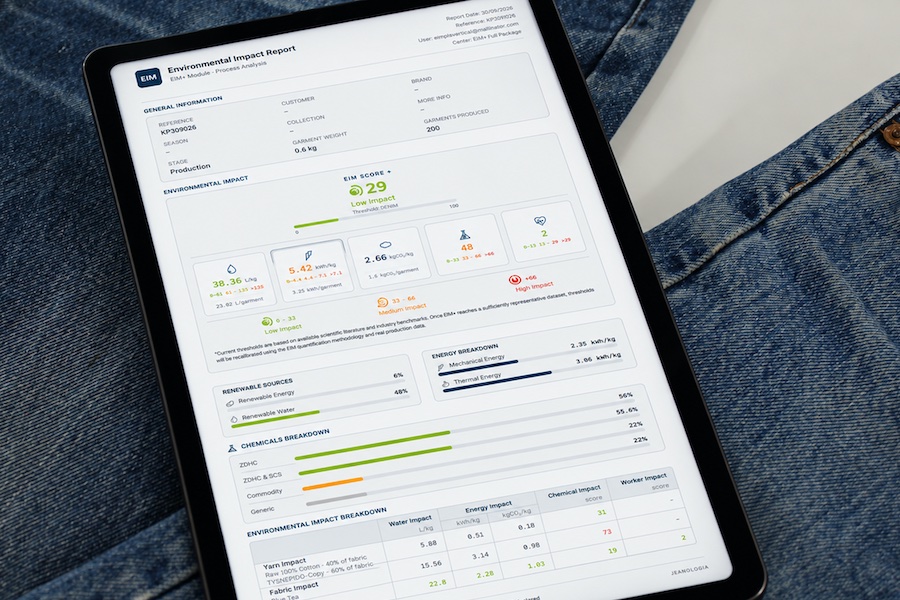
HKRITA signs MoU with Jeanologia and Looptworks to establish the Green Machine Circular Textile Ecosystem

The Hong Kong Research Institute of Textiles and Apparel (HKRITA) yesterday officially signed a landmark Memorandum of Understanding (MoU) with two key global partners, Jeanologia and Looptworks, to establish the Green Machine Circular Textile Ecosystem – a first-of-its-kind collaboration to accelerate the large-scale recycling of blended textiles.

#Sustainability

Textile Exchange unveils agenda for 2026 conference in Vancouver

Textile Exchange has released the agenda for its 2026 Conference, which will take place from October 12–16 in Vancouver, Canada. Under the theme “The Implementation Era,” the event will focus on translating sustainability commitments into practical action and scaling solutions across businesses, supply systems, and landscapes.

Latest News

#Spinning

Ibrahim Fibres and Trützschler: A strong partnership enters its next phase with the TC 30Si

For more than two decades, Ibrahim Fibres and Trützschler have grown side by side, driven by a shared ambition to continuously improve spinning performance, strengthen technology leadership and set new benchmarks in the textile industry. Today, Ibrahim Fibres is a leading yarn and polyester staple fiber manufacturer in Pakistan. The company operates the largest number of Trützschler cards in the country, with more than 200 machines running across its mills in Faisalabad, and plays an important role in one of Asia’s largest textile industries.

#Digital Printing

USColorworks expands digital platform with Kornit Atlas MATRIX and Atlas MAX PLUS solutions

Kornit Digital Ltd. (NASDAQ: KRNT), a global pioneer in sustainable, on-demand digital fashion and textile production, today announced that USColorworks, a North Carolina-based apparel decoration and fulfillment company specializing in custom and on-demand printing for retail and promotional markets, has expanded its Kornit digital production platform with the addition of Atlas MATRIX and Atlas MAX PLUS systems to deliver high-quality, on-demand apparel across cotton, blended fabrics and polyester.

#Functional Fabrics

CovationBio introduces two new bio-based innovations at Functional Fabric Fair New York

Covation Biomaterials LLC (“CovationBio®”) is showcasing its two new bio-based innovations, Xatryx® and Sorona® elasterell-p fiber, at this year’s Functional Fabric Fair in New York City, July 7–9, 2026. Attendees can visit CovationBio at Booth #404 to explore this next generation of bio-based performance materials.

#Research & Development

Geotextiles made from recycled materials: GREEN leads the way into the industry

For the industry, recycled materials are creating new opportunities in geotextile production. In the GREEN project, the Fraunhofer Cluster of Excellence Circular Plastics Economy CCPE demonstrates that recycled polypro-pylene (PP), polyethylene terephthalate (PET), and high-density polyeth-ylene (HDPE) can be processed into nonwovens, fibers, and membranes that meet industrial requirements. This creates opportunities for use in existing production lines and new value chains in the geotextile market.

TOP