[pageLogInLogOut]

#Sustainability

H&M Foundation backs women garment workers in Bangladesh
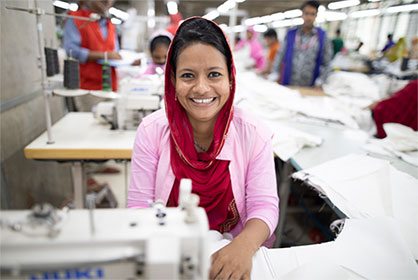
The non-profit H&M Foundation is initiating a long-term project to support women garment workers in Bangladesh, starting with their urgent needs connected to COVID-19. As a first step, 12 million SEK (1.3 million USD) is donated to WaterAid, CARE and Save the Children to provide around 76,000 young women, their families and community members in around Dhaka with emergency relief, also reaching 1 million people with messages on COVID-19 and hygiene practices. The H&M Foundation also calls for others to show their support.
Photo: CARE. Lipiya (20) is Senior Sewing Operator at a ready-made garment factory in Gazipur, Bangladesh.


Bangladesh has been identified by WHO as one of the 25 most vulnerable countries to be affected by the COVID-19 pandemic, with a high population density, poor infrastructure, weak health systems and low awareness of basic preventive measures. As the coronavirus is rapidly spreading within the country some high-risk areas are currently in lockdown to maintain social distancing and flatten the curve.

The textile sector is one of the largest contributors to the country’s GDP and the local and global effects of the pandemic has a great impact on textile workers within the garment industry. At the same time, the use of automation and digital technology is making its way into the textile industry, also creating a great risk of unemployment for millions of Bangladeshis.

Women are particularly at risk, as they represent the majority of the total workforce within the garment industry and are often employed to execute the tasks which are highly susceptible to automation. There is an urgent need to create a skilled female workforce to save jobs and create new job opportunities.


From urgent needs to long-term support

H&M Foundation is initiating a long-term project, running over several years, to support women garment workers in these excessive transitions, starting with their urgent needs connected to COVID-19. As a first step, they are donating 12 million SEK (USD 1,3 million) to WaterAid, CARE and Save the Children to provide 26,700 young women and their families in and around Dhaka with emergency relief, also reaching 1 million people with messages on COVID-19 and hygiene practices.

“We will directly support women and their families with for example cash assistance for food, medication and other necessities, provide COVID-19 awareness raising and testing, hygiene materials and handwashing facilities. We hope to see more donors show their support in different ways", says Carola Tembe, Program Manager, H&M Foundation.

H&M Foundation is also supporting families where gender based violence increases as an effect of the crisis, as well as specifically supporting disadvantaged children, focusing on child protection and child education.

To follow up, a holistic approach will be taken to involve important players from different sectors to achieve systemic, long-lasting change, equipping women garment workers in Bangladesh for a future where work is defined by automation and digitalization. H&M Foundation will for example be looking at upskilling, re-skilling, digital literacy efforts and entrepreneurship. They will also be launching community programs and utilizing social innovation to solve challenges or spark new ideas relevant to female textile workers employability.





More News from TEXDATA International

#Texprocess 2026

Texprocess 2026: Automation, digitalisation and AI reshape textile processing

Investment decisions in textile processing have become increasingly complex. Rising energy prices, labour shortages and geopolitical uncertainties are forcing companies to prioritise technologies that deliver measurable improvements in efficiency and process stability. This applies not only to apparel production, but also to the processing of technical textiles and high-performance materials. Modernisation projects are therefore being evaluated more selectively – but the pressure to upgrade production systems continues to grow. Texprocess 2026 reflects this tension between cautious investment behaviour and increasing technological demand.

#Techtextil 2026

Textile Chemicals & Dyes: Innovation in Textile Chemistry moves into focus at Techtextil 2026

From PFAS-free finishes and water-saving dyeing technologies to advanced coatings and recycling-compatible formulations, innovation in textile chemistry is accelerating across the industry. Reflecting this development, Techtextil 2026 introduces Textile Chemicals & Dyes as a dedicated product segment, highlighting the growing role of chemical solutions in shaping the next generation of technical textiles.

#Recycling / Circular Economy

textile.4U publishes special edition “Top 100 Textile Recycling Companies 2025”

With a comprehensive 176-page special edition, textile.4U is dedicating its latest issue entirely to one of the most dynamic and influential topics in today’s textile industry: textile recycling. The new issue, published exclusively in high-quality print, presents the Top 100 textile recycling companies researched and selected by TexData – organizations that already play a key role in the transition to circular textiles or are expected to have a significant impact in the near future.

#Recycling / Circular Economy

Responsible Textile Recovery Act of 2024 signed by Governor

Senator Josh Newman (D-Fullerton) is proud to announce that Senate Bill 707 (SB 707), the Responsible Textile Recovery Act of 2024, has been signed into law by the Governor of California, Gavin Newsom. This groundbreaking legislation establishes the country’s first Extended Producer Responsibility (EPR) textile recycling program, marking a significant step forward in the state’s efforts to combat waste and promote sustainability.

More News on Sustainability

#Sustainability

Experts publish APAC policy priorities

Cascale today announced the publication of its APAC Policy Priorities Paper, developed by the Asia-Pacific (APAC) Policy Member Expert Team (MET) to identify key regional sustainability challenges and provide practical, aligned recommendations for policymakers and industry stakeholders across Asia-Pacific.

#Sustainability

GOTS version 8.0 released: advanced supply chain accountability, from fibre to finished product

Global Standard is pleased to announce the release of GOTS Version 8.0, the latest update to the world's leading processing standard for organic textiles. The updated Standard strengthens requirements for air emissions and waste management, as well as criteria for product safety. It introduces new provisions on circularity, microfibre management and updates in residue testing. Version 8.0 also elevates due diligence obligations and formalises governance requirements, including ESG disclosure, anti-corruption policies and conflict-of-interest safeguards, to support credible, responsible business conduct.

#Sustainability

The nova-Institute establishes new Renewable Feedstock Department to lay the groundwork for industrial defossilisation

The transition from fossil-based to renewable carbon – sourced from biomass, CO₂ utilisation and recycling – is the cornerstone of a climate-neutral chemical industry. The nova-Institute’s new department is dedicated to providing the essential data, analyses and strategic roadmaps required to secure a reliable future feedstock supply and make this transition a commercial and ecological reality.

#Sustainability

Textile Exchange unveils commitment-based pathway for members to accelerate responsible raw material production

Textile Exchange has unveiled further details about its new membership structure, designed to guide the fashion, textile, and apparel industry in a collective course of action toward preferred production systems for raw materials and fibers.

Latest News

#Textile processing

Major expansion for ACG Kinna follows record year

In response to growing demand for its full textile and finished product line automation services, ACG Kinna – a member of TMAS, the Swedish textile machinery association – has inaugurated a 1,000-square-metre expansion at its headquarters in Skene, Sweden.

#Textiles & Apparel / Garment

YKK launches “YZiP® Light” aluminum alloy zipper for cotton pants

YKK Corporation (Headquarters: Chiyoda-ku, Tokyo; President: Koichi Matsushima; hereafter, YKK) has launched YZiP® Light, a lightweight aluminum alloy zipper for cotton pants, with sales beginning in late March. The introduction of YZiP® Light expands YKK’s zipper portfolio—led by the flagship YZiP® copper alloy zipper—providing customers with greater flexibility to meet diverse garment needs.

#Techtextil 2026

Shima Seiki showcases WHOLEGARMENT® and 3D knitting solutions for technical textiles at Techtextil 2026

Leading textile technology solutions provider SHIMA SEIKI MFG., LTD. of Wakayama, Japan, along with its Italian subsidiary SHIMA SEIKI ITALIA S.p.A., will be participating in the Techtextil 2026 exhibition in Frankfurt, Germany next month. On display will be WHOLEGARMENT® and other advanced three-dimensional knitting applications across a wide range of industries besides fashion apparel that are not typically associated with knitting, such as technical textiles using industrial materials and advanced three-dimensional knitting.

#Raw Materials

The 83rd Plenary Meeting: Reports from the ICAC Secretariat

Every year, one of the most anticipated sessions at the International Cotton Advisory Committee's (ICAC) Plenary Meeting is the Reports from the Secretariat — and the 83rd edition in Bremen, Germany, did not disappoint.

TOP