[pageLogInLogOut]

#Sustainability

Levi Strauss & Co. and Hohenstein collaborate
(c) 2019 Hohenstein
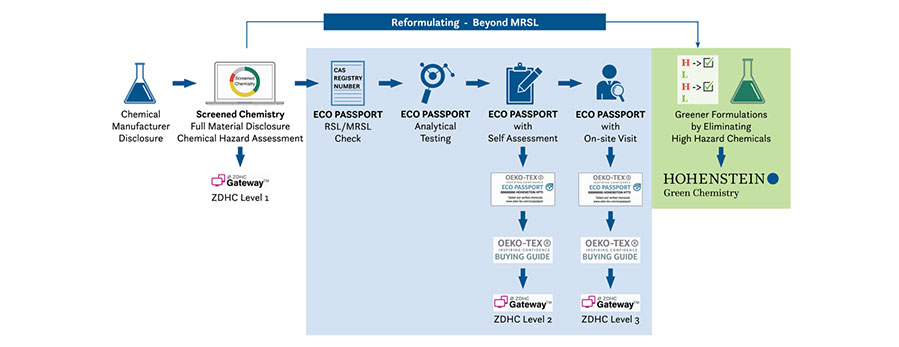
Levi Strauss & Co. (LS&Co.) and Hohenstein announced a collaboration to utilize the ECO PASSPORT by OEKO-TEX® certification system in the LS&Co. supply chain. This will amplify the capabilities of the Screened Chemistry program developed by LS&Co., helping establish a clearer pathway toward safer chemistry in the apparel industry by providing enhanced levels of testing, verification and transparency for chemical safety.

LS&Co. and Hohenstein both approach chemicals management from the perspective that safer inputs lead to safer outputs. Screened Chemistry, originated by LS&Co. as an open source program others can adopt, scrutinizes chemical formulations to prevent potentially hazardous compounds from entering the apparel supply chain and identify safer alternatives. By screening emerging chemistries that are not yet covered by Manufacturing Restricted Substances Lists (MRSLs), LS&Co. has created a more holistic approach to ensuring safe and responsible chemicals management.

ECO PASSPORT by OEKO-TEX® is an independent certification system for chemicals in the apparel, textile and leather industries. During a multi-stage process, ECO PASSPORT analyzes whether each individual ingredient in a chemical product meets international statutory requirements and is not harmful to human health. On-site inspections can validate claims that suppliers are using safer and better chemistry, manufactured according to industry best practices.

“Levi Strauss & Co. is committed to responsible chemicals management across our supply chain and our industry. This collaboration helps take our existing programs to the next level by establishing a new standard for responsible chemical stewardship that melds the hazard-based approach of Screened Chemistry with the robust testing and validation capabilities of Hohenstein,” said Michael Kobori, Levi Strauss & Co. VP of Sustainability.

“We believe that the collaboration between LS&Co. and Hohenstein is a significant step toward identifying and pulling better chemistry into apparel, footwear and textile supply chains,” said John Frazier, Senior Technical Director at Hohenstein.


“The coupling of Screened Chemistry, ECO PASSPORT by OEKO-TEX®, brand leadership and progressive chemical suppliers is a powerful signal of good things to come for chemicals management.”

The combined use of Screened Chemistry and ECO PASSPORT complements the recognized standards agreed upon by the Zero Discharge of Hazardous Chemicals (ZDHC) Roadmap to Zero initiative, an industry collaboration designed to drive the adoption of safer chemistry across the apparel supply chain. Through its testing and on-site verification, ECO PASSPORT will enable chemical suppliers to achieve higher levels of conformance with ZDHC. ECO PASSPORT’s certification results are published in the OEKO-TEX® Buying Guide, providing a credible third-party assessment of chemical supplier performance.

This partnership will enable LS&Co. to advance and better implement its existing chemicals management program and create a template that others in and beyond apparel can follow. The result is a program that goes beyond a risk management approach and provides a roadmap for companies to eliminate and prevent the introduction of chemical hazards in the supply chain.



More News from Hohenstein Institute

#Textiles & Apparel / Garment

Global size study for brands and retailers to optimize fit and market coverage

Hohenstein Apparel Fit Solutions, a global leader in apparel fit, sizing, and product development, today announces the launch of its Global Size Study, a new initiative designed to equip brands to better understand and serve their target consumers through more accurate, market-relevant sizing.

#Sustainability

A new standard to combat plastic waste in forests

With DIN SPEC 35808 “Tree Shelter for Forestry Applications,” the testing and research service provider Hohenstein, in collaboration with Rottenburg University of Forestry, as well as forestry authorities and industry partners, has established a clear framework for bio-based and fully biodegradable tree shelters. The pre-standard defines requirements and practical testing methods designed to reduce plastic waste in forests and strengthen the long-term protection of soil and the environment.

#Research & Development

Hohenstein publishes 2025 Sustainability Report

The testing and research service provider Hohenstein has published its latest sustainability report, outlining key progress and strategic initiatives. The report focuses on ambitious CO₂ reduction targets, the company’s new mission statement and the systematic expansion of sustainable services for customers worldwide.

#Research & Development

New DIN SPEC assesses environmental impact of textile fragments in soil

Textile products made from synthetic fibres, finished fabrics or dyed materials release fibre fragments into the environment at every stage of their life cycle. With the new DIN SPEC 19296, Hohenstein has developed a standardised testing method to analyse how these fragments behave in soil under natural conditions. Until now, little was known about their environmental behaviour or potential ecological effects once released.

More News on Sustainability

#Man-Made Fibers

The updated poster on biodegradable Polymers in various environments has been released

As part of the PerPlacsBio project, nova-Institute has updated its popular poster on the biodegradability of polymers in different environments. The updated version reflects current standards, certifications and the latest scientific findings. The poster can be used to assess biodegradable alternatives for use in agriculture and forestry, and it is now available in German for the first time.

#Denim

Denim moves towards sustainability

EIM (Environmental Impact Measurement), the global reference platform for measuring the environmental impact of garment finishing, presents the second edition of its annual report Denim Industry Progress & Insights 2025. The study analyses over 100,000 real denim finishing processes, providing an accurate and up-to-date view of the industry’s evolution towards more sustainable models.

#Recycling / Circular Economy

Europe’s textile future at a turning point: New 2030 Circularity Blueprint aims to scale recycling and unlock investment opportunities

The EU textile system is at a critical crossroads. Today, less than 1% of discarded garments are recycled into new garments, despite EU-wide obligations for separate collection. In response, Global Fashion Agenda (GFA) is launching the 2030 Circularity Blueprint, in partnership with ReHubs. This ambitious initiative is designed to support the transformation of the EU textile ecosystem to advance textile-to-textile recycling and drive the transition to a circular economy.

#Sustainability

Number of GOTS-certified facilities grow 15% globally as demand for credible sustainability standards continues to strengthen

Global Organic Textile Standard (GOTS) certification continued to grow in 2025, with nearly 18,000 certified facilities worldwide, despite ongoing geopolitical uncertainty and rapidly evolving regulatory requirements across global textile supply chains.

Latest News

#Technical Textiles

Fifteen years of Autoneum – From spin off to global technology leader

What started as a strategic carve‑out has since become the success story of a global technology leader in acoustic and thermal management solutions for vehicles. Headquartered in Winterthur, Switzerland, Autoneum supplies leading automobile manufacturers worldwide with innovative, lightweight and increasingly sustainable solutions.

#Textile chemistry

The CHT Group GmbH awarded Best Managed Company 2026

The CHT Group GmbH has been honored as Best Managed Company 2026. The seal of approval recognizes excellently managed medium-sized companies and is awarded as part of a program by Deloitte Private, UBS, the Frankfurter Allgemeine Zeitung, and the Federation of German Industries (BDI).

#Nonwoven machines

Kruger, Canada, orders first nonwovens line for sustainable wipes from ANDRITZ

International technology group ANDRITZ has received an order from newly established Kruger Nonwovens to deliver a complete WetlaceTM hybrid line for the Wayagamack mill in Trois-Rivières, Quebec, Canada. With this investment, pulp and paper producer Kruger is preparing to enter the nonwovens market with a new generation of plastic-free, chemical-free materials for sustainable wipes. The line is the first of its kind in Canada and is scheduled to start production in 2028.

#ITM 2026

Picanol to present its leading weaving technology at ITM 2026

Picanol is pleased to announce it will be participating in ITM 2026 in Istanbul. This is a key event for industry professionals to engage with the Turkish textile industry as well as the extensive international audience attending the fair. During the event, Picanol will present its latest innovations to the visitors in Hall 8, booth 802.

TOP