[pageLogInLogOut]

#Sustainability

Textile Exchange reports global production of organic cotton increases 56 percent

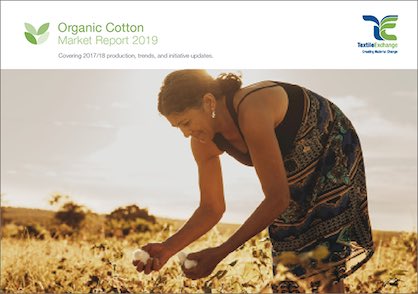
Textile Exchange’s 2019 Organic Cotton Market Report reveals that 2017/2018 saw an impressive 56 percent growth in global organic cotton production, with India, China, and Kyrgyzstan as the biggest contributors to this increase.

Latest figures show that global production of organic cotton fiber reached 180,971 metric tons (MT) in 2017/2018 - the highest volume seen since 2009/2010 when the financial crisis led to a dramatic decline. Textile Exchange, the only organization to collect and report on global organic cotton production data, estimates that this growth is set to continue, with India, Tanzania, Turkey, Kyrgyzstan and China all having significant areas of cotton-growing land in transition to organic.

The number of facilities certified to voluntary organic standards is also on the rise, with facilities certified to the Global Organic Textile Standard and Textile Exchange’s Organic Content Standard growing by 15 and 16 percent respectively.

Cotton is grown organically in 19 countries around the world and the Organic Cotton Market Report reveals that 98 percent of the production stems from just 7 of these: India (47 percent), China (21 percent), Kyrgyzstan (12 percent), Tukey (6 percent), Tajikistan (5 percent), the United States (3 percent), and Tanzania (3 percent).

Organic cotton now makes up 0.7 percent of total cotton production globally. In 2017/2018, the fiber was planted on a total of 356,131 hectares (ha), with an additional 44,394 ha in transition to organic. Production was carried out by a total of 182,876 farmers, the majority of whom were smallholders growing organic cotton in rotation with other crops. An interesting trend, identified in India this reporting year, was that organic cotton farmers increased the proportion of certified land used to grow cotton (as opposed to other organic crops) from 45 to 70 percent, which contributes in part to the 44 percent growth seen in India’s production.
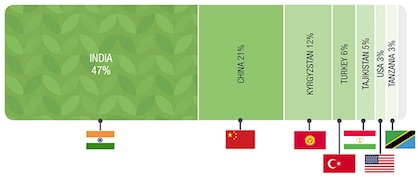
(c) Textile Exchange


(c) 2019 Textile Exchange

Farmer access to cotton seed that has not been genetically modified (GM) remains a huge obstacle for organic farmers, particularly in countries such as China and India where GM cotton dominates the cotton landscape. The report highlights some of the great progress being made in this area and includes an urgent call to action for added investment in non-GM seed programs, as well as for companies to develop their own organic cotton safeguarding programs.

With the rise in awareness of the climate emergency that our planet is facing, Textile Exchange sees organic cotton as a key component to the myriad of solutions that are urgently needed. Liesl Truscott, Director of European & Materials Strategy at Textile Exchange, said:

“Organic cotton, alongside other organic land-based fibers, must be part of the future. Organic cotton farmers, organizations, companies, and other supporters represented in this report provide a guiding light. We are proud to bring you our 2019 Organic Cotton Market Report and are committed to leveraging organic cotton as a market-driven solution to industry transformation and meeting the Global Goals.”

Textile Exchange’s Managing Director, La Rhea Pepper, also believes wholeheartedly in the importance of this fiber in driving change:

“Organic production of cotton is the tip of the spear that has been driving change within the sector. It establishes a direction of travel for all of us, starting with regenerative soil practices.”

The 2019 Organic Cotton Market Report provides a unique overview of global organic cotton production, focusing on the 2017/2018 harvest year but including both historical trends and forecasts at global, regional, and country levels. Also included are stakeholder maps identifying the key initiatives working hard to support organic cotton in each region, alongside latest updates from many of these programs and Q&As with industry insiders.

Download the full 2019 Organic Cotton Market Report

https://store.textileexchange.org/product/2019-organic-cotton-market-report/

More News from Textile Exchange

More News on Sustainability

#Sustainability

Cascale Forum: Colombo convenes 500+ manufacturers brands, and stakeholders to advance capacity building and collaboration across the consumer goods industry

Cascale today announced program details for Cascale Forum: Colombo, taking place March 30–April 1, 2026 in Sri Lanka. Building on the success of the 2025 Forum in Ho Chi Minh, Vietnam, this gathering will convene manufacturers, brands, retailers, NGOs, policymakers, and solution providers under the theme “Action by Design: Accelerating a Fairer, More Resilient Value Chain.”

#Business

Canopy introduces a first-of-its-kind $2 billion USD investment blueprint to decarbonize global materials supply chains

Today, the global, solutions-driven not-for-profit Canopy joined partners at Davos to introduce a new finance model designed to accelerate the growth of low-carbon materials and transform the paper, packaging, and textile supply chains. The event was anchored by a keynote speech from Sri A Revanth Reddy, Hon’ble Chief Minister of Telangana, with India set to host the first iteration of the new investment blueprint.

#Sustainability

Storm Creek achieves bluesign® PRODUCT status

Storm Creek (ASI#/PPAI#) is proud to announce a meaningful sustainability milestone: the company has achieved bluesign® PRODUCT status: becoming the first US-based supplier in the promotional products industry to earn this globally respected certification. While this marks an industry first, for Storm Creek, it represents something far more important: a continuation of doing what they believe is right.

#Nonwovens

EDANA wraps up its Sustainability & Policy Forum 2025: Uniting the industry and EU policymakers to navigate the future of nonwovens

Against a backdrop of rapidly evolving environmental legislation, the EDANA Sustainability & Policy Forum 2025 concluded the past week in Brussels, marking a step forward in the dialogue between the nonwovens industry and European policymakers. Held from 9-10 December at the historic Residence Palace, the two-day event successfully brought together business leaders, sustainability experts, and EU officials to address the dual challenges of circularity and industrial competitiveness.

Latest News

#Fabrics

MUNICH FABRIC START: Between Attitude and Sensuality

The future begins where we reimagine it. After seasons of restraint, Spring.Summer 27 marks a conscious counter-trend: optimism, sensuality, and creative freedom are replacing pragmatism and neutrality. Physical presence and individuality are regaining importance – as a response to uncertainty, exhaustion, and algorithmic predictability. The overarching theme of PLEASURE stands for fashion as an emotional space, as an expression of attitude and cultural reflection. Colours, surfaces, and materials become vehicles for self-confidence and joie de vivre.

#Denim

organIQ seek: smart alternative to potassium permanganate

CHT Group announces new technical findings within its organIQ seek platform that significantly advance the transition toward permanganate-free denim bleaching. Through extensive industrial testing and application research, CHT confirms that organIQ seek can now be used with remarkable effectiveness as a substitute for potassium permanganate in spray bleach, while remaining aligned with sustainability expectations and cost realities in the European market. At the COLOMBIATEX in Medellín as well as at the Exintex in Puebla and the Kingpins Show in Amsterdam the CHT Group will present organIQ seek as an alternative to potassium permanganate.

#Functional Fabrics

PERFORMANCE DAYS: Focus topic shifts to the beginning of the value chain

Following the last Focus Topic in October 2025, which placed Textile-to-Textile Recycling at its core, PERFORMANCE DAYS continues to drive the conversation around circularity – this time with an expanded and more upstream perspective. The upcoming Focus Topic, “Textile to Textile: The Role of Collectors and Sorters,” presented during the spring edition on March 18–19, will spotlight one of the most essential yet often overlooked components of a functioning circular textile system: the efficient collection and sorting of post-consumer textiles.

#Knitting & Hosiery

Proven performance, optimised costs – the new RE 6 EL

Nowadays textile companies increasingly need to produce small production runs and respond to market changes with instantaneous pattern changes in order to operate profitably – meaning they require machines that offer maximum flexibility, reliability and cost efficiency. KARL MAYER understands the challenges of the market and is launching its new RE 6 EL. The Raschel machine offers the core strengths of the classic RSE 6 EL and essentially the same performance parameters, but has been further cost-optimised largely due to local production advantages. This makes the newcomer an efficiency champion in production, especially when it comes to frequent pattern changes.

TOP