[pageLogInLogOut]

#Sustainability

Reducing the use of plastics without changing production technology?
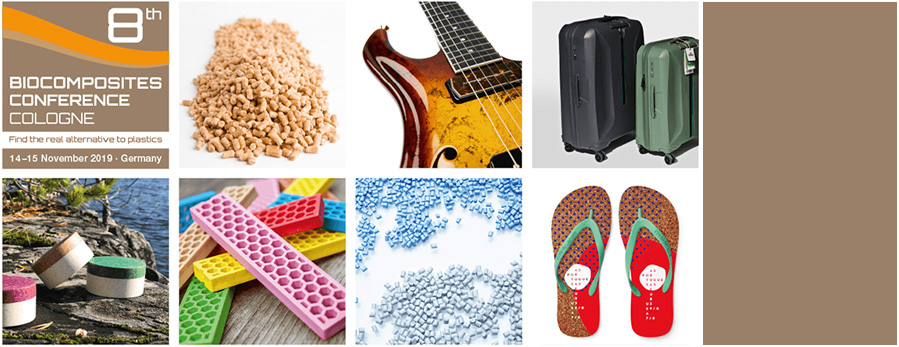
(c) 2019 nova institut / Flaxwood / Trifilon / Sulapac / Bioblo Spielwaren / Coperion / Amorim
130,000 t of biocomposite granulates are available for greening in Europe. World's largest biocomposites conference in November in Cologne (Germany).

Today’s customers expect companies to reduce plastics in their products. But this is difficult without compromising performance and processability. Biocomposites can be the solution: 30 to 80 % of plastics are replaced by biogenic fillers such as wood flour or cork, or by natural fibres for reinforcement. The advantage is that these granulates can be processed on your existing machines without major modifications, whether by injection moulding, extrusion or additive production (3D printing). At the same time, the products differ from normal plastic products in their very pleasant feel and unusual appearance. Also, mechanical properties change, the products become stiffer and more tensile and bend-resistant due to the natural fibres.

nova-Institute has now published a list of all European producers and suppliers of biocomposite granulates. The list includes 30 producers from nine different countries. The amount of granulates produced and sold in 2018 was almost 130,000 t. This is a considerable increase compared to previous years and double-digit growth is expected in the next few years.

What are the reasons for this success?

For one thing, there has never been a greater demand for alternatives to classic plastic products. For another thing, larger quantities of high quality granulates are available on the market for the first time. The manufacturers – often active for more than 10 years already – have used the time to further optimize their granulates. The larger volumes in turn allow for lower prices. Never before has it been so inexpensive to make your production greener without compromising on performance and processability.

Today, there are biocomposites for virtually every application: consumer goods, toys, handles and shoes, façade and terrace elements, floors, automotive interiors, and even space applications.


The Portuguese cork manufacturer AMORIM is the largest producer of such granulates with over 50,000 tons per year. Almost everyone owns or knows products such as shoes, handles for sports equipment or bathroom floors, which are made from those cork materials. Next comes Biologic from Belgium (>10,000 t/year) and Advanced Compounding and Tecnaro from Germany with over 5,000 t/year each. These three companies offer a wide range of polymers as well as a wide variety of wood and natural fibres as fillers and reinforcers. Even recycled blue jeans fibres or wine residues can now be processed into plastics. In the meantime, UPM (Finland), Sappi (South Africa) and Stora Enso (Sweden/Finland), large companies from the wood-based products and pulp sectors, have also entered into the production of biocomposites. The two tables above and below give a comprehensive overview of the 30 biocomposite granulate manufacturers in Europe.

Among the biocomposite granulates, cork granulates account for the largest share with approx. 60%. Wood and cellulose fibre granulates account for slightly more than 25% and natural fibre granulates for 15%.

The use of biogenic fillers and reinforcing materials greatly reduces the proportion of fossil carbon in the granulate and increases the proportion of renewable carbon accordingly. This makes it possible to leave more fossil resources in the ground and consequently to protect the climate. If one wants to have even more renewable resources in the product, bio-based and/or recycled plastics can be used. This makes it possible to produce materials that completely dispense with fossil carbon and are based purely on renewable carbon. Most biocomposite granulate producers therefore also offer different bio-based plastics as well as PP and PE as recyclates.

In November this year, the world’s largest conference on biocomposites will take place in Cologne. In addition to biocomposite granulates, which will be presented comprehensively in numerous applications, high-performance materials will also be on the agenda. The Innovation Award “Biocomposite of the Year 2019” will also be elected by participants.

8th Biocomposites Conference Cologne, 14–15 November 2019, Germany

More News from TEXDATA International

#Recycling / Circular Economy

textile.4U publishes special edition “Top 100 Textile Recycling Companies 2025”

With a comprehensive 176-page special edition, textile.4U is dedicating its latest issue entirely to one of the most dynamic and influential topics in today’s textile industry: textile recycling. The new issue, published exclusively in high-quality print, presents the Top 100 textile recycling companies researched and selected by TexData – organizations that already play a key role in the transition to circular textiles or are expected to have a significant impact in the near future.

#Recycling / Circular Economy

Responsible Textile Recovery Act of 2024 signed by Governor

Senator Josh Newman (D-Fullerton) is proud to announce that Senate Bill 707 (SB 707), the Responsible Textile Recovery Act of 2024, has been signed into law by the Governor of California, Gavin Newsom. This groundbreaking legislation establishes the country’s first Extended Producer Responsibility (EPR) textile recycling program, marking a significant step forward in the state’s efforts to combat waste and promote sustainability.

#Textiles & Apparel / Garment

Modtissimo promotes sustainability with 28 coordinates in the Green Circle

Modtissimo is proving more and more to be a textile and clothing show that delivers the latest innovations in the area of sustainability, with the iTechStyle Green Circle being the main showcase for companies' creations. In this 60+4 edition, taking place on 12 and 13 September, 28 coordinates will be exhibited in a section organised by CITEVE and curated by Paulo Gomes.

#Europe

The EU and Egypt team up to mobilise private sector investments at Investment Conference and sign a Memorandum of Understanding underpinning €1 billion in macro-financial assistance for Egypt

At the EU-Egypt Investment Conference, co-organised by the EU and the Government of Egypt on 29-30 June, the EU and Egypt are teaming up to intensify private sector investments in Egypt. They are also signing a Memorandum of Understanding (MoU) for the disbursement to Egypt of up to €1 billion in Macro-Financial Assistance.

More News on Sustainability

#Sustainability

YKK recognized with Top ‘A’ rating by CDP for climate change leadership for third consecutive year

YKK Corporation announced its achievement of the highest “A List” rating in the 2025 Climate Change survey conducted by the global environmental disclosure nonprofit, CDP . This marks the third consecutive year YKK has received this prestigious recognition.

#Weaving

Itema announces strategic partnership with Ivy Decarb to accelerate decarbonization in weaving process

Itema is pleased to announce the strategic partnership with Ivy Decarb, the digital platform helping textile companies measure and reduce their carbon footprint.

#Man-Made Fibers

Teijin Carbon Europe receives EcoVadis Silver status – ranked among the top 15% of evaluated companies

Teijin Carbon Europe (TCE) has been recognized for its sustainability performance and has been awarded the EcoVadis Silver Medal in the latest assessment. In its first-ever EcoVadis evaluation, the company achieved a notable 72 out of 100 points, ranking among the top 15% of all companies evaluated worldwide, within the “Manufacture of Man-Made Fibres” category.

#Research & Development

The region of renewable raw materials: Central German Alliance for Bioplastics

The development of sustainable plastic solutions is rapidly gaining importance in light of global environ- mental pollution, dwindling fossil resources and ambitious climate protection targets. As part of the re- gional alliance RUBIO, which brings together 18 partners from central Germany and the Berlin-Branden- burg area, the bio-based and biodegradable plastic polybutylene succinate (PBS) was comprehensively investigated, starting with the raw material, through the manufacturing process, to industrial application.

Latest News

#Spinning

First PA66 spinning plant with EvoQuench successfully commissioned

With the successful commissioning of a multi-digit PA66 spinning line for microfiber yarns, Chinese textile company Shandong Nanshan Fashion Technology Co., Ltd. has added yarn production to its textile value chain.

#Knitting & Hosiery

SHIMA SEIKI returns to ShanghaiTex

Leading flat knitting solutions provider SHIMA SEIKI MFG., LTD. of Wakayama, Japan, together with its Hong Kong and Chinese market subsidiary SHIMA SEIKI (HONG KONG) LTD., will exhibit at the ShanghaiTex 2025 exhibition (Booth No.: Hall N3, Booth A20) held in Shanghai, China this month. This marks the return of SHIMA SEIKI to ShanghaiTex after a 14-year hiatus, its last exhibit at the show having been in 2011.

#Research & Development

Fraunhofer CCPE presents the “Monomaterial Design Set” – Innovative solutions for circular product design

Composite materials made from different types of plastic often extend the lifetime of products but make recycling more difficult in the circular economy. That is why Fraunhofer CCPE has developed the “Monomaterial Design Set”. This new approach helps to reduce the variety of plastics used in durable products and offers circular solutions for designers and product developers.

#Man-Made Fibers

arena introduces renewable LYCRA® EcoMade fiber in its latest swimwear collection

Italian swimwear specialist arena has unveiled a new collection that brings sustainability and performance even closer together. Launched on December 4, the line features swimsuits made from recycled nylon and renewable LYCRA® EcoMade fiber — the first time the bio-based spandex has been used commercially in swimwear.

TOP