[pageLogInLogOut]

#Sustainability

SDG roadmap for the apparel, retail and textile sector

Textile Exchange and KPMG, one of the leading global advisory firms, joined forces to develop a Sustainable Development Goal (SDG) roadmap for the apparel, retail and textile sector: “Threading the Needle: Weaving the Sustainable Development Goals into the Textile, Retail and Apparel Industry.”

In 2015, the global community of businesses, governments, and civil society organizations agreed to the SDGs, an unprecedented set of 17 targets for people, planet, prosperity, and peace. The SDGs offer a framework to drive business value while impacting a transformative set of sustainability, economic, and social targets.

The report, Threading the Needle, is a culmination of industry interviews, non-government organization inputs, and desk research, the report highlights practical examples for companies in the sector and beyond, grappling with how to integrate the SDGs into their core business and global supply chain. The report features:

Representative examples of SDG aligned shared value opportunities specific to the textile, retail, and apparel industry.

A cluster approach to SDG integration that maps potential programs to defined business needs.

Resources for starting and enhancing a company’s SDG journey, including guidance on multi-stakeholder partnerships and country-specific considerations.

A framework for making the business case for SDG integration.
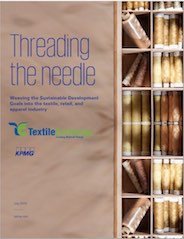
Threading the Needle report (c) 2018 KPMG / Textile Exchange


Download:

https://textileexchange.org/downloads/threading-the-needle
More News from Textile Exchange

More News on Sustainability

#Sustainability

GOTS version 8.0 released: advanced supply chain accountability, from fibre to finished product

Global Standard is pleased to announce the release of GOTS Version 8.0, the latest update to the world's leading processing standard for organic textiles. The updated Standard strengthens requirements for air emissions and waste management, as well as criteria for product safety. It introduces new provisions on circularity, microfibre management and updates in residue testing. Version 8.0 also elevates due diligence obligations and formalises governance requirements, including ESG disclosure, anti-corruption policies and conflict-of-interest safeguards, to support credible, responsible business conduct.

#Sustainability

The nova-Institute establishes new Renewable Feedstock Department to lay the groundwork for industrial defossilisation

The transition from fossil-based to renewable carbon – sourced from biomass, CO₂ utilisation and recycling – is the cornerstone of a climate-neutral chemical industry. The nova-Institute’s new department is dedicated to providing the essential data, analyses and strategic roadmaps required to secure a reliable future feedstock supply and make this transition a commercial and ecological reality.

#Textile chemistry

Jeanologia urges industry to accelerate PP Spray phase-out following ZDHC Watchlist update

Potassium permanganate has officially entered the Chemical Watchlist of the ZDHC Foundation, signaling increased scrutiny and potential phase-out of one of the most hazardous chemicals still used in denim finishing. The inclusion confirms an industry shift that Jeanologia anticipated more than a decade ago.

#Textiles & Apparel / Garment

Global Standard strengthens presence in Southeast Asia at VIATT 2026

Global Standard will participate in the Vietnam International Trade Fair for Apparel, Textiles and Textile Technologies (VIATT) 2026, organized by Messe Frankfurt, the first textile trade show in the APAC region this year. Global Standard will host a booth and Felica Shi will lead a seminar on Global Organic Textile Standard (GOTS). The trade fair will take place from February 26 to 28, 2026, in Ho Chi Minh City, Vietnam.

Latest News

#Raw Materials

Lenzing Group positions bio‑based materials as a strategic asset for Europe’s economic security

The Lenzing Group, a leading supplier of regenerated cellulose fibers for the textile and nonwovens industries, hosted a high‑level roundtable in Brussels to discuss how bio‑based materials can strengthen Europe’s economic security and support the shift toward a fossil‑free future. Organized in cooperation with Euractiv, the event brought together representatives of the European Commission, the UK Mission to the EU, academia, civil society, and industry.

#Natural Fibers

Beyond Cotton: Natural Fibres in the Spotlight at the Bremen Cotton Conference - Branded by DNFI

Climate targets, fragile supply chains, and rising regulatory requirements are fundamentally changing the perspective of the textile industry - the focus is increasingly shifting toward the base material. Not only cotton, but natural fibres are gaining significant importance: they stand out not only because of their outstanding functional properties, but also because they make a valuable contribution to the bioeconomy and responsible product development.

#Textiles & Apparel / Garment

Coats to showcase innovative reinforcement and filler materials for leather goods and accessories at APLF 2026

Coats, a world-class Tier 2 manufacturer and trusted partner for the apparel and footwear industries, will be promoting four advanced materials from its ‘Lifestyle Solutions’ portfolio at APLF 2026 in Hong Kong in March. Each innovation has been specifically engineered to help luxury and premium brands elevate the craft, durability, sustainability and creative expression required in the manufacturing of handbags, purses, and other high-end designer accessories.

#Textiles & Apparel / Garment

Design, innovation and sustainability propel VIATT 2026’s expanding role in ASEAN textile sourcing

At its third edition, the Vietnam International Trade Fair for Apparel, Textiles, and Textile Technologies (VIATT) further reinforced its role as a key sourcing and business platform for ASEAN’s textile industry. The three-day fair welcomed over 17,000 visits from 54 countries and regions, and featured over 460 exhibitors from 21 countries and regions across 18,000 sqm. The 2026 edition was marked by the introduction of new international pavilions and zones, broadening the fair’s sourcing scope across new geographies and product categories. The fringe programme, headlined by the debut Trend Forum, further distinguished VIATT as the region’s most integrated textile trade platform – uniquely spanning the entire value chain.

TOP