[pageLogInLogOut]

#Spinning

FET’s game changer for the biomedical market
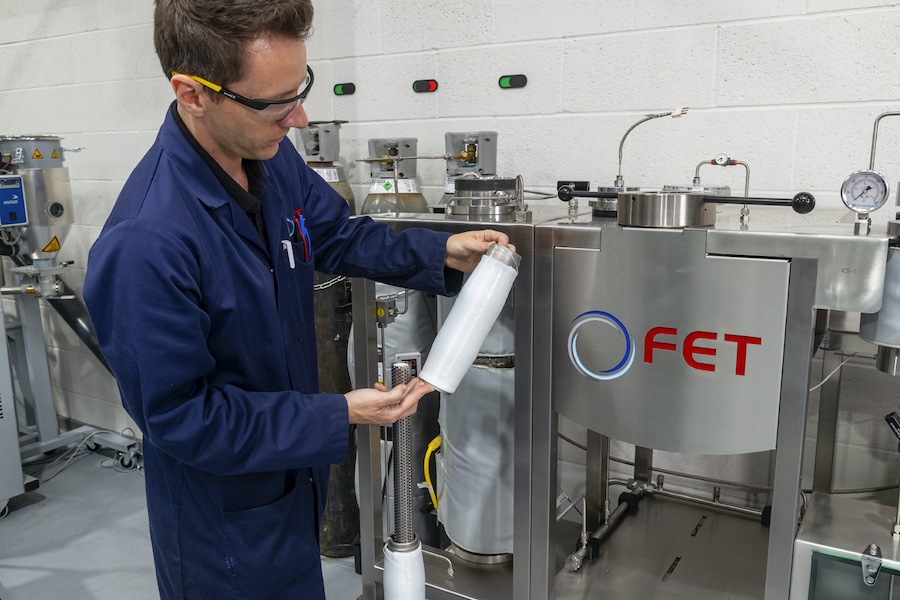
A much more sustainable, cost effective and very flexible process for manufacturing critical fibres based on ultra high molecular weight polyethylene (UHMWPE) is being launched by the UK’s Fibre Extrusion Technologies (FET).
FET’s closed-loop supercritical CO2 system can achieve more than 95% solvent recovery without loss of performance. © 2025 FET


Unbeatable properties

UHMWPE is prized in many industries due to its extraordinary properties. The fibre is, for example, ten times stronger than steel by weight, while exhibiting outstanding abrasion resistance, low friction and high impact strength. UHMWPE fibres are also chemically inert, resistant to most chemicals and UV light and do not absorb water. They maintain performance in a wide range of temperatures and despite their toughness are extremely lightweight.

As a result, they are unbeatable in demanding applications such as high-performance ropes in maritime industrial and rescue applications. In addition, they are invaluable in ballistic protection, cut-resistant clothing and high-performance sports gear – and increasingly in medical implants.

Biomedical market

“FET has supplied many extrusion systems to the biomedical market, most notably for the production of both resorbable and non-absorbable sutures,” says FET Managing Director Richard Slack. “In exploring what else we could do in assisting these customers, it became clear that there was a need for smaller quantities of UHMWPE fibres in bespoke sizes.”

“The current systems for manufacturing UHMWPE filament yarns are on a huge scale, with very complex processing routes,” adds Research and Development Manager Jonny Hunter. “This means the supply chain is currently very inflexible with minimal opportunity for new product development. These disadvantages have been fully addressed in the development of our new FET-500 series lab and small scale gel spinning system.”
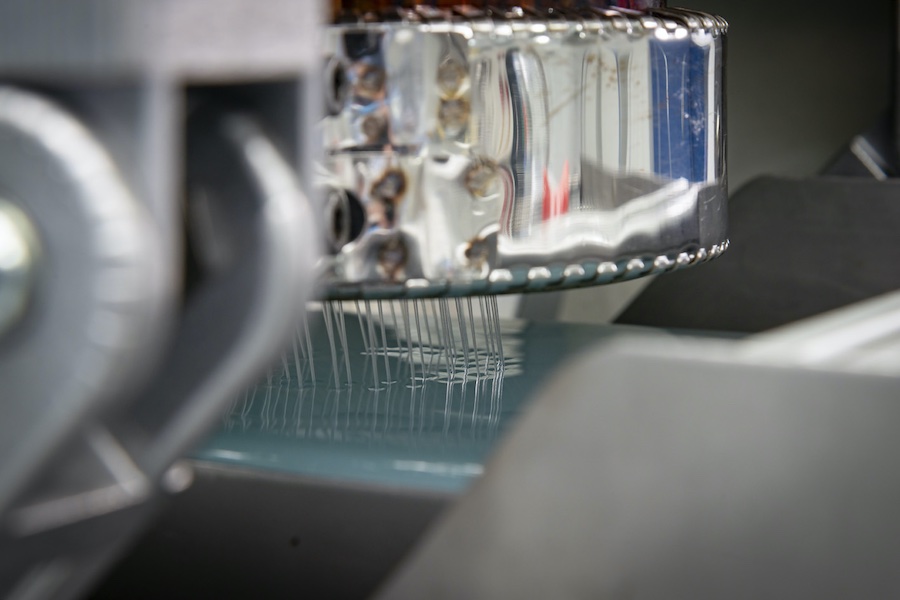
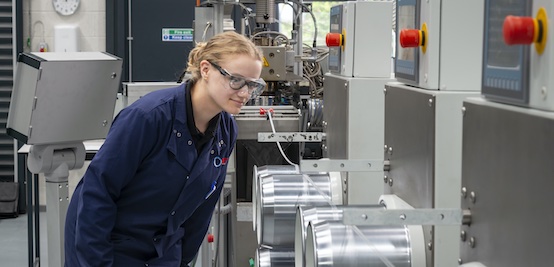
The FET-500 gel spinning system in action close up. © 2025 FET


Solvent extraction

A major FET innovation is the introduction of a patented batch system for solvent extraction exploiting supercritical carbon dioxide (CO2).

UHMWPE production, until now, has involved the use of large volumes of hazardous solvents such as dichloromethane (DCM) or hexane. The UHMWPE powder is mixed with mineral oil to form a gel which is subsequently extruded, cooled and solidified. The oil is then extracted from the fibres using DCM or hexane and the solid fibres are then drawn at high temperature to further align the polymer chains, resulting in final strong and tough fibres. Typically, it takes 10 kg of Hexane to extract 1 kg of oil. 

“Solvent reclamation using extraction baths and hot air drying chambers is not practical for the scale of our system,” explains FET’s Senior Material and Process Scientist Kris Kortsen. “The current baths employed can be up to 200 metres long and the waste volumes are considerable. Expertise is needed in dealing with such dangerous chemicals and overall the process has an immense environmental impact.

“CO2, by contrast, is a cheap and abundant sustainable solvent that is non-toxic, non-flammable and leaves no residue.” 

Closed loop

FET’s closed-loop system can achieve more than 95% solvent recovery without loss of performance, resulting in residue-free UHMWPE filament yarns via a vastly improved route in terms of both safety and logistics.

A further innovation is the highly modular drawing system based on heated godet rollers, enabling flexible temperature and drawing control for new product development and the ability to be expanded at any time to meet customer needs.

A comprehensive LCA study detailing the full savings potential is currently being prepared and will be published shortly.

“Having processed over 130 separate polymers in the development of our extrusion systems, we believe the FET-500 is a game changer,” concludes Richard Slack. “We believe there is a big gap in the market for smaller quantities of UHMWPE, and our first line is now fully operational at the FET Fibre Development Centre in Leeds. We look forward to demonstrating it and discussing its full potential with interested companies from around the world.”
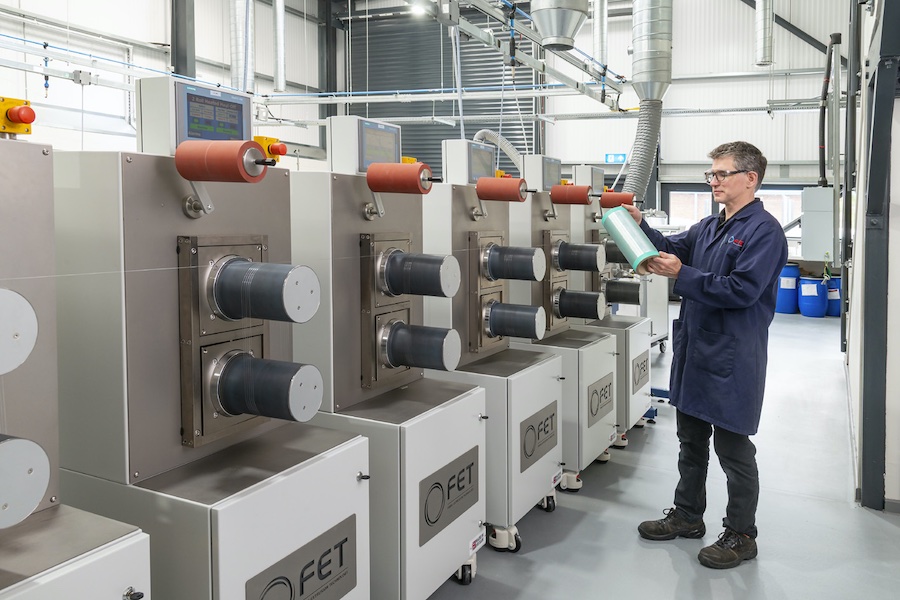
A highly modular drawing system based on heated godet rollers enables flexible temperature and drawing control for new product development. © 2025 FET


More News from Fibre Extrusion Technology Ltd.

More News on Spinning

#Spinning

Rieter adjusts group structure in preparation for Barmag integration

The planned acquisition of the “Barmag” Division of OC Oerlikon will create the leading system provider worldwide for natural and man-made fibers. Rieter is confident it will receive all regulatory approvals to complete the acquisition in the fourth quarter of 2025. The Rieter Group is therefore adjusting its Group structure as of January 1, 2026, to take this acquisition into account and to be able to provide an even more agile response to market challenges.

#Spinning

Demand for high-performance yarns on the rise

Barmag, a subsidiary of the Swiss Oerlikon Group, will commission three HMLS yarn systems with a total of 30 stations at renowned technical yarn manufacturers in China over the next three months.

#ITMA Asia + CITME Singapore 2025

T-CAN – Revolutionizing can transport

In virtually all spinning mills, transporting sliver cans is still done manually. Rising labor costs, lack of operators and increasing quality requirements make this a growing challenge. With T-CAN, Trützschler introduces a practical solution: a fully automated can transport system that will be presented live at ITMA ASIA 2025 in Singapore.

#Recycling / Circular Economy

textile.4U publishes special edition “Top 100 Textile Recycling Companies 2025”

With a comprehensive 176-page special edition, textile.4U is dedicating its latest issue entirely to one of the most dynamic and influential topics in today’s textile industry: textile recycling. The new issue, published exclusively in high-quality print, presents the Top 100 textile recycling companies researched and selected by TexData – organizations that already play a key role in the transition to circular textiles or are expected to have a significant impact in the near future.

Latest News

#Knitting & Hosiery

Mayer & Cie. to shut down after failed search for investor – 270 jobs affected

Mayer & Cie., the long-established German manufacturer of circular knitting and braiding machines, will cease operations after its international search for an investor ended without success. The company, based in Albstadt-Tailfingen, had been undergoing insolvency proceedings in self-administration since its filing on 23 September 2025. As Schwarzwälder Bote reports, the insolvency court has now formally opened the proceedings, triggering the decision to wind down the business in an orderly process.

#Man-Made Fibers

Trevira CS® ignites Heimtextil 2026 with "WE CARE" campaign

Indorama Ventures, a global sustainable chemical company, announces its Trevira CS® brand’s powerful and socially responsible presentation at Heimtextil 2026 in Frankfurt, Germany, from January 13 to 16, 2026. The impactful theme of the show: “WE CARE.”

#Recycling / Circular Economy

European research project addresses textile waste through integrated recycling technologies

A major European research initiative coordinated by Fraunhofer UMSICHT has been launched to develop integrated solutions for textile waste recycling. The AUTOLOOP project aims to create a comprehensive system that could process 1.24 million tonnes of textile waste annually by 2050, whilst potentially creating over 130,000 green jobs across the EU. This project aims to develop, test and integrate automated sorting, tracing, and closed-loop recycling technologies for polyester-based textiles (NRT), addressing the pressing challenge of textile waste management.

#Recycled_Fibers

CARBIOS and Wankai sign strategic PET biorecycling pact

CARBIOS (Euronext Growth Paris: ALCRB) and Wankai New Materials (“Wankai”), a listed subsidiary of Zhink Group, the 3rd largest PET producer in China and 4th worldwide, announce the signing of the definitive agreement establishing a strategic partnership for the industrial rollout of CARBIOS’s PET biorecycling technology in Asia. The first milestone will be the construction of a PET biorecycling plant in China.

TOP