[pageLogInLogOut]

#Spinning

A great future for recycled yarns…but what about the costs?
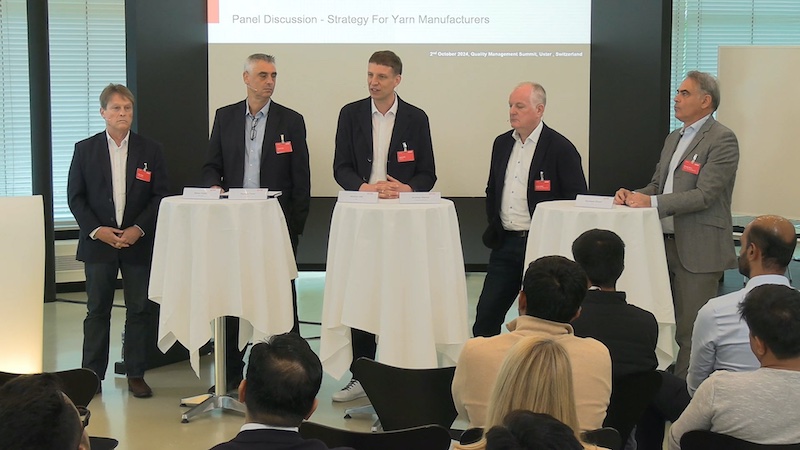
Uster Technologies brought textile industry leaders together to discuss the current issues in using recycled raw material. A delegation of spinners from India met experts from Rieter, Säntis-Textiles, Otto Yarns, Gherzi Textile Organization and TVU at Uster headquarters in Switzerland. This article summarizes the challenges and opportunities of recycled yarns from both sustainability and business aspects.
An expert panel discusses yarn production from recycled material © 2025 Uster


The ideas and solutions of the panelists diverge on the subject how to be successful with recycled yarns. They see different approaches to achieve the goal. The quality of recycled yarn could be improved with an additional step between mechanical opening and the spinning process, according to Michael Will (Head Textile Technology & Process Analytics) from Rieter. The pre-opening or carding does not necessarily have to be in the responsibility of the spinners. It could also be done by the fiber suppliers. Andreas Merkel (CEO) from Otto Yarns anticipates better results with pre-consumer fibers. Post-consumer waste remains a difficult raw material – although readily available in large quantities. He forecasts great future opportunities, but it will take some time.

Stefan Hutter, Owner of Säntis-Textiles, also believes in the recycling business, and that recycled material will become a standard. He expects two segments growing: one based on industrial and the other on post-consumer waste. A lot of groundwork has been done, but it’s still a good time to jump in on this business.

Looked at from a trading and dyeing perspective, the quality and sourcing of recycled yarns are challenges. Thomas Franz (Sales and Purchasing Manager) at TVU states that yarn properties are not comparable with virgin fibers – and more difficult with cotton than polyester – and so neither dyeing results nor process efficiency are the same.

Who pays for sustainable yarns?

Producers agree that there will always be a disadvantageous difference compared to virgin fibers. The question is, could consumer expectations be corrected in terms of quality and price regarding garments made from recycled raw material?

Giuseppe Gherzi, Managing Partner at Gherzi Textile Organization, makes clear that the problem is not the consumer expectations, but that retails and fashion brands are not ready to pay more for recycled garments. The power for change lies in legislation. But there’s a lot of uncertainty. In the end, regulations generate costs as they need a control system.

How to prove recycled yarn?

Technology to secure, that recycled products are genuine are available and also Uster Research & Development team is working on this subject. It is possible to verify the lifecycle of recycled items, such as denim, from their first to third use. However, the cost and whether brands are willing to pay for traceability remain concerns.

Can traceability be addressed in spinning? Michael Will says: “With innovative technology in combing a 50/50 blend could become a 40/60 but is it necessary to declare this change?” The result of the further discussion of spinning practices was that using a certain percentage of less expensive recycled fibers should be a common standard in the future as long as quality requirements are met – without the need for information or proof.

Of course, the certification also adds to the cost for yarn producers. Plants, as well as raw material shipments and shipments to the customer, need to be certified. Only when the complete chain is certified can, for example, a GRS (Global Recycled Standard) logo be applied. With a required minimum of recycled content in the product a certification system is a must. Merkel could imagine two markets in future: a mass market for cost-effective yarn production with recycled cotton fiber but no certification; and a smaller market with certificates required. There’s a crucial fact that lower prices are expected for recycled, but that’s not the case in reality.

How to make it profitable?

Making good money with recycled yarn will be possible by optimizing and shortening the processes in yarn production. Hutter believes that the costs will come down as soon the market picks up and grows and there’s more material in the market. This happened with polyester and will also follow with cotton. The market wants recycled products.

Spinners are advised to start at some point – meaning with a certain blend of recycled material – to develop recycled yarn further. It’s crucial to learn by testing and analyzing over some years finally to achieve the required product at a much better quality.

The panel discussion is available in full, including the outlook over a time period of five years to those interested in more details. Access the video via this link:

https://web.uster.com/cn/atddp/paneldiscussionvideo

More News from Uster Technologies AG

#ITMA Asia + CITME Singapore 2025

Uster presents novelties at ITMA Asia + CITME 2025

There’s news from Uster Technologies to be announced for the industry’s upcoming event in Singapore. The Uster 360Q universe is growing with new products, solutions and services. Innovation developments can also be recorded in the fields of man-made fiber testing and fabric inspection. Uster innovations address the industry’s trending topics as mill management and process control, optimization of delivered fabric quality and yield.

#Spinning

Uster Technologies marks 150 years of empowering quality excellence

Uster Technologies marks 150 years of excellence – a milestone that reflects continuous adaptation to customer needs and industry change. Over the decades, Uster has evolved from manufacturing quality testing instruments into a trusted partner shaping the future of textile production.

#Recycling / Circular Economy

Challenges of making yarn from recycled fibers

What does it take to spin quality yarn from recycled fibers? Uster Technologies brought textile industry leaders together to discuss the role of technology, data and automation – as well as the current challenges in using recycled raw material. Experts from Rieter, Säntis Textiles, Otto Yarns, and TVU commented on the current situation and looked into the future of spinning in a panel discussion organized at Uster headquarters.

#Spinning

Uster Technologies wins another infringement lawsuit

In a ‘victory for innovation in China’ Uster Technologies has secured a decisive judgment in a patent infringement lawsuit against a competitor. The final ruling by the Supreme People’s Court of PR China confirms that the competitor’s actions in copying the patented yarn feeder of the Uster Tester 6 constitute unlawful infringement.

More News on Spinning

#Spinning

Rieter adjusts group structure in preparation for Barmag integration

The planned acquisition of the “Barmag” Division of OC Oerlikon will create the leading system provider worldwide for natural and man-made fibers. Rieter is confident it will receive all regulatory approvals to complete the acquisition in the fourth quarter of 2025. The Rieter Group is therefore adjusting its Group structure as of January 1, 2026, to take this acquisition into account and to be able to provide an even more agile response to market challenges.

#Spinning

Demand for high-performance yarns on the rise

Barmag, a subsidiary of the Swiss Oerlikon Group, will commission three HMLS yarn systems with a total of 30 stations at renowned technical yarn manufacturers in China over the next three months.

#Spinning

FET prepares for final exhibition of 2025

Fibre Extrusion Technology Ltd (FET) of Leeds, UK has completed its second major exhibition of 2025 at ITMA ASIA in Singapore, which is aimed at the textile and garment industry in South and Southeast Asia and the Middle East. Once again, this trade show proved to be a successful one for FET, with considerable interest from several countries surrounding China.

#ITMA Asia + CITME Singapore 2025

T-CAN – Revolutionizing can transport

In virtually all spinning mills, transporting sliver cans is still done manually. Rising labor costs, lack of operators and increasing quality requirements make this a growing challenge. With T-CAN, Trützschler introduces a practical solution: a fully automated can transport system that will be presented live at ITMA ASIA 2025 in Singapore.

Latest News

#Recycling / Circular Economy

Advanced Recycling Conference 2025 fuels innovation across key waste streams

The Advanced Recycling Conference (ARC) 2025 brought together nearly 220 experts from 28 countries to spotlight pioneering advancements and foster industry collaboration in recycling across diverse waste streams including plastics, textiles, automotive and other materials.

#Dyeing, Drying, Finishing

Navis TubeTex announces U.S. partnership with Icomatex

Navis TubeTex, a global leader in advanced dyeing and finishing machinery solutions, is pleased to announce a new partnership with Icomatex (www.icomatex.com), a respected European manufacturer of high-quality stenters and textile finishing equipment. Under this agreement, Navis TubeTex will exclusively represent the Icomatex stenter line in the United States.

#Recycling / Circular Economy

ADVANSA launches ADVA®tex: A new step toward textile-to-textile recycling

ADVANSA has introduced ADVA®tex, a new filling fibre made entirely from recycled pre-consumer textile waste, positioning the material as a significant step forward in textile-to-textile (T2T) recycling. The fibre is designed for use in duvets, pillows, mattresses, and furniture applications and is available in three versions.

#Knitting & Hosiery

KARL MAYER celebrates 35 years of EL pattern drive

KARL MAYER is celebrating an anniversary this year: on 30 November 1990, the first warp knitting machine with electronic guide bar control, the KS 4 EL, was delivered – another milestone for patterning. As early as 1980, the SU gearbox with the MRS42SU had initiated the transition from mechanical chains to digital data.

TOP