[pageLogInLogOut]

#Spinning

IDF in India: Flexibility for the upcycling of textile waste
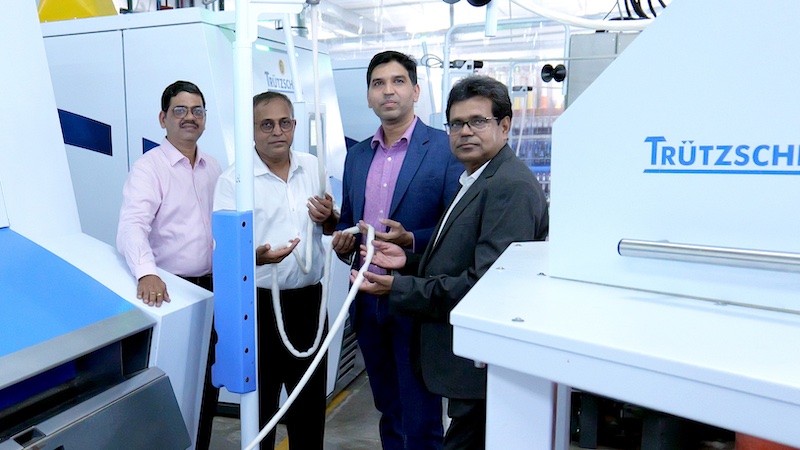
Trützschler and the Indian company Gimatex have a long relationship that began in 2006. Since then, they have successfully collaborated on many projects. Gimatex has used Trützschler’s IDF successfully in direct spinning. Now, they are using it to turn textile waste into valuable ring yarn.
f.l.t.r.: Shailesh Thakur (Deputy General Manager Sales ATE), Shiladitya Joshi (Deputy General Manager Marketing Trützschler), Vineet Mohota (Director Gimatex) and Gautam Kumar Dhang (CEO Fabric Business Gimatex) © 2024 Trützschler


Gimatex Industries Pvt. Ltd. has high standards for quality and sustainability. The company operates fully integrated facilities with ginning, spinning, recycling, weaving and processing units in Hinganghat, within India’s major cotton-growing region of Vidarbha. It also runs a state-of-the art fabric processing unit in Dholka, near Ahmedabad. As a family-owned company with over 125 years of history, it has a lot in common with Trützschler. Together, the two partners are working in close collaboration with the shared aim of extending that long history far into the future.

“Our clients demand consistent quality and competitive prices,” says Mr. Vineet Mohota, Director at Gimatex. “We meet those demands by always leveraging the latest technologies to boost quality, save energy and make progress for sustainability. Trützschler is a strong partner for that work.”

Lower costs and higher productivity

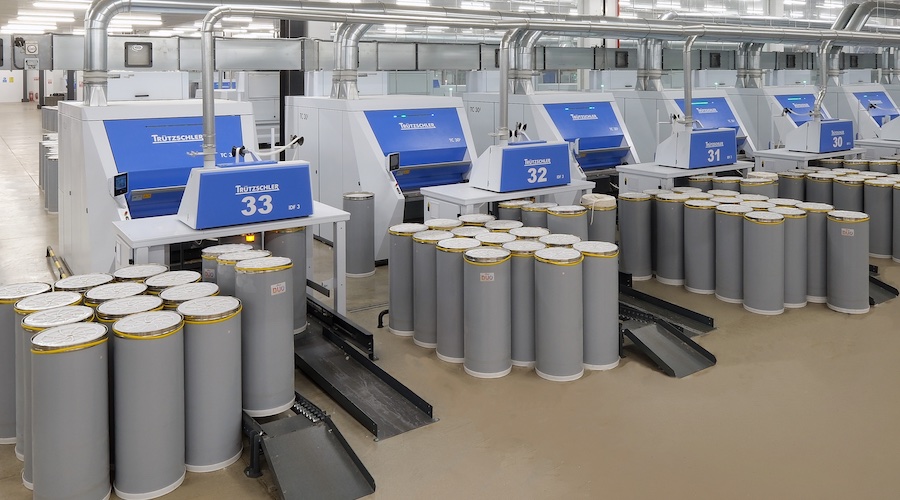
Trützschler’s Integrated Draw Frame (IDF) technology is at the heart of this collaboration. Gimatex is using these innovative solutions to produce high-quality yarn. In particular, IDF enables Gimatex to produce top-quality yarns from a uniquely wide variety of raw materials – from 100 percent cotton through to polyester, recycled fibers and blends of various different inputs.

Gimatex mainly uses Trützschler IDF to manufacture rotor yarns in a direct spinning process. Direct spinning means shortening the spinning process by eliminating draw frame passages. Fiber slivers are fed directly from the card into the integrated drafting passage. This direct spinning concept uses less electricity and less space than conventional draw frame passages, which helps Gimatex to cut costs while increasing output volumes – with no compromise in quality. Most often, IDF technology is used for rotor and vortex spinning. However, the team at Gimatex is now also one of the first spinning mills in India to develop a special IDF process for producing traditional and recycled ring yarn. This allows the company to leverage the same setup it uses for open-end yarn. The ring yarn produced in this unusual way is mostly coarser varieties and recycling blends for cotton / spandex (lycra) products, with Ne 10s and Ne 16s. The yarn goes through a blow room into a TC 15 card with IDF, before entering a Trützschler TD 10 draw frame, a speed frame and a ring frame.
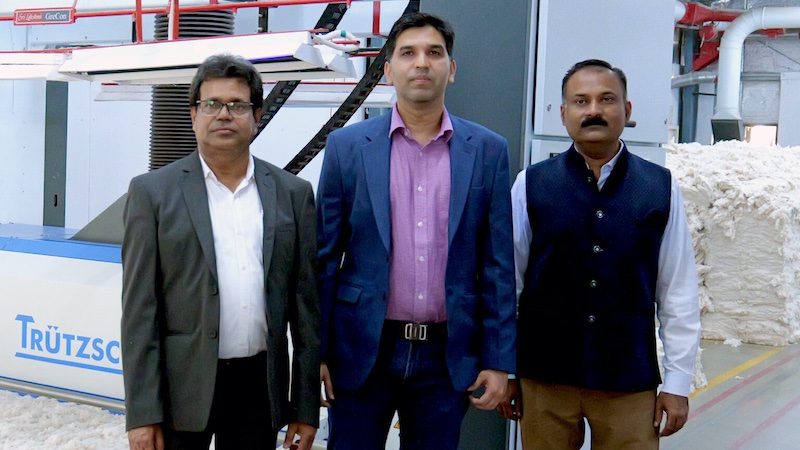
From left to right: Gautam Kumar Dhang (CEO Fabric Business Gimatex), Vineet Mohota (Director Gimatex) and Manish Deolankar (General Manager Gimatex) in front of Trützschler’s Bale Opener © 2024 Trützschler


Longstanding partnership

“The performance of Trützschler’s IDF machines is great,” says Mr. Mohota. “We also get support from Trützschler’s expert teams. They’re always available to give guidance and answer questions, and they’re able to access data from around the globe to share best practices for every application.” Gimatex and Trützschler have established a close relationship over a long period. IDF machines are a flexible, highly efficient and sustainable technology that is helping to extend that valuable partnership. As market conditions in India continue to evolve, we will keep working hand in hand to adapt to change successfully – while meeting high expectations from customers.
More News from Truetzschler GmbH & Co. KG

#Spinning

Perfect quality through collaboration: Machinery from Trützschler, Toyota and Murata at Zirve Tekstil

In today’s textile industry, excellence is not achieved by chance – it’s the result of deliberate decisions, technical expertise, and the courage to go beyond conventional paths. The Turkish company Zirve Tekstil has done just that: by combining the best technologies from Trützschler, Toyota and Murata, they’ve created a production setup that delivers outstanding yarn quality – recognized worldwide.

#Spinning

Details matter: How Trützschler cylinder wires boost efficiency in Pakistan’s spinning sector

Pakistan’s textile industry, especially its spinning sector, is the backbone of the national economy and a vibrant hub of innovation. Today’s spinning mills face growing demands for efficiency, quality, and sustainability. From the serene northern valleys to the vibrant port city of Karachi in the south, mills like Suraj Cotton Mills, Liberty, and Nishat Chunian are turning to advanced solutions.

#ITMA Asia + CITME Singapore 2025

T-CAN – Revolutionizing can transport

In virtually all spinning mills, transporting sliver cans is still done manually. Rising labor costs, lack of operators and increasing quality requirements make this a growing challenge. With T-CAN, Trützschler introduces a practical solution: a fully automated can transport system that will be presented live at ITMA ASIA 2025 in Singapore.

#Spinning

Pre-Cleaner CL-X: The future of cotton cleaning

What if the future of cotton cleaning was already here – setting a new standard for cleaning efficiency, productivity and energy savings? That future has a name: CL-X. Since its market launch in 2022, the Pre-Cleaner CL-X has become a true bestseller, proving its value in several hundred customer applications worldwide. Now, new results from Türkiye demonstrate again how the Pre-Cleaner CL-X outperforms the competition.

More News on Spinning

#Spinning

Rieter advances strategic repositioning amid market volatility

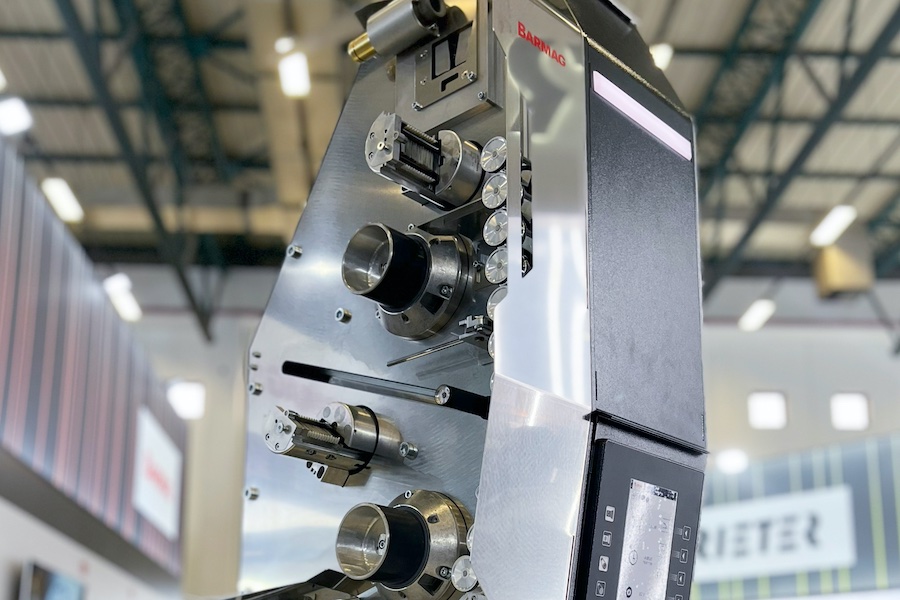
Rieter successfully completed the acquisition of Barmag on February 2, 2026, and reached an important milestone in the company’s repositioning. Barmag will be integrated into the Rieter Group as the “Man-Made Fiber” Division. With this strategically transformative acquisition, Rieter is expanding its core business beyond the short-staple fiber business in a targeted way. This positions Rieter as the global market leader along the entire value chain for natural and man-made fibers. In addition, as a complete systems supplier, Rieter is further strengthening its technological leadership in the areas of automation and digitization.

#Spinning

Measure and control the fiber – optimize yarn quality

Producing consistent yarn quality is an everyday challenge – and a very difficult one. Detailed knowledge and understanding of the fiber raw material is absolutely critical to achieving the best possible quality in the yarn. To help spinners, Uster experts have put together guidelines for avoiding yarn irregularity claims, in a special edition of the Uster News Bulletin.

#Spinning

A breakthrough innovation for diaper manufacturers

Developed and manufactured by Mesdan, Italy, the Loop knotter type 093E is a special version of the well-known Loop knotter, specifically designed to join hygiene-grade spandex yarns used in the personal care industry.

#Spinning

Rieter responds to higher raw material prices

Global political and economic developments have been leading to rising raw material and energy costs for some time. The textile machinery industry is also affected by this trend. Rieter machines and components consist to a large extent of steel, copper, aluminum and electronics. These materials in particular have seen higher demand and higher prices in recent months.

Latest News

#Associations

European Business Coalition welcomes provisional application of EU–Mercosur Agreement and calls for Swift and full implementation

With the European Commission’s decision to provisionally apply the EU–Mercosur Interim Trade Agreement, a process spanning more than 25 years now moves decisively into its implementation phase.

#Recycled_Fibers

Selenis to double capacity in Portugal by Q3 2027 - Accelerating the Global transition to circular and low-carbon polyesters

Selenis, a global leader in high-performance specialty polyesters and part of the IMG Group, has announced a transformational expansion of its industrial headquarters in Portalegre, Portugal. This strategic investment is set to double the site’s production capacity by the third quarter of 2027, significantly accelerating the industrial scale-up of bio-based, medical-grade, and circular co-polyesters.

#Technical Textiles

Independent testing confirms no detectable PFAS in Milliken firefighter turnout gear fabrics

Independent laboratory testing has confirmed that Milliken fabrics used in the manufacturing of firefighter turnout gear contain no detectable PFAS, based on third-party analysis conducted by Forever Analytical, an independent laboratory specializing in screening products and environmental samples for the presence of per- and polyfluoroalkyl substances (PFAS).

#Home Textiles

Intertextile Shanghai Home Textiles returns in August as global sourcing hub and trend barometer for home textiles industry

Following the conclusion of Heimtextil last month, the flagship fair in Messe Frankfurt’s global home and contract textiles portfolio, Intertextile Shanghai Home Textiles – Autumn Edition will return 18 – 20 August 2026 at the National Exhibition and Convention Center (Shanghai). Building on the momentum generated in Frankfurt, the Shanghai fair will reinforce its position as the foremost home and contract textile platform in Asia – successfully bridging the gap between East and West, and connecting global product trends, supply-chain shifts, and buyer demand in one marketplace.

TOP