[pageLogInLogOut]

#Spinning

Green Mindset for More Profit
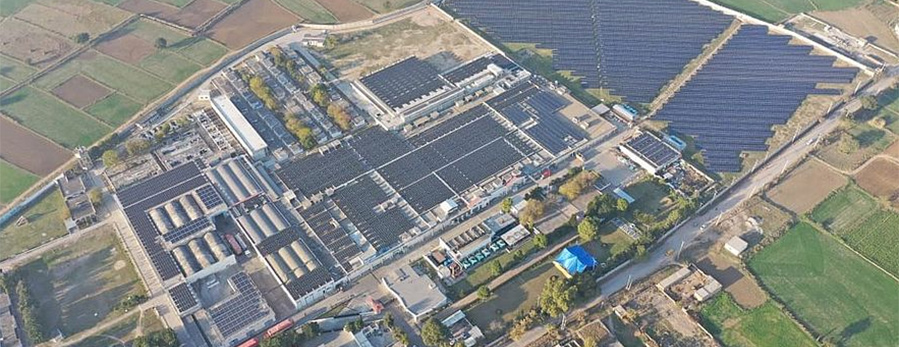
Aerial view of Kohinoor Textile Mills’ solar park achieving great energy efficiency. © 2023 Rieter
Kohinoor Mills is one of Pakistan’s largest vertically integrated textile operations with over 1 800 employees. The company delivers over 70 million meters of world-class grey, white and dyed fabrics to leading fashion brands and retailers around the globe. It is involved in three major businesses: weaving, dyeing & finishing and energy. Kohinoor Textile Mills’ spinning production facilities in Rawalpindi, Gujjar Khan comprise 158 544 ring spindles, 384 MVS spindles, and 2 712 open end rotors capable of spinning a wide range of yarn counts using cotton and man-made fibers.

The Challenge

To remain competitive, Kohinoor Textile Mills is continuously monitoring all of its cost factors to keep them at the lowest possible levels. With the ongoing rise of labor and energy costs, the company looked for ways to further optimize its operations. On one hand, Kohinoor Textile Mills invested in renewal energy, with the ambition to balance sustainability and profitability. On the other hand, the company turned to Novibra to boost its production while limiting costs.

The Solution

Kohinoor Textile Mills successfully installed a solar plant system with a capacity of 8.35 MW. This accomplishment not only makes the company the one and only spinning unit in Pakistan based on green energy at day time; it also results in significant energy savings.

Besides, the company equipped its ring spinning machines with some 21 600 NASA HPS spindles and CROCOdoff underwinding free crown. Thanks to the outstanding features of both Novibra products, Kohinoor Textile Mills benefited from lower downtime, better labor usage and energy saving.

The Customer’s Benefits

Kohinoor Textile Mills’ captive solar plant is creating up to 30% savings in energy. This has translated into cost andoperational efficiencies across processes. The combination of NASA HPS spindles and CROCOdoff clamping crowns eliminated expensive and time-consuming machine downtimes related to cleaning.

Kohinoor Textile Mills is thus able to run its machines for 10 to 15 more minutes, which corresponds to an additional 4.80 lb per machine per day for 1 200 spindles, equivalent to 1.44 bags per months. The quality parameters are also excellent as the company is operating its machines to the required speeds with minimum slip variation.

As a leader, Kohinoor adopts a green mindset and shows the industry that sustainability can bring more profitability.


"We have a very strong and long-standing working relationship with Novibra based on the following points: consistent products with very good life duration, reliability of products to help to maintain our maintenance cycle for such huge volume of spindles very effectively and remarkable after-sales service and quality."

Muhammad Irfan, General Manager, Kohinoor Mills Limited
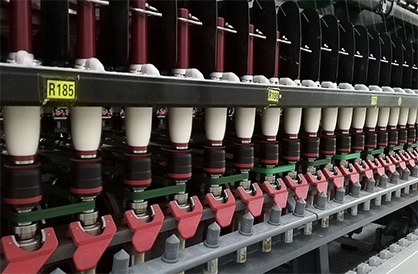

Kohinoor Textile Mills - NASA HPS 68 equipped with CROCOdoff and brake U28 © 2023 Rieter


More News from Rieter Textile Systems

#Spinning

Rieter sees Barmag integration on track as orders and sales rise

The first half of 2026 was shaped by the successful completion of the largest acquisition in Rieter’s history. The Man-Made Fiber Division enables entry into the growth segment of man-made fibers and sustainably strengthens Rieter’s market position in the Asia region. The expanded Group is now the world’s leading system supplier for the processing of natural and man-made fibers. In the first half of the year, initial cost savings in material costs and operating expenses have already been realized. The targeted synergies are expected to amount to at least CHF 20 million by the end of the 2028 financial year. Due to the completion of the acquisition on February 2, 2026, the first half of the year for the Man-Made Fiber Division only amounts to five months.

#Spinning

"We will become a recycling powerhouse"

The textile industry is now in its fourth consecutive year of crisis, while automation, artificial intelligence and recycling are reshaping the rules of the game. In this interview, Rieter CEO Thomas Oetterli discusses the first signs of a market recovery, reflects on his first three years at the helm of the company, explains the integration of Barmag, outlines Rieter’s vision of the fully automated spinning mill and highlights the strategic importance of recycling. In doing so, he explains why the new Rieter Group aims to play a leading role in transforming the textile value chain into a circular economy.

#ITM 2026

Rieter at ITM 2026: Spinning Redefined with Automation and Intelligence

Spinning mills need solutions that deliver stability, efficiency and future-proof performance. Rieter has put together a powerful portfolio for ITM 2026 in Istanbul, Türkiye. These innovations give customers the tools to enhance cost efficiency, improve responsiveness and actively develop their competitive edge. Step-by-step, Rieter is moving closer to its Vision 2027 – the fully automated spinning mill. With each new technology, Rieter enables spinning mills worldwide to operate with greater precision and reliability, ensuring they remain at the forefront of an increasingly demanding global market.

#Spinning

Rieter Annual General Meeting 2026: Shareholders approve all board proposals

At the Annual General Meeting of Rieter Holding Ltd. held on April 16, 2026, 342 shareholders representing 64.0% of the share capital approved all motions proposed by the Board of Directors. The shareholders adopted the Annual Report as well as the Financial Statements and Consolidated Financial Statements for 2025. They also granted discharge to the members of the Board of Directors and the Group Executive Committee for their activities in the reporting year. In an advisory vote, the 2025 Report on Non-Financial Matters was also approved.

More News on Spinning

#Spinning

Barmag Fuzhou Customer Day concludes successfully, boosting high-quality chemical fiber growth in Fujian & Guangdong

Barmag hosted its Customer Day themed “A New Era. Powered by Innovation.” in Fuzhou on June 28, welcoming nearly one hundred invited customers from Fujian and Guangdong provinces. Georg Stausberg, CEO of Barmag Group, attended along-side the sales and R&D expert China team to jointly present integrated solutions covering the entire man-made fiber value chain.

#Spinning

STEELTOP®: A new benchmark in flat tops for spinning preparation

Modern carding generations achieve higher production performance, placing significantly greater stress on flat tops. Higher cylinder speeds and increased fiber density, combined with tighter carding gaps, create more demanding operating conditions. At the same time, poorer raw material quality and the increased use of recycled materials further intensify these challenges. With STEELTOP®, Trützschler introduces a new full steel flat top series developed for these demanding modern carding processes.

#Spinning

Ibrahim Fibres and Trützschler: A strong partnership enters its next phase with the TC 30Si

For more than two decades, Ibrahim Fibres and Trützschler have grown side by side, driven by a shared ambition to continuously improve spinning performance, strengthen technology leadership and set new benchmarks in the textile industry. Today, Ibrahim Fibres is a leading yarn and polyester staple fiber manufacturer in Pakistan. The company operates the largest number of Trützschler cards in the country, with more than 200 machines running across its mills in Faisalabad, and plays an important role in one of Asia’s largest textile industries.

#Spinning

Object Carpet tests production of rPET BCF yarn on Neumag BCF line

In a joint project with Object Carpet GmbH, Denkendorf; the Institute for Textile Technology (ITA), Augsburg; and Next Generation Recyclingmaschinen GmbH (NGR), Feldkirchen, Austria, Barmag investigated the processing of recycled polyester for BCF yarn. The goal was to evaluate the fundamental suitability of 100% recycled carpet material for reuse in carpet yarn production to create a closed-loop system in carpet manufacturing. To date, commercial rPET BCF processes have been based solely on rPET from bottle pellets.

Latest News

TOP