[pageLogInLogOut]

#Spinning

The portal bale opener BO-P – the first step to optimum yarn quality
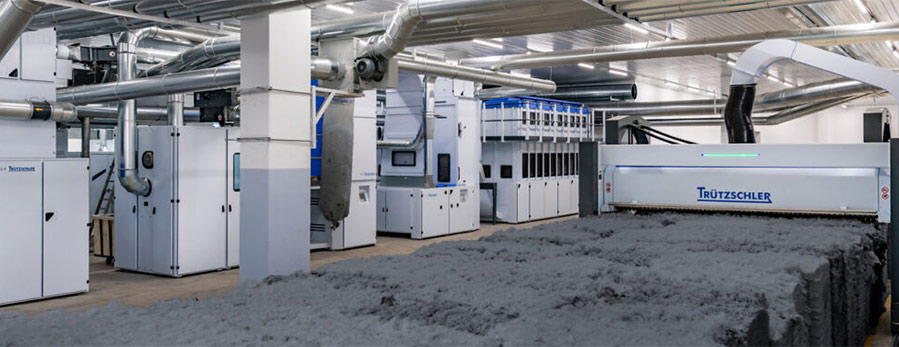
© 2022 Trützschler
Differences in trash content, color and packing density of bales repeatedly lead to quality fluctuations in the spinning mill. So do elementary fiber properties like length, fineness or degree of maturity. In times of rising raw material prices, bales from different origins and quality grades are increasingly combined into one bale feed – and they must be blended well to ensure consistent yarn quality. The portal bale opener (BO-P) is the answer to these challenges. Three years after its launch, there are more than 150 BO-Ps helping to meet the increased requirements for blending and fiber opening for customers worldwide.

Whether ring spinning, open-end, airjet or recycling applications, “the foundation for yarn uniformity is laid in the blow room,” says Mr. Shi Chuangong, owner of Xiajing Xinshixing Textile Co, Ltd from China, which produces 30 tons of combed cotton yarn daily in its spinning mill. “With its larger working width and fine opening rollers, the BO-P meets these requirements exactly.

The BO-P can process up to six bales at the same time. As a result, fluctuations in quality or color in the bale feed are already almost non-existent before the next process step. In comparison, bale openers that can only process three or four bales in parallel already have a blending gap of 50 percent at this stage (for three bales versus six bales), or 33 percent (for four bales versus six bales).
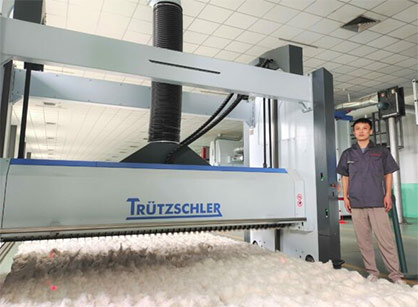
Mr. Hou Zongfei, Technical Chief Xiajing Xinshixing Textile Co., Ltd © 2022 Trützschler


Gentle opening, smaller fiber tufts, more efficient downstream processing

“The BO-P meets the requirements that we expect from a bale opener,” says Mr. Hakan Karagöl, General Manager Iskur Textile, which produces 130 tons of OE and 58 tons of ring yarn in various material combinations every day. “The advantages of fiber blending and opening that are possible for subsequent process steps when using the BO-P have clearly exceeded our expectations.”

Alongside the fiber blend, tuft size is another indicator of the quality of the fiber opening. The BO-P again benefits from its working width in this regard. For the same production quantity, the theoretical tuft size of the BO-P with a working width of 3500 mm is only half that of a bale opener with a working width of 1750 mm. The BO-P detaches the same amount of fiber material from twice the number of bales to achieve much finer tufts. In addition, the tooth density of the opening rollers is 25 percent higher compared to other bale openers. This makes detaching and cleaning the fiber tufts in the subsequent process steps considerably more efficient, so fewer good fibers are rejected.

Less space required

Today, spinning mills are faced with logistical challenges that require space-efficient solutions. In this context, the portal design of the BO-P offers a big advantage over other bale openers because less floor space is required for the same bale feed or production quantity.

The BO-P is also the right option for customers that want to process different materials with one bale opener. The number and length of different bale groups can be selected and programmed flexibly, up to 75 meters.


Higher productivity

The BO-P also sets new standards for productivity. It enables the production of 3000 kg/h (at 3500 mm working width) or 2500 kg/h (at 2900 mm working width).

Overview of the benefits of the BO-P:

  • Available as BO-P 2900 (working width 2900 mm) and BO-P 3500 (working width 3500 mm).
  • Production of up to 3000 kg/h.
  • Better blending.
  • Finer fiber tufts.
  • Flexible working areas with permanent access for bale inspection.
  • State-of-the-art and maintenance-free drives.
  • Production-optimized suction.
  • Intelligent safety system.
  • A T-LED remote display.


“Optimally mixed and gently opened fibers from the very beginning, combined with a consistently high production output, convince day after day,” says Mr. Hakan Karagöl, General Manager from Iskur Textile. “Many thanks to the entire Trützschler team.”
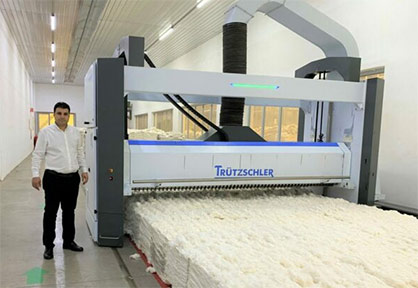
Mr. Hakan Karagöl, General Manager Iskur Textile. © 2022 Trützschler


More News from Truetzschler Card Clothing GmbH

More News on Spinning

#Spinning

Perfect quality through collaboration: Machinery from Trützschler, Toyota and Murata at Zirve Tekstil

In today’s textile industry, excellence is not achieved by chance – it’s the result of deliberate decisions, technical expertise, and the courage to go beyond conventional paths. The Turkish company Zirve Tekstil has done just that: by combining the best technologies from Trützschler, Toyota and Murata, they’ve created a production setup that delivers outstanding yarn quality – recognized worldwide.

#Spinning

Monitor, adjust, perfect

FiberGuard BCF is the name of the new system for real-time monitoring of yarn tension in all Neumag BCF production processes. Barmag, the innovation and technology leader for filament spinning systems, presented this innovation of its Neumag product line at ITMA Asia + CITME in Singapore last November. The new BCF yarn tension sensor is compatible with all current Neumag BCF machines and can be easily retrofitted to existing Neumag BCF S8 machines.

#Spinning

Rieter completes acquisition of Barmag

Rieter has successfully completed the acquisition of Barmag as of February 2, 2026. This strategically important acquisition makes Rieter the world’s leading system provider for natural and synthetic fibers.

#Spinning

atmos.io paves the way to the digital factory

UNITEX is expanding its capacity by a further 36,000 tons per year with a new filament yarn production plant. Once again, the Vietnamese company is relying on solutions from Barmag.

Latest News

#Associations

Engineering depth and diversity for composites

Airbond is the latest member of the British Textile Machinery Association (BTMA) to receive recognition for contributions to the composites industry. The engineering firm based in Pontypool, South Wales, has just received the Make UK Energy and Sustainability Award for its Lattice 3D Printing project.

#Research & Development

Award-winning research for sustainable carbon fibre cycles

Sustainable recycling of carbon fibres is possible through targeted electrochemical surface modification, which makes the sizing of carbon fibres resistant to solvolysis. ITA PhD student Sabina Dann was awarded the MSW Award from RWTH Aachen University for her master's thesis on this development. The award ceremony took place on 12 November 2025 in Aachen.

#Technical Textiles

Carrington Textiles and Pincroft unite defence expertise at Enforce Tac

Carrington Textiles and Pincroft return to Enforce Tac for the third time, presenting a co-branded stand that brings together textile manufacturing and specialist finishing under one roof.

#Yarns

Eastman introduces Naia™ Lyte at Première Vision Paris, marking a major breakthrough in fiber tenacity for cellulose acetate filament yarn performance

Eastman unveils Naia™ Lyte, a new cellulose acetate filament yarn that represents an important milestone in performance for lightweight and premium fabrics, at Première Vision Paris. Presented for the first time to the international fashion and textile community, Naia™ Lyte expands the capabilities of acetate yarn by introducing enhanced tenacity, unlocking new creative and technical possibilities for designers, mills and brands.

TOP