[pageLogInLogOut]

#Recycling / Circular Economy

Breaking new ground in Turkey’s textile industry
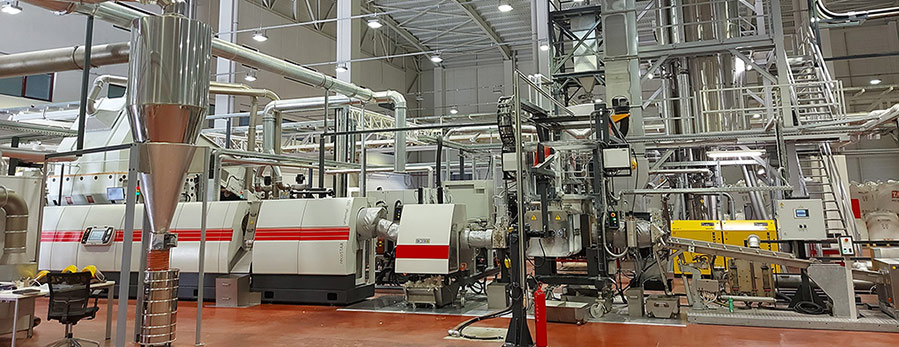
Starlinger recoSTAR universal 165 H-VAC iV+. © Starlinger
The Starlinger recoSTAR universal 165 H-VAC iV+, which is part of Korteks’ 10 million dollars investment in a new polymer recycling facility, took up operation in May 2021. It has a production capacity of 7,200 tons per year and currently processes clean in-house polyester fibers from production scrap together with washed post-consumer PET flakes at a ratio of 50/50.

Korteks, one of the world’s biggest yarn producers based in Bursa, Turkey, has started the production of recycled polyester filament yarn in its production facility using a Starlinger recycling line.

Korteks uses the polyester regranulate at a share of 100 % for its new polyester filament yarn line it is going to market under the name “TAÇ Reborn”. With this investment, the company has made an important step towards establishing a circular economy in the Turkish textile industry.
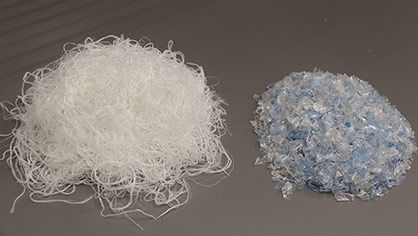
Korteks recycles polyester filament yarn waste and PET bottle flakes. © Korteks


“We have been in extensive cooperation with Starlinger for a long time” said Baris Mert, General Manager of Korteks. “Thanks to their unique and innovative recycling technology we can offer new products in line with the circular economy model. That's why, as Europe's largest integrated and innovative polyester yarn producer, we are very pleased to work with Starlinger, the market leader in PET and polyester recycling and refining.”

Rapid Sleeve Changer: Finest melt filtration for perfect yarn

The Starlinger recycling line is the first of its kind in Turkey and is equipped with special components for filament yarn recycling. A RSC (Rapid Sleeve Changer) candle filter developed by Starlinger ensures finest melt filtration down to 15 micrometer. It has been specially designed for polyester recycling and reaches an output of 1000 kg/h. For continuous operation the filter elements are changed “on the fly” without interrupting production, which significantly limits melt loss.

The viscoSTAR SSP unit at the end of the recycling process guarantees consistent IV increase according to the first-in-first-out principle. This makes sure that the produced regranulate has the ideal properties required for filament yarn production. The technical configuration of the line does not only allow the processing of a polyester fiber/PET flake mix as input materials, but also 100 % polyester filament scrap or 100 % PET bottle flakes.

With the new recycling facility, which comprises a total closed area of 17,000 m² and has a monthly production capacity of 600 tons, Korteks was able to reduce the production waste at its virgin PES yarn site to zero.
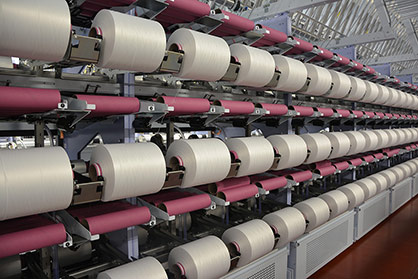
TAÇ polyester yarns are used in a wide variety of applications. © Korteks


A paradigm shift in synthetic fiber production

“We are proud to be a partner in Korteks’ quest for more sustainability in the textile business”, said Paul Niedl, Commercial Head of Starlinger recycling technology. “Turkey is a significant global player in this industry. If more and more Turkish textile manufacturers start using recycled materials, this will be an important signal for the sector and a big step towards a circular economy. We support this development with our extensive know-how in synthetic fiber recycling and supply the fine-tuned and reliable recycling technology required in this field.”
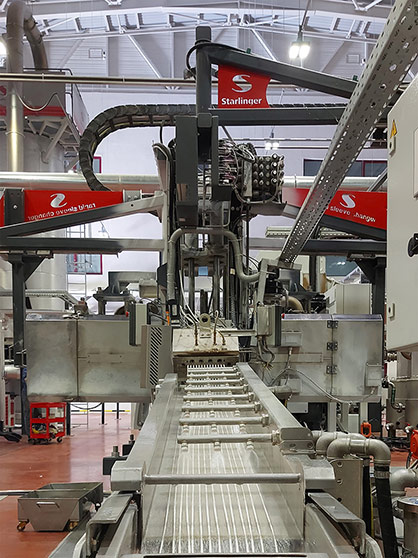
Filter change on the fly: The RSC candle filter before the strand pelletizer operates continuously and has a throughput of 1000 kg/h. © Starlinger


Korteks expects the recycling market in general to grow as there is increased acceptance for recycled products in the society, and predicts the need for recycling solutions also for other synthetic and natural fibers.

“At Korteks, we always aim at sustainable growth that reduces environmental impact and creates value. For this reason, we are gradually expanding our product range in sustainable and smart textiles every day”, said Baris Mert. “The period of the pandemic that the world has been going through has once again strikingly revealed the necessity of building a sustainable living together. The textile industry is also deeply affected by this big transformation on the globe. We believe that those who can manage this change well will also set the global textile agenda in the future. With this belief, we carried out the polyester recycling facility project with an investment of 10 million dollars. Thanks to this project, we broke new ground in Turkey and can produce polyester filament yarn from 100 % PET bottles. Having Starlinger at our side as a business partner gives us strength in our long-term journey towards sustainability.”

More News from Starlinger & Co GmbH

More News on Recycling / Circular Economy

#Recycling / Circular Economy

AI Circular Economy Conference 2026 fuels innovation at the intersection of AI and Circular Economy

The AI Circular Economy Conference 2026, organised by nova-Institute, brought together 116 participants from 15 countries in Cologne and online to explore the transformation of the chemical and materials industry supported and accelerated by artificial intelligence. During the two-day event, leading experts from industry, research, start-ups and the investment community discussed how AI can maximise the potential of renewable carbon creating efficient circular value chains. The conference featured 24 presentations and multiple panel discussions, highlighting the growing convergence of digital technologies and circular material systems. It demonstrated how artificial intelligence is progressing from the experimental stage to real industrial implementation within the circular economy.

#Recycled_Fibers

Circ deepens access to recycled fibers with Xinxiang Bailu Chemical Fiber Co., Ltd. partnership agreement

Circ®, a global leader in textile‑to‑textile recycling, today announced a new partnership agreement with Xinxiang Bailu Chemical Fiber Co., a Canopy Dark Green Shirt producer and one of the world’s leading producers of viscose filament. The agreement marks a significant step in Circ’s continued expansion in China and strengthens its position within the country’s rapidly evolving circular textile ecosystem; further supporting Circ’s ability to supply recycled fibers near existing fashion supply chains.

#Recycled_Fibers

Worn Again Technologies unveils the Accelerator

Worn Again Technologies unveils the Accelerator, the next major step towards commercialising its pioneering Textile-to-Fibre recycling process and proving the technical and economic feasibility of polycotton recycling.

#Recycling / Circular Economy

Textile‑to‑textile recycling leader Circulose joins Spinnova’s ecosystem to accelerate technology scale‑up

Textile‑to‑textile recycling leader Circulose joins Spinnova’s ecosystem (consortium) to help advance the scale‑up of Spinnova’s technology. Spinnova has actively sought partners to accelerate commercial scale‑up, and Circulose, as a key player in textile recycling, strengthens the ecosystem by providing a raw material that is in high demand across the industry.

Latest News

#INDEX 2026

EDANA unveils nominees for INDEX™26 Awards: Highlighting the next generation of nonwoven excellence

EDANA is proud to unveil the highly anticipated nominees for the INDEX™26 Awards, the nonwoven industry’s highest accolade for technical and sustainable excellence. Out of a record-breaking field of entries, these finalists represent the cutting edge of material science—from bio-based hygiene fibers and PFAS-free protective textiles to revolutionary water-filtration machinery. Each nominee has been selected by a jury of industry experts for their ability to solve critical global challenges, including the transition to a circular economy and the pursuit of enhanced consumer performance.

#Raw Materials

Lenzing Group positions bio‑based materials as a strategic asset for Europe’s economic security

The Lenzing Group, a leading supplier of regenerated cellulose fibers for the textile and nonwovens industries, hosted a high‑level roundtable in Brussels to discuss how bio‑based materials can strengthen Europe’s economic security and support the shift toward a fossil‑free future. Organized in cooperation with Euractiv, the event brought together representatives of the European Commission, the UK Mission to the EU, academia, civil society, and industry.

#Natural Fibers

Beyond Cotton: Natural Fibres in the Spotlight at the Bremen Cotton Conference - Branded by DNFI

Climate targets, fragile supply chains, and rising regulatory requirements are fundamentally changing the perspective of the textile industry - the focus is increasingly shifting toward the base material. Not only cotton, but natural fibres are gaining significant importance: they stand out not only because of their outstanding functional properties, but also because they make a valuable contribution to the bioeconomy and responsible product development.

#Textiles & Apparel / Garment

Coats to showcase innovative reinforcement and filler materials for leather goods and accessories at APLF 2026

Coats, a world-class Tier 2 manufacturer and trusted partner for the apparel and footwear industries, will be promoting four advanced materials from its ‘Lifestyle Solutions’ portfolio at APLF 2026 in Hong Kong in March. Each innovation has been specifically engineered to help luxury and premium brands elevate the craft, durability, sustainability and creative expression required in the manufacturing of handbags, purses, and other high-end designer accessories.

TOP