[pageLogInLogOut]

#Spinning

Spinning corespun yarns with SSM Dual Core
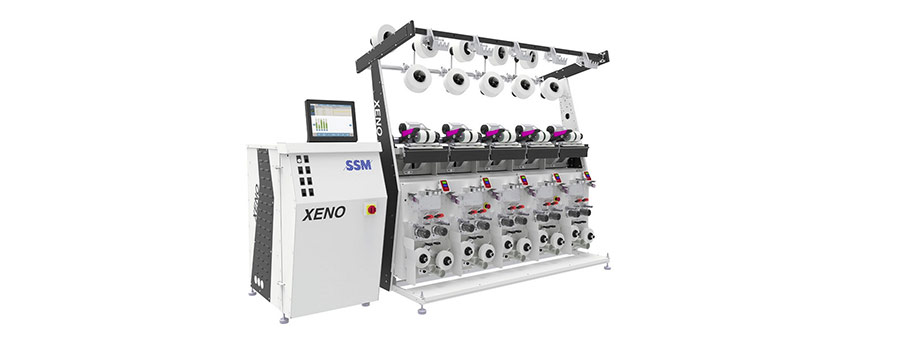
Air covering machine SSM XENO-AC TWIN for producing core yarns with a dual or triple core © 2021 SSM
In the past, items of clothing such as jeans were produced purely from cotton. Some time ago now, elastic woven fabrics became established in the clothing industry thanks to their positive characteristics. To produce these elastic yarns, so-called corespun yarns with a dual core that are spun on a ring spinning machine are used for weft threads and sometimes also warp threads. Due to the increased demand for elastic yarns, traditional ring spinning mills are upgrading their machines to compete in this market.

Corespun yarns that are used to produce woven stretch fabrics consist of an elastic core with a second spinnable fibre wrapped around its entire length. The core can only be made from elastane. Or alternatively, it is made from an elastane yarn and a textured filament yarn. This is known as a “dual-core yarn”. Today, there is even a trend for making the core from two elastane yarns with different drafts and yarn counts together with a textured filament yarn. These “triple-core yarns” further improve the characteristics of these woven stretch fabrics in terms of their stretch and shape-retaining characteristics.

Two Production Possibilities

There are essentially two methods of producing corespun yarns with a dual or triple core. In the first method, the elastane yarn and textured filament yarn are spun directly on a Rieter ring spinning machine with the spinnable fibres that act as sheathing. In the second method, the elastane yarn and textured filament yarn are doubled, air-covered and wound up together on a SSM XENO-AC TWIN machine (Fig. 1) before being processed on the ring spinning machine. In a second step, cotton is spun over the dual- or triple-core yarn located on the “cheese packages” (Fig. 2), for example using a Rieter ring spinning machine (Fig. 3). Both methods require specialized superstructural parts to be fitted on existing ring spinning machines.

For the direct method in which the dual- or triple-core yarn is not pre-wound, these superstructural parts are very tall. In order to reload the ring spinning machine, it must be switched off. This causes a productivity loss of around 13% in comparison to the indirect method. Furthermore, the operating personnel have to climb onto the ring spinning machine in order to place the bobbins with the textured filament. This is not only dangerous but also means that additional personnel are temporarily required who could be utilized for other operational tasks.
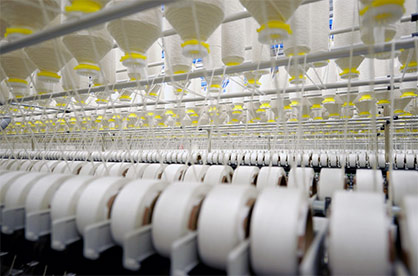
Spinning dual- or triple-core yarn on a ring spinning machine © 2021 SSM


Advantage Indirect Method

As discussed above, producing corespun yarns with a dual or triple core using the indirect method requires an additional work step: preparing the core yarn using the air covering machine SSM XENO-AC TWIN. The bobbin holder on the ring spinning machine needed for this solution is much lower and more user-friendly. A further advantage is that each spinning position can be loaded while all the other positions continue to operate. This means there is no production downtime while the machine is being reloaded. The conversion costs for both methods are around the same, with the SSM XENO-AC TWIN method being slightly cheaper.
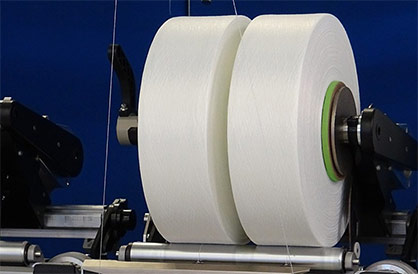
Cheese packages made of air-covered elastane and textured filament yarn © 2021 SSM


Air Covering Machine Ensures Consistent Quality

The main advantage of the indirect method with the air covering machine is that the core yarn is centered better during processing on the ring spinning machine and is very well covered with the spinning staple fibres as a result. This ensures that the core yarn is optimally protected. It is very difficult for the operator to detect a non-centered core yarn in the yarn. This flaw can only be seen once the fabric has been woven and dyed. Since elastane cannot be dyed, poor centering of the core yarn can create flawed spots in the woven fabric that disrupt its overall appearance. The air covering machine ensures consistent quality and consequently reduces complaints.

Excellent Entry Opportunity for Traditional Ring Spinners

Corespun yarns with a dual or triple core where the filament has already been doubled and air-covered on an air covering machine are therefore of a higher quality than corespun yarns produced directly on a ring spinning machine.

The method with the SSM XENO-AC TWIN offers traditional ring spinners an excellent opportunity to enter the elastic corespun yarn market and achieve success. This method is also very user-friendly and safe. No compromises on yarn quality have to be made.

Please do not hesitate to contact us for further information about the SSM applications and possibilities.

SSM Schärer Schweiter Mettler AG


More News from SSM Schärer Schweiter Mettler AG

More News on Spinning

#Spinning

Development of bio-based polyethylene fibers for textile applications – BB Engineering partici-pates in the bioPEtex research project

In the German research project bioPEtex, BB Engineering (BBE) is working with other partners to develop textiles made from 100% bio-based polyethylene (PE). The aim is to make use of this poly-mer, which has hardly been used in the chemical fiber industry to date. BBE is contributing its spinning and texturizing expertise and developing the texturing process on an industrial scale. The first promising results are already available – opening up new opportu-nities for sustainable and economically attractive applications in the textile industry.

#Techtextil 2026

Saurer sets new standards at Techtextil 2026

When the international textile industry gathers at Techtextil in Frankfurt from April 21 to 24, Saurer is going to present a powerful solution for the growing demands in the field of technical yarns with the TechnoCorder TC2plus.

#Techtextil 2026

High-performance yarns for tomorrow's mobility

At this year's Techtextil in Frankfurt (April 21–24), Barmag will be presenting comprehensive solutions for the production of industrial filament yarns at the VDMA joint stand (Hall 12, C56). The focus will be on applications that ensure greater safety, durability, and efficiency in automotive engineering.

#Spinning

Rieter advances strategic repositioning amid market volatility

Rieter successfully completed the acquisition of Barmag on February 2, 2026, and reached an important milestone in the company’s repositioning. Barmag will be integrated into the Rieter Group as the “Man-Made Fiber” Division. With this strategically transformative acquisition, Rieter is expanding its core business beyond the short-staple fiber business in a targeted way. This positions Rieter as the global market leader along the entire value chain for natural and man-made fibers. In addition, as a complete systems supplier, Rieter is further strengthening its technological leadership in the areas of automation and digitization.

Latest News

#Composites

More affordable, environmentally friendly hydrogen pressure tanks at ITA-JEC booth

As a highlight of the JEC, the Institut für Textiltechnik (ITA) of RWTH Aachen University will be presenting hydrogen pressure tanks manufactured using multifilament winding processes at the NRW joint booth in Hall 5, Stand G65.

#Textile chemistry

DyStar Group Announces Board Transition to Drive Innovation

DyStar, a leading specialty chemical company with a heritage of more than a century in product development and innovation, announced today the appointment of Ruan Cunfan to its Board of Directors, effective 20 February 2026.

#Recycling / Circular Economy

Textile‑to‑textile recycling leader Circulose joins Spinnova’s ecosystem to accelerate technology scale‑up

Textile‑to‑textile recycling leader Circulose joins Spinnova’s ecosystem (consortium) to help advance the scale‑up of Spinnova’s technology. Spinnova has actively sought partners to accelerate commercial scale‑up, and Circulose, as a key player in textile recycling, strengthens the ecosystem by providing a raw material that is in high demand across the industry.

#Yarns

UNIFI® introduces Luxel™: A Linen-inspired, easy-care performance yarn

Unifi, Inc. (NYSE: UFI), the makers of REPREVE® and one of the world’s leading innovators in recycled and synthetic yarns, today announced the launch of Luxel™, a groundbreaking yarn technology that combines the luxurious look and feel of linen with high-performance, easy-care, and textile-to-textile recycled materials.

TOP