[pageLogInLogOut]
TRÜTZSCHLER SPINNING - FROM WASTE TO VALUE

#Spinning

The portal solution for higher productivity and increased quality
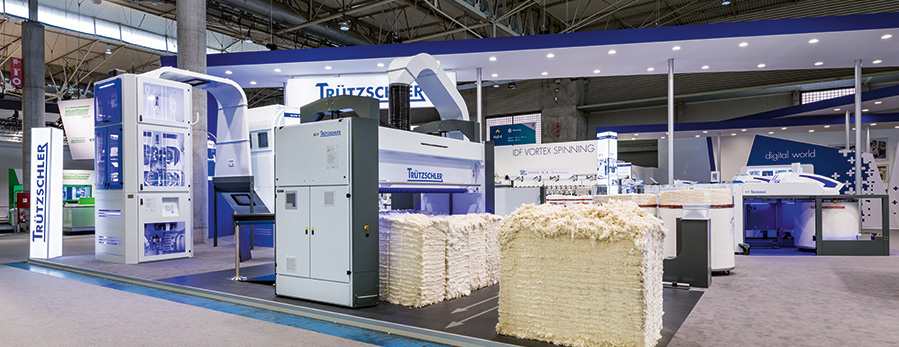
ITMA 2019 Booth (c) 2019 Truetzschler
The foundation for high yarn quality is established in the blow room. Careful bale opening is a fundamental pillar of this process. Only in this way, a homogenous tuft flow is ensured for optimal downstream processing. The latest Truetzschler innovation in the blowroom offers more quality and economy as well: The Portal Bale Opener BO-P allows significantly more bales to be placed side by side and processes them in parallel using two opening rolls. This results in significantly better blending and higher productions of up to 3,000 kg/h.

First customer feedback

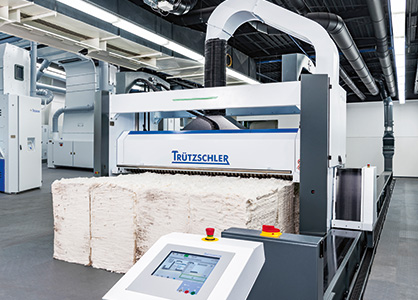
The Indian company Polytex was equipped with the first portal bale opener in India prior to ITMA in Barcelona. Within less than one week the entire installation and start-up was completed. By positioning the BO-P with a working width of 2,9 metres and a length of 60 metres close to a wall it was possible to save space. 
(c) 2019 Truetzschler


For the deputy general manager K. Sundara Rajan it was important to invest in the currently most secure bale opener on the market: “A comprehensive concept to ensure the safety of the employees is of great significance for the company. The combination of the high working width and the lower overall width was another essential argument for the purchase”. After about 7 months of experience with the BO-P the customer highlights also the low maintenance and the quiet operation.

Johannes Bossmann, design engineer, about the way from the idea to the finished product: “When the concept of the portal bale opener was presented at Truetzschler for the first time, the benefits for our customers were clear to see. At that time the BO-P was only an idea without any proof from the market and with many technical and technological challenges ahead. Truetzschler had the knowledge, experience and confidence to put this idea into reality. It’s a big joy to see that the BO-P is well received and that it performs the way we promised it to our customers.”

From a bale plucker to the portal bale opener

The Truetzschler blow room was born in the beginning of the 20th century. In 1902 Truetzschler started to expand its product range and began to build cleaning and dust removal systems for cotton processing. The first automatic bale work-off in form of a “bale plucker” was introduced in 1963. 16 years later, in 1979, the BLENDOMAT, which worked according to the “bale milling” principle, was created. Over the years the BLENDOMAT principle has been adopted by all machine builders worldwide. 2019 Truetzschler presented the next generation at the ITMA in Barcelona. The Portal Bale Opener BO-P sets new standards in quality and economy.

Better blending from the start

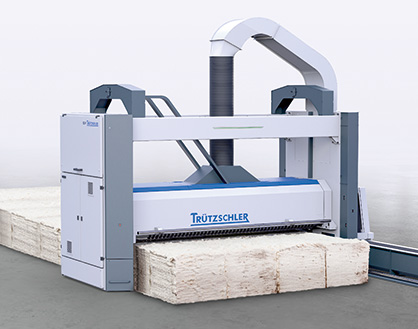
The new and unique portal concept makes the large working width possible in the first place. With a 2,9 m or 3,5 m width and a bale lay-down area of up to 75 m length, the Portal Bale Opener BO-P offers flexible bale placement. Because two opening rolls work in parallel, tufts from 5 to 14 bales are processed simultaneously. This lays the foundation for homogeneous blending in the blow room.

(c) 2019 Truetzschler


Increased opening and higher performance

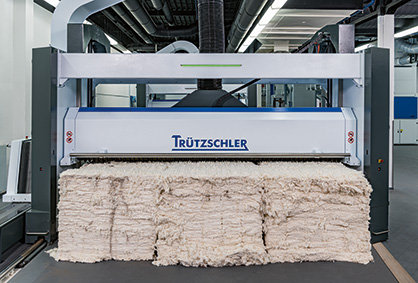
The two longwork-off rolls have nearly twice as many teeth, newly arranged. This results in a fiber-friendly work-off and a uniform, homogeneous surface appearance. Due to the large working width and the simultaneous use of two opening rolls, small tufts are already produced during the first process in the spinning mill. This is impossible for systems with only one roll and a smaller working width. The new conditions allow productions of up 3.000 kg per hour. 
(c) 2019 Truetzschler


Less space requirement and better accessibility

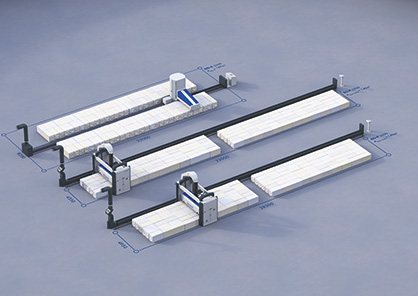
The bale work-off couldn’t be more compact and space-saving. With a working width of 3.5 m, up to 460 bales can be combined to a bale lay-down. An intelligent workplace protection on the BO-P does not require any space-consuming safety areas. To make optimal use of the space, the BO-P can also be positioned close to the wall with free access to the bale lay-down area. In addition, the new bale lay-down on only one side considerably simplifies the bale logistics in the spinning mill. The long bale lay-down area can be flexibly used. The areas can have different lengths. This, for instance, can be beneficial to span an unattended night shift or weekend. 
(c) 2019 Truetzschler


Simple and easy to operate

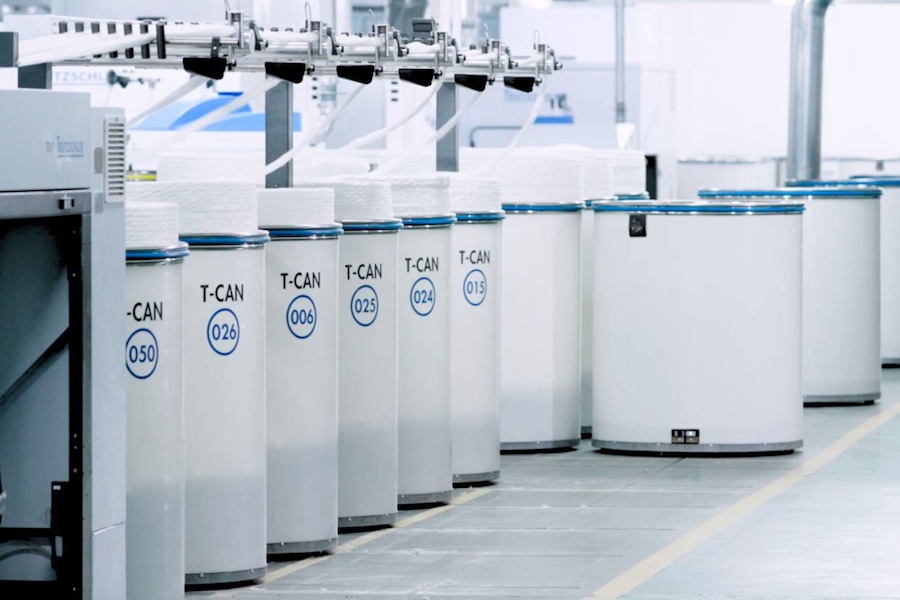
The remote display T-LED clearly indicates the operating status also at a larger distance and eliminates unnecessary walking for the operator. In case of malfunctions and prior to machine start-up, clear visual warnings are issued.
(c) 2019 Truetzschler


More News from Truetzschler GmbH & Co. KG

#ITM 2026

Trützschler’s Integrated Draw Frame IDF 3: Unlocking the full potential of short fiber processing

Spinning mills worldwide are looking for solutions that combine higher productivity, stable quality and shorter processes, especially when processing short fibers. Trützschler’s integrated draw frame IDF 3 has proven to be a powerful answer to these requirements. Evaluations from several customer trials in Türkiye under real production conditions highlight the strong performance of the IDF 3, particularly when combined with the next-generation card TC 30i.

#ITM 2026

Experience Trützschler’s leading fiber processing technologies at ITM 2026

From June 9 to 13, the Trützschler Group will present its latest machinery, service expertise and digital solutions at ITM 2026 in Istanbul, Türkiye. Visitors are invited to explore innovations across Spinning, Card Clothing, and Nonwovens at Hall 7, Booth 714A at the Tüyap Fair Convention and Congress Center. They can experience modern fiber processing with Trützschler!

#Spinning

Perfect quality through collaboration: Machinery from Trützschler, Toyota and Murata at Zirve Tekstil

In today’s textile industry, excellence is not achieved by chance – it’s the result of deliberate decisions, technical expertise, and the courage to go beyond conventional paths. The Turkish company Zirve Tekstil has done just that: by combining the best technologies from Trützschler, Toyota and Murata, they’ve created a production setup that delivers outstanding yarn quality – recognized worldwide.

#Spinning

Details matter: How Trützschler cylinder wires boost efficiency in Pakistan’s spinning sector

Pakistan’s textile industry, especially its spinning sector, is the backbone of the national economy and a vibrant hub of innovation. Today’s spinning mills face growing demands for efficiency, quality, and sustainability. From the serene northern valleys to the vibrant port city of Karachi in the south, mills like Suraj Cotton Mills, Liberty, and Nishat Chunian are turning to advanced solutions.

More News on Spinning

#Spinning

Object Carpet tests production of rPET BCF yarn on Neumag BCF line

In a joint project with Object Carpet GmbH, Denkendorf; the Institute for Textile Technology (ITA), Augsburg; and Next Generation Recyclingmaschinen GmbH (NGR), Feldkirchen, Austria, Barmag investigated the processing of recycled polyester for BCF yarn. The goal was to evaluate the fundamental suitability of 100% recycled carpet material for reuse in carpet yarn production to create a closed-loop system in carpet manufacturing. To date, commercial rPET BCF processes have been based solely on rPET from bottle pellets.

#Spinning

New spinning package with two-step filtration for recycled yarns and more

At the ITM in Istanbul, BB Engineering unveiled its new, patented ValuePack spinning package for the first time, which features a two-stage filtration system. This is particularly beneficial for re-cycling processes. Until now, spinning packs have used either metal powder (“sand”) or filter candles as filter media. Both options are suitable for differ-ent applications, and each has its own specific advantages and dis-advantages.

#Research & Development

GenuTrace client advisory: Is your cotton supply chain UFLPA ready?

U.S. Customs and Border Protection has released updated operational guidance (CBP Publication No. 5560-0526) expanding its forced labor enforcement framework. The guidance supersedes the original 2022 UFLPA Operational Guidance and now covers all forced labor enforcement authorities — UFLPA, CAATSA, and WROs/Findings — in a single unified document. For cotton importers, the enforcement posture has not softened. It has become more structured, more documented, and more demanding. Learn more about UFLPA.

#Spinning

"We will become a recycling powerhouse"

The textile industry is now in its fourth consecutive year of crisis, while automation, artificial intelligence and recycling are reshaping the rules of the game. In this interview, Rieter CEO Thomas Oetterli discusses the first signs of a market recovery, reflects on his first three years at the helm of the company, explains the integration of Barmag, outlines Rieter’s vision of the fully automated spinning mill and highlights the strategic importance of recycling. In doing so, he explains why the new Rieter Group aims to play a leading role in transforming the textile value chain into a circular economy.

Latest News

#Natural Fibers

Cotton made in Africa partners receive top marks in independent verifications

Cotton made in Africa® (CmiA) and CmiA Organic are two internationally recognised standards that aim to promote sustainable development in the African cotton sector south of the Sahara. To ensure the standards’ credibility among brands, retailers, and consumers, independent verifiers evaluate compliance on the ground. The verification results for 2025, now published in the Aggregated Verification & Implementation Report, were very strong: The verifiers awarded consistently very good remarks regarding management, people, prosperity, and the environment.

#Associations

Bangladesh: Italian textile machinery mission stops in Dhaka and Chittagong

Technological upgrading and the transition toward higher value-added production are driving the new Italian industrial mission to Bangladesh. This year, the mission will split between the country’s two main manufacturing hubs, where Italian manufacturers will meet the leaders of the local textile supply chain in two strategic stages: July 7th in Dhaka and July 9th in Chittagong.

#Recycling / Circular Economy

RE&UP establishes Fiber Club consortium to scale Next-Gen material sourcing

Originally developed as an umbrella framework by innovation platform Fashion for Good, the RE&UP Fiber Club aims to accelerate the commercial adoption of circular Next-Gen materials across the global fashion ecosystem.

#Yarns

Yarn Expo Shenzhen 2026 closes doors, advancing sustainable and innovative sourcing in South China

Yarn Expo Shenzhen 2026 served as a strategically positioned mid-year sourcing platform for the Greater Bay Area, highlighting Shenzhen’s role in connecting regional demand, supply and innovation exchange across the textile value chain. During the three-day fair, over 20,000 visits were drawn from 74 countries and regions[1], as exhibitors and buyers engaged with new developments in greener, performance-led, and value-added yarn and fibre solutions. Held in conjunction with Intertextile Shenzhen Apparel Fabrics and PH Value, the fair underscored the benefits of closer synergy and new materials across yarn, fabric and apparel platforms for the South China market.

TOP