[pageLogInLogOut]

#Recycling / Circular Economy

Recycling Atelier Augsburg and Kelheim Fibres cooperate
© ITA Augsburg gGmbH
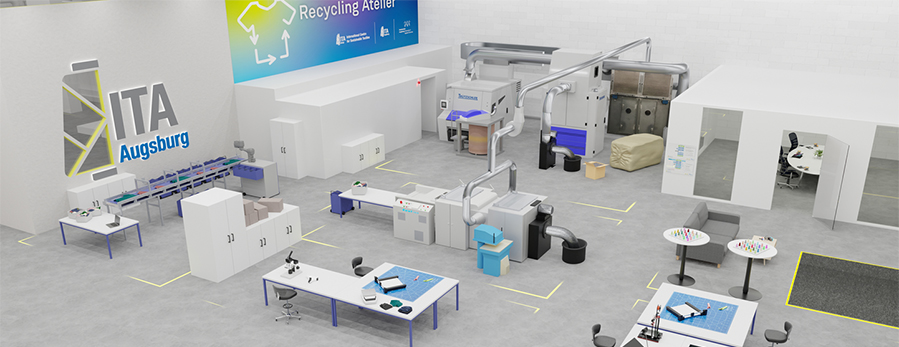
Kelheim Fibres, the world's leading manufacturer of viscose speciality fibres, has joined Recycling Atelier Augsburg. Recycling Atelier Augsburg is a unique centre for research and development in the field of textile recycling. It is located at the Institut für Textiltechnik Augsburg an affiliated institute of Augsburg University of Applied Sciences. The two institutions founded the Recycling Atelier in June 2022 together with twelve partners from the German textile industry.

As a model factory, the Recycling Atelier Augsburg combines the most important processes of textile recycling and offers holistic and comprehensive research along the value chain," explains Georg Stegschuster, head of the Recycling Atelier Augsburg.

The scientists research on all process steps of textile recycling: from material analysis to sorting, preparation and textile processing to sustainable product design. Comprehensive data collection and the use of artificial intelligence as well as innovative materials play a central role.

Kelheim Fibres is a producer of high-quality viscose fibres, which consist of cellulose, the main component of the renewable raw material wood, and are used worldwide for products in areas such as hygiene, textiles, and technical applications.


"In New Business Development as well as Fibre and Application Development, we follow the Open Innovation concept - the cooperation with the Recycling Atelier offers us an ideal platform for this. Here we work with partners to advance sustainability and performance," explains Maik Thiel, project manager at Kelheim Fibres.

Recycled cotton fibres are often very short or of uneven length, which makes further processing of 100 % recycled material a challenge. This is where the speciality fibres from Kelheim Fibres come into play, whose addition should enable the production of high-quality new products, such as nonwovens. In the future, the fibres provided by Kelheim Fibres will also be made from recycled pulp. Closing the loop further.

In the Recycling Atelier, the focus is on the triad of technical and ecological sense as well as economic benefit. In this way, the partners of the Recycling Atelier are standing up against fast fashion, outsourced corporate responsibility and a general decline in raw material quality, which often fuels downcycling - the low-quality reuse - of materials.

More News from Institut für Textiltechnik of RWTH Aachen University (ITA)

#Research & Development

Elastic yarns to become more recyclable and environmentally friendly in future

On 29 April 2026, ITA student Tobias Dickmeiß was awarded a sponsorship prize by the Wilhelm Lorch-Stiftung for his innovative approach, to replacing conventional elastane with elastic yarns made from thermoplastic copolyester elastomers (TPC). Thanks to their thermoplastic nature and compatibility with typical polyesters used in the textile industry, elastic TPC yarns offer improved recyclability. Furthermore, the use of the melt-spinning process in yarn production eliminates the need for solvents that are harmful to the environment and human health.

#Research & Development

Walter Reiners Foundation Prize awarded to three ITA graduates

Sabina Dann, Lukas Balon and Annegret Storm from the Institut für Textiltechnik (ITA) of RWTH Aachen University were awarded the Walter Reiners Foundation Prize by the German Engineering Federation (VDMA) for their master’s and bachelor’s theses. Peter Dornier, Chairman of the Walter Reiners Foundation, presented the awards during Techtextil at the VDMA stand in Frankfurt am Main, Germany.

#Research & Development

ITA spin-off Solid Air (SA) Dynamics reaches the semi-finals of the Rice Business Plan Competition

The ITA spin-off SA Dynamics has been nominated for the semi-finals of this year’s Rice Business Plan Competition (RBPC), one of the world’s most prestigious start-up competitions, held at Rice University in Houston, Texas.

#Techtextil 2026

Smart textiles can also be sustainable, eco-friendly and AI-powered – ITA at Techtextil 2026

Sports shoes made from algae, leggings made from mushrooms, filtering (diesel) oil from water, 4D textiles, recyclable, sustainable and featuring AI – this is what the ITA Group is presenting at three individual stands run by ITA Aachen, ITA Augsburg gGmbH and ITA Technologietransfer GmbH on the joint stand of Elmatex in hall 12.0 D05.

More News on Recycling / Circular Economy

#ITM 2026

BB Engineering unveils new, patented “Val-uePack” spin pack at ITM

At the upcoming ITM in Istanbul, taking place June 9–13 at the Tüyap Fair Convention and Congress Center in Hall 7, Booth 702B, BB Engineering will once again be represented at a joint booth with its parent company, Barmag, and its representative, Tekstil Servis. The German machine manufacturer will show-case its expertise in man-made fiber and recycling technology, presenting its entire product portfolio, which includes compo-nents such as extruders and filters, as well as complete sys-tems for spinning synthetic fibers, air-texturing, and PET recy-cling.

#Recycled Fibers

Syre expands partnership with Target to advance next-generation recycled materials at scale

Advancing next-generation materials to support scalable circular solutions across global retail Stockholm, May 2026 — Syre, the textile impact company hyperscaling textile-to-textile recycling today announced an expanded collaboration with Target to accelerate the adoption of next-generation recycled materials across retail at scale.

#Recycling / Circular Economy

Project REWEAR investigates diverse economies of rewear as a global practice of circularity

Every year, European households discard millions of tonnes of clothing. Around a quarter of what gets separately collected is exported, much of it classified as rewearable. A significant share ends up in markets like Kantamanto in Accra, Ghana, where an estimated 15 million garments arrive every week. New research published today reveals what happens when that clothing arrives.

#Recycling / Circular Economy

RE&UP contributes to Global Fashion Summit 2026 circularity discussion

RE&UP contributed to the global conversation on textile circularity at Global Fashion Summit 2026 in Copenhagen, where Fatih Konukoğlu, Chairman of RE&UP and Vice Chairman of Sanko Holding, took part in both the keynote session “The New Rules” and the panel discussion “A Reckoning and Renewal for Circular Horizons”, alongside leaders from H&M Group, Looper Textile Co. and Sourcing Journal.

Latest News

#INDEX 2026

“We clearly see that reliability, flexibility, service and total cost of ownership are becoming increasingly important again.”

The nonwovens industry continues to face a challenging market environment. Nevertheless, AUTEFA Solutions reports successful projects, new line sales and growing demand for energy-efficient and flexible solutions. In this interview, André Imhof of AUTEFA Solutions talks about competitiveness against Chinese suppliers, new service and recycling concepts, the growing importance of application development and the opportunities created by countercyclical investments.

#INDEX 2026

“Needle punching technology is more universal and sustainable than ever!”

Needle punching technology was long regarded as a rather traditional and comparatively slow technology within the nonwovens industry. In this interview, Johann Philipp Dilo explains why needle punching is more relevant than ever today – ranging from energy efficiency and resource conservation to hygiene applications, new machine concepts and design-oriented nonwoven solutions.

#Research & Development

Textile climate control system in workwear – exhibition at the 2026 SME Innovation Day!

Conventional protective workwear often reaches its limits during strenuous physical activity. In particular, the transport of sweat and excess body heat poses a problem. The German Institutes of Textile and Fiber Research (DITF) conducted research on flow-optimized, air-conducting textile structures that enable targeted climate control directly on the body. These structures can be integrated straight into protective work garments. The textile climate control system supports the body’s natural thermoregulation. This contributes to improved workplace safety and comfort.

#Nonwovens

PET spunbond from China – EDANA welcomes imposition of provisional anti-dumping measures

On 13 May 2026, after eight months of investigation, the European Commission imposed provisional anti-dumping duties of 45.6-50.0% on imports of PET spunbond from China. EDANA welcomes this expression of the Commission’s clear determination to protect EU industries from the unfair trade practices of Chinese producers.

TOP