[pageLogInLogOut]

#Research & Development

Cheaper Formula 1 cars

© pixabay
Carbon is the stuff Formula 1 racing cars are made of, in particular the car body. But carbon is expensive. It can be produced cheaper and more efficient if artificial intelligence (AI) monitors the production process. A camera system combined with AI automatically detects defects in the production of carbon fibres. This makes expensive manual inspection of the carbon fibres obsolete and the production price of the carbon fibre can be re-duced in the long term.

For this idea, the young engineer Deniz Sinan Yesilyurt received the second prize of the "Digitalisation in Mechanical Engineering" Young Talent Award on 6 December.

Carbon fibres are sought after because of their good mechanical properties. They are very light - weighing up to 50 percent less than aluminium by the same strength. This offers many advantages. Especially in times of energy transition, lightweight materials like carbon are more relevant than ever. At the same time, carbon fibres are as resistant to external stresses as metals. However, achieving these good properties of carbon fibres is very complex.
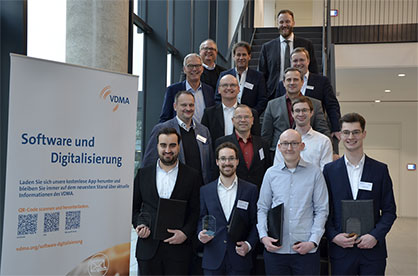
The lucky winners - first row, far left: Deniz Sinan Yesilyurt © VDMA


Up to 300 individual fibre strands - bundles of individual fibres - have to be monitored simultaneously during production. If carbon fibres break, it costs time and money to remove the damaged fibres. This is just one example of various defects that can occur in the fibres during production.


Therefore, Mr Yesilyurt attached a camera to the carbon fibre line that takes pictures of various fibre defects during production and collects them in a database. The artificial intelligence in the camera's information technology system evaluates the fibre defects by assigning the images to predefined reference defects. Hence, it recognises various fibre defects with a classification accuracy of 99 per cent. The process developed by Mr Yesilyurt can also be used in other areas that produce chemical fibres.

Deniz Sinan Yesilyurt received the prize from the German Engineering Federation (VDMA) in Frankfurt am Main, Germany. He is a Bachelor's graduate at the Institut für Textiltechnik (ITA) of RWTH Aachen University. The full title of his bachelor's thesis is: "Development of a Kl-supported process monitoring using machine learning to detect fibre damage in the stabilisation process". The VDMA awarded the prize to a total of four theses from different universities from Germany, Austria and Switzerland.



More News from Institut für Textiltechnik of RWTH Aachen University (ITA)

#Research & Development

TERNAfil wins first place at PitchMiUp Night 2026 in Minden

The RWTH spin-off TERNAfil has developed MAXCarbon, a new high-performance hybrid fibre that combines the mechanical performance of carbon with the temperature and corrosion resistance of ceramic materials. For this development, TERNAfil was awarded first prize at the PitchMiUp Night in Minden on 21 May 2026.

#Research & Development

Carbon-ceramic hybrid fibre proves its worth – NRW Minister for Science Mona Neubaur congratulates ITA start-up TERNAfil

MAXCarbon technology, a novel carbon-ceramic hybrid fibre developed by ITA spin-off TERNAfil, secured third place at the HIGH-TECH.NRW Demo Day on the TÜV NORD campus in Essen. The technology combines the strength of carbon fibres with the temperature and corrosion resistance of ceramic materials. Mona Neubaur, Minister for Science in North Rhine-Westphalia, congratulated the team on their success and on winning prize money of 4,000 euros.

#Research & Development

TCLF: Resilient value chains in times of crises

The textiles, clothing, leather and footwear (TCLF) industry was at the centre of the webinar “Resilient value chains in times of crises”, which took place on 28 April 2026. Global supply chains continue to face increasing pressure, raw material dependencies are growing and economic uncertainties are affecting the entire sector.

#Research & Development

Elastic yarns to become more recyclable and environmentally friendly in future

On 29 April 2026, ITA student Tobias Dickmeiß was awarded a sponsorship prize by the Wilhelm Lorch-Stiftung for his innovative approach, to replacing conventional elastane with elastic yarns made from thermoplastic copolyester elastomers (TPC). Thanks to their thermoplastic nature and compatibility with typical polyesters used in the textile industry, elastic TPC yarns offer improved recyclability. Furthermore, the use of the melt-spinning process in yarn production eliminates the need for solvents that are harmful to the environment and human health.

More News on Research & Development

#Research & Development

GenuTrace client advisory: Is your cotton supply chain UFLPA ready?

U.S. Customs and Border Protection has released updated operational guidance (CBP Publication No. 5560-0526) expanding its forced labor enforcement framework. The guidance supersedes the original 2022 UFLPA Operational Guidance and now covers all forced labor enforcement authorities — UFLPA, CAATSA, and WROs/Findings — in a single unified document. For cotton importers, the enforcement posture has not softened. It has become more structured, more documented, and more demanding. Learn more about UFLPA.

#Research & Development

“Production is a product”

From technical textiles and AI-driven robotics to the limitations of textile circularity: Professor Dr Thomas Gries looks back on more than two decades of development at ITA Aachen. In the interview, he explains why production technology remains a decisive success factor, discusses international collaborations and innovation ecosystems, and shares his views on the transformation of production landscapes and the challenges facing an increasingly regulated industry.

#Research & Development

Textile climate control system in workwear – exhibition at the 2026 SME Innovation Day!

Conventional protective workwear often reaches its limits during strenuous physical activity. In particular, the transport of sweat and excess body heat poses a problem. The German Institutes of Textile and Fiber Research (DITF) conducted research on flow-optimized, air-conducting textile structures that enable targeted climate control directly on the body. These structures can be integrated straight into protective work garments. The textile climate control system supports the body’s natural thermoregulation. This contributes to improved workplace safety and comfort.

#Research & Development

Walter Reiners Foundation Prize awarded to three ITA graduates

Sabina Dann, Lukas Balon and Annegret Storm from the Institut für Textiltechnik (ITA) of RWTH Aachen University were awarded the Walter Reiners Foundation Prize by the German Engineering Federation (VDMA) for their master’s and bachelor’s theses. Peter Dornier, Chairman of the Walter Reiners Foundation, presented the awards during Techtextil at the VDMA stand in Frankfurt am Main, Germany.

Latest News

#Carpets

DOMOTEX Hannover 2028 off to a strong start with expanded portfolio

Preparations for DOMOTEX 2028 are already gaining strong momentum. Following its successful repositioning as the Home of Flooring & Interior Finishing, around 100 international manufacturers have already secured their place during the initial registration phase.

#Knitting & Hosiery

STOLL: Agreement signed for the divestiture of selected assets

In early 2025, KARL MAYER announced its strategic decision to focus on its core business areas of WARP KNITTING, WARP PREPARATION, and TECHNICAL TEXTILES. As part of this move, the flat knitting machine business under the STOLL brand was discontinued and the production site in Reutlingen was closed in October 2025.

#Nonwovens

Lenzing Group highlights scalable, bio-based nonwovens solutions at leading global industry fairs

From CIDPEX in China to Techtextil in Frankfurt and INDEX in Geneva, the Lenzing Group showcases ready-for-market, bio-based nonwoven solutions and receives industry recognition for LENZING™ Nonwoven Technology.

#Digital Printing

DTF vs DTG Printing - The technologies shaping today’s custom merchandise market

From sportswear to branded tote bags, custom merchandise continues to grow in popularity across sectors, driving print shops to cater to short runs, personalisation, and rapid turnaround. As print providers look to this market, two printing technologies often stand out: Direct‑to‑Film (DTF) and Direct‑to‑Garment (DTG). Each offers its own benefits, and understanding these differences helps determine the most suitable production method for print service providers.

TOP