[pageLogInLogOut]

#Research & Development

The VR glove from the 3D printer
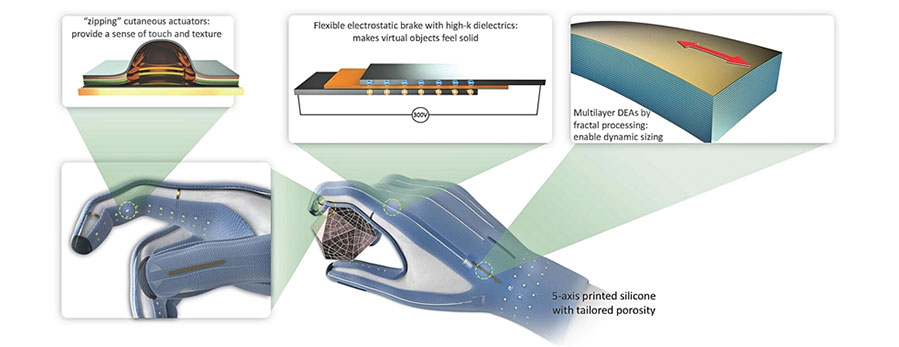
Mm-size hydraulically amplified electrostatic acutators provide a sense of touch and texture (left). High force electrostatic clutch actuators, that can block finger joints make virtual objects feel solid (middle). Multi-layer Dielectric-Elastomer-Actuator for active sizing of the glove and local compression (right). Illustration: Herbert Shea, EPFL (2021) © 2022 Empa
Together with EPFL and ETH Zurich colleagues, an Empa team is developing next-generation VR gloves that will make virtual worlds tangible. The glove is to be tailored to each user and capable of being produced largely automatically – using a 3D printing process.

Research sometimes needs a sacrifice. Empa researcher Patrick Danner has just made one – and filmed it. "When I applied a good 2000 volts to the sample, it caught fire," he reports drily in the debriefing. The mishap is clearly visible in his cell phone video: First it smokes, then flames erupt from the experimentally created polymer. "Hopefully, you were still able to save a piece of it," counters Dorina Opris, head of the "Functional Polymeric Materials" research group. A piece of evidence is important to learn from the result and draw conclusions.
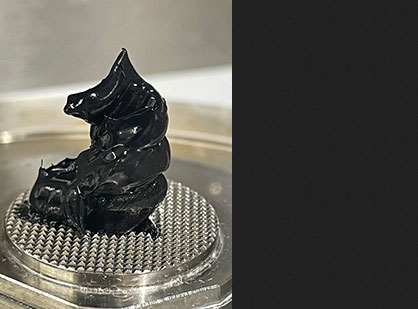
The desired electroactive polymer should have a consistency similar to hand cream so that the artificial muscles can be produced automatically in a 3D printer. Image: Empa


With their research on electroactive polymers, Dorina Opris and Patrick Danner are part of a large-scale project called "Manufhaptics". The goal of the four-year project, led by Herbert Shea of the Soft Transducers Lab at EPFL, is a glove that makes virtual worlds tangible. Crucially, all of the glove's components, which exert various forces on the surface of the hand, are to be producible in a 3D printer. So this is about research into new materials, with the production method being considered from the very start.

Three types of actuators

To make virtual surfaces feel real and objects tangible at the right size, the research teams from EPFL, ETH Zurich and Empa want to integrate three different types of actuators into the glove: Underneath the fingers, nubs can grow up to replicate a specific texture of a surface. In the area of the finger joints, electrostatic brakes are mounted that stiffen the glove and block the joints. This simulates larger, solid objects that offer resistance when touched. The third type of actuators that complete the virtual experience are called DEA's (Dielectric Elastomer Actuator). These DEA's are used on the back of the hand; they tighten the outer skin of the glove so that it fits perfectly at all points. During the VR experience, they can also apply pressure to the surface of the hand. The DEA's are Empa's topic.


Dorina Opris, the head of the research group, has years of experience with such electroactive polymers. "They react to electric fields and contract like a muscle," the researcher explains. "But they can also serve as a sensor, absorbing an external force and generating an electrical pulse from it. We're also thinking of using them to harvest energy locally: From movement, electricity can thus be generated anywhere."
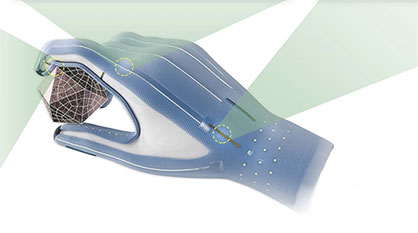
The next-generation VR glove will make virtual worlds tangible. Illustration: Herbert Shea, EPFL (2021)


The Manufhaptics project presents new challenges for Opris and her colleague Patrick Danner. "Until now, we have produced our polymers using solvents through a chemical synthesis," explains Opris. Now everything has to work without solvents: The plan is to superimpose up to 1000 fine layers from the 3D printer, always alternating between the electroactive polymer and a current-conducting layer. "Solvent has to be avoided in such a process" says Opris. Patrick Danner explains the next difficulty: The two inks needed for making the layers must have the exact right consistency to flow out of the 3D printer's nozzle. "Our project partner Jan Vermant from ETH Zurich wants something with similar properties to a hand cream. It should come out of the printer easily and then remain dimensionally stable on the base." And after that, this "creamy" layered structure still needs to crosslink into the appropriate polymer.

After a long series of tests, Patrick Danner found a promising formulation – a cream that is liquid enough and at the same time dimensionally stable, and from which electroactive polymers can be created in a single step. His colleague Tazio Pleji at ETH Zurich, a member of Jan Vermont's team, has successfully processed the material in his 3D printer into several layers – always alternating between polymer and electrode material. There are not yet 1,000 layers, but only about 10, and the artificial muscle from the 3D printer does not yet function satisfactorily.

The competition is at Harvard

But Opris and Danner are confident of mastering the task together with the printing specialists at ETH Zurich – possibly as the first team in the world. The only scientific competitors in this field are based at the renowned Harvard University in Massachusetts. "I know the colleagues there from some congresses," says Dorina Opris. "We watch very closely what they are upt to. And they're certainly watching our work, too."



More News from TEXDATA International

#Recycling / Circular Economy

textile.4U publishes special edition “Top 100 Textile Recycling Companies 2025”

With a comprehensive 176-page special edition, textile.4U is dedicating its latest issue entirely to one of the most dynamic and influential topics in today’s textile industry: textile recycling. The new issue, published exclusively in high-quality print, presents the Top 100 textile recycling companies researched and selected by TexData – organizations that already play a key role in the transition to circular textiles or are expected to have a significant impact in the near future.

#Recycling / Circular Economy

Responsible Textile Recovery Act of 2024 signed by Governor

Senator Josh Newman (D-Fullerton) is proud to announce that Senate Bill 707 (SB 707), the Responsible Textile Recovery Act of 2024, has been signed into law by the Governor of California, Gavin Newsom. This groundbreaking legislation establishes the country’s first Extended Producer Responsibility (EPR) textile recycling program, marking a significant step forward in the state’s efforts to combat waste and promote sustainability.

#Textiles & Apparel / Garment

Modtissimo promotes sustainability with 28 coordinates in the Green Circle

Modtissimo is proving more and more to be a textile and clothing show that delivers the latest innovations in the area of sustainability, with the iTechStyle Green Circle being the main showcase for companies' creations. In this 60+4 edition, taking place on 12 and 13 September, 28 coordinates will be exhibited in a section organised by CITEVE and curated by Paulo Gomes.

#Europe

The EU and Egypt team up to mobilise private sector investments at Investment Conference and sign a Memorandum of Understanding underpinning €1 billion in macro-financial assistance for Egypt

At the EU-Egypt Investment Conference, co-organised by the EU and the Government of Egypt on 29-30 June, the EU and Egypt are teaming up to intensify private sector investments in Egypt. They are also signing a Memorandum of Understanding (MoU) for the disbursement to Egypt of up to €1 billion in Macro-Financial Assistance.

More News on Research & Development

#Research & Development

Fraunhofer CCPE presents the “Monomaterial Design Set” – Innovative solutions for circular product design

Composite materials made from different types of plastic often extend the lifetime of products but make recycling more difficult in the circular economy. That is why Fraunhofer CCPE has developed the “Monomaterial Design Set”. This new approach helps to reduce the variety of plastics used in durable products and offers circular solutions for designers and product developers.

#Research & Development

How innovations drive BASF’s success

“Innovation has always been part of BASF’s DNA. Especially in these volatile times, it is crucial to leverage our innovative strength to develop competitive solutions that differentiate us as a company in our markets and give us a competitive edge,” said Dr. Stephan Kothrade, Member of the Board of Executive Directors of BASF and Chief Technology Officer, at the company’s Research Press Briefing held today. To achieve this, BASF implemented its “Winning Ways” strategy about a year ago with the clear goal of becoming the preferred chemical company to enable its customers’ green transformation.

#Research & Development

Small tolerances, big impact and a recyclable alternative to elastane

ITA Master's student Janne Warnecke investigated tension differences over the fabric width in the weaving process and thereby contributed to quality assurance; ITA Bachelor's student Jasmin Roos found a basis for the development of recyclable yarns and textiles. For these developments, they were awarded the Walter Reiners Foundation's Promotion and Sustainability Prizes on 27 November. Peter D. Dornier, Chairman of the Walter Reiners Foundation, presented the awards at the Aachen-Dresden-Denkendorf International Textile Conference (ADD-ITC) in Aachen, Germany.

#Associations

Young researchers recognised for cutting-edge work in recycling, fibre technology and textile mechanics

At the Aachen-Dresden-Denkendorf International Textile Conference held in Aachen at the end of November, Peter D. Dornier, Chairman of the Walter Reiners Foundation of the VDMA, honoured five successful young engineers. Promotion and sustainability prizes were awarded in the categories bachelor/project theses and diploma/master theses. Academic theses that develop solutions for resource-saving products and technologies, for example, are eligible for the sustainability awards.

Latest News

#Spinning

First PA66 spinning plant with EvoQuench successfully commissioned

With the successful commissioning of a multi-digit PA66 spinning line for microfiber yarns, Chinese textile company Shandong Nanshan Fashion Technology Co., Ltd. has added yarn production to its textile value chain.

#Knitting & Hosiery

SHIMA SEIKI returns to ShanghaiTex

Leading flat knitting solutions provider SHIMA SEIKI MFG., LTD. of Wakayama, Japan, together with its Hong Kong and Chinese market subsidiary SHIMA SEIKI (HONG KONG) LTD., will exhibit at the ShanghaiTex 2025 exhibition (Booth No.: Hall N3, Booth A20) held in Shanghai, China this month. This marks the return of SHIMA SEIKI to ShanghaiTex after a 14-year hiatus, its last exhibit at the show having been in 2011.

#Man-Made Fibers

arena introduces renewable LYCRA® EcoMade fiber in its latest swimwear collection

Italian swimwear specialist arena has unveiled a new collection that brings sustainability and performance even closer together. Launched on December 4, the line features swimsuits made from recycled nylon and renewable LYCRA® EcoMade fiber — the first time the bio-based spandex has been used commercially in swimwear.

#Spinning

Saurer Technologies Twisting Solutions at ICFE 2026

Saurer Technologies Twisting Solutions, a global leader in textile machinery innovation, will be present at the International Carpet and Flooring Expo ICFE 2026. Join us January 6–9 at the Istanbul Expo Center, Türkiye, as industry leaders, manufacturers, and innovators gather to explore the latest breakthroughs in carpet and flooring technology. Let’s meet at the new established global Center of the Carpet Sector in hall 3, booth 300!

TOP