[pageLogInLogOut]

#Research & Development

Resource dog fur: Finest animal hair fibers for sustainable and ethical fashion

The textile and fashion industry must become more sustainable. The young brand modus intarsia shows how it can be done. From the undercoat of dogs, which is normally combed out and ends up in the garbage, the two founders have developed a high-quality yarn. Fashion designer Ann Cathrin Schönrock came up with the idea, and textile engineer Franziska Uhl from Reutlingen University, together with scientists at the German Institutes of Textile and Fiber Research Denkendorf (DITF), tested the developed yarn on industrial machines and produced it on a larger scale.

Chiengora® is what they call the cashmere-like yarn - "Chien", French for "dog", and "gora" in reference to the fine angora that originally comes from rabbits. The yarn has the advantage over cashmere in that the raw material does not have to be flown in from Mongolia and the animals are not bred and kept for wool production. The raw material for the yarn is produced incidentally during daily animal care, especially when the animals shed their winter coats in the spring. Thus, the use of Chiengora® not only conserves resources, but also serves animal welfare.
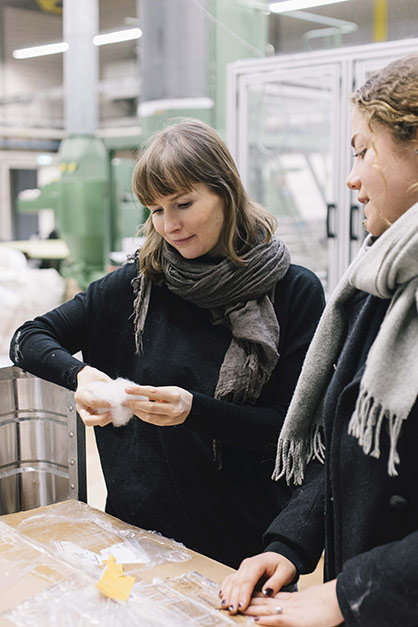
Ann Cathrin Schönrock (left) and Franziska Uhl (right) with wool fiber flocks from dog fur. Photo: modus intarsia


The founding team consists of Ann Cathrin Schönrock (31) from Berlin and Franziska Uhl (25) from Reutlingen. As a trained fashion and knitwear designer with high demands on quality, ethics and sustainability, Ann Cathrin Schönrock started collecting the undercoat from her own dog, from dogs of acquaintances and friends, but also from groomers and breeders back in 2017. After initial feasibility studies, Franziska Uhl from the Faculty of Textile & Design at Reutlingen University joined the team. As part of her bachelor's thesis, she researched which dog hairs are particularly suitable for yarn development. At the DITF, together with Volkan Ünal and Waltraud Abele, she tested her theses on industrial-scale machines and optimized the production processes - from wool fiber flocks to finished wool yarn.


The potential is great. There are more than 10.4 million dogs in Germany alone. Although not all dog breeds have suitable undercoat, so far more than 1,000 tons of it end up in the garbage every year throughout Europe. Schönrock and Uhl have set up a decentralized collector network. Anyone can participate, collect the undercoat of their four-legged friend and send it to Reutlingen. The project is supported by the state EXIST start-up grant and an investment from the textile industry. The entrepreneur Anna Yona from Wildling invests in "Yarnsustain".
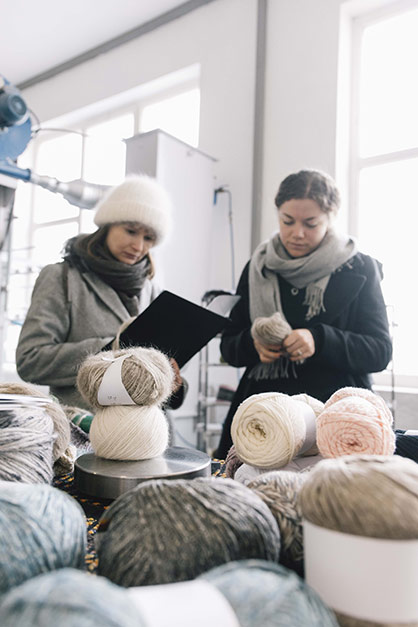
Ready-made yarn. Hat and scarf are made of Chiengora®. Photo: modus intarsia


More News from TEXDATA International

#Texprocess 2026

Texprocess 2026: Automation, digitalisation and AI redefine textile processing

Making investment decisions in textile processing has become significantly more demanding. Increasing energy costs, a shortage of skilled labour and ongoing geopolitical uncertainties are compelling companies to focus on technologies that deliver clear gains in efficiency and process reliability. This applies equally to apparel manufacturing and to the processing of technical textiles and high-performance materials. As a result, modernisation initiatives are assessed more carefully – even as the need to upgrade production systems continues to intensify.

#Techtextil 2026

Techtextil 2026: Between innovation pressure & market reality

From 21 to 24 April 2026, Techtextil in Frankfurt am Main will once again become the central meeting point for the international technical textiles and nonwovens industry. Running in parallel, Texprocess will focus on the industrial implementation of textile processing technologies as the leading platform in this field. Together, the two trade fairs form a closely integrated presentation and working platform along the entire textile value chain – from material development to finished applications.

#Techtextil 2026

Between geopolitical pressure and industrial resilience

In this interview, Dr. Janpeter Horn (VDMA) discusses the current challenges facing textile machinery manufacturers, shaped by geopolitical tensions, regulatory developments and subdued investment. He also outlines why innovation strength, integrated solutions and strategic positioning remain key to global competitiveness.

#Texprocess 2026

Between investment restraint and modernization pressure

Texprocess 2026 takes place in a complex market environment shaped by uncertainty and innovation pressure. In this interview, Elgar Straub (VDMA) explains why the trade fair is particularly relevant this year and which technologies are driving efficiency and competitiveness.

More News on Research & Development

#Research & Development

Elastic yarns to become more recyclable and environmentally friendly in future

On 29 April 2026, ITA student Tobias Dickmeiß was awarded a sponsorship prize by the Wilhelm Lorch-Stiftung for his innovative approach, to replacing conventional elastane with elastic yarns made from thermoplastic copolyester elastomers (TPC). Thanks to their thermoplastic nature and compatibility with typical polyesters used in the textile industry, elastic TPC yarns offer improved recyclability. Furthermore, the use of the melt-spinning process in yarn production eliminates the need for solvents that are harmful to the environment and human health.

#Research & Development

Walter Reiners Foundation Prize awarded to three ITA graduates

Sabina Dann, Lukas Balon and Annegret Storm from the Institut für Textiltechnik (ITA) of RWTH Aachen University were awarded the Walter Reiners Foundation Prize by the German Engineering Federation (VDMA) for their master’s and bachelor’s theses. Peter Dornier, Chairman of the Walter Reiners Foundation, presented the awards during Techtextil at the VDMA stand in Frankfurt am Main, Germany.

#Techtextil 2026

Young talents honoured – 60 years Walter Reiners Foundation

At the Techtextil trade fair in Frankfurt at the end of April, Peter D. Dornier, chairman of the VDMA’s Walter Reiners Foundation, presented awards to five successful young engineers. Promotion and sustainability awards were presented in the categories of bachelor’s/project theses and diploma/master’s theses. Academic theses are eligible for the sustainability awards if, for example, they develop solutions for resource-efficient products and technologies.

#Research & Development

Regional hemp bast for lightweight construction profiles

The cultivation of fibre hemp for the production of ropes and clothing has a long tradition in Saxony. Due to its excellent fibre properties, it is also suitable as a renewable raw material for reinforcement in fibre composites. At the STFI and IWU in Chemnitz, the CannaPul project is cur- rently investigating how a regional value chain for hemp-based lightweight construction profiles can be established. To this end, the technical processing of hemp fibres into continuous fibre strands and their embedding in a suitable bio-based matrix are being investigated.

Latest News

#INDEX 2026

ANDRITZ at INDEX ’26: Driving sustainability with next-generation nonwoven technologies

From May 19-22, ANDRITZ Nonwoven & Textile is presenting its innovative solutions for the nonwoven & textile industry in Geneva, Switzerland. ANDRITZ will focus on technologies for sustainable and durable nonwovens, converting, sustainable fiber processes, textile recycling, and life-cycle services on booth 2114 in hall 02.

#INDEX 2026

INDEX™26: World’s leading nonwovens exhibition presents groundbreaking product launches, exclusive seminars and immersive experiences

From 19 to 22 May 2026, 620 exhibitors from 44 countries will gather in Geneva at Palexpo for INDEX™26. The exhibition aims to demonstrate how the future of technical materials will increasingly be shaped by collaborative supply chains and integrated innovation across the nonwovens industry. This year’s edition focuses not only on individual technological advances, but also on how cooperation throughout the value chain can enhance the performance, sustainability and value of nonwoven solutions.

#INDEX 2026

The LYCRA Company launches LYCRA® ADAPTIV fiber for nonwovens, advancing comfort and fit in disposable hygiene at INDEX™ 26

The LYCRA Company, a leader in innovative and sustainable fibers for apparel and personal care, today announced the official global launch of LYCRA® ADAPTIV fiber for nonwovens at INDEX™ 26, in Geneva, Switzerland, May 19–22. This breakthrough stretch fiber, already trusted by leading global apparel brands, now ushers in a new era of comfort, fit, and performance for baby diapers, disposable hygiene products, adult incontinence, and feminine care.

#INDEX 2026

Innovations for today – solutions for tomorrow: Trützschler Nonwovens at INDEX™ 2026

From 19 to 22 May, Trützschler Nonwovens will present itself at booth 1641 as a long-term partner to its customers. The focus will be on new products for all nonwoven processes, further developments of the digital working environment T‑ONE, and an expanded service portfolio.

TOP