[pageLogInLogOut]

#Research & Development

Sven Schöfer from ITA won AVK innovation prize
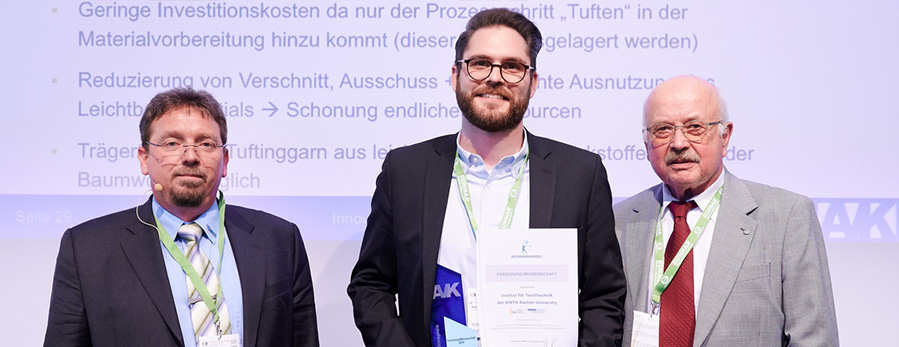
The lucky winner with the certificate, from left to right: Professor Jens Ridzewski (AVK), Sven Schöfer (ITA), Dr Rudolf Kleinholz (AVK), source: Reed Exhibitions / Oliver Wachenfeld
On 10 September 2019, Sven Schöfer from ITA won the third AVK Innovation Prize in the "Research and Science" category at Composite Europe in Stuttgart, Germany. With his work a reduction of material usage by up to 50 percent through innovative draping strategy in the production of fibre composite materials is possible.

In fibre reinforced plastic (FRP) production, stamp forming is one of the most economical processes for automated large-scale production, e.g. in the BMW i-series. However, the current processes are susceptible to draping errors and a high proportion of waste. An innovative process developed at the Institut für Textiltechnik of RWTH Aachen University, short ITA, can now significantly reduce the scrap rate and reduce the waste rate of high-priced reinforcing textiles, such as carbon fibre textiles, by up to 50 percent. Sven Schöfer from ITA achieved this effect with his work "Development of a textile-based material feed to increase the preform quality during stamp forming of reinforcing layers". On 10 September 2019, he won the third AVK Innovation Prize in the "Research and Science" category at Composite Europe in Stuttgart, Germany.

How does the current process work?

In stamp forming, clamping grippers are usually used in industry to feed the stacked individual layers to the forming process and position them on the lower tool via a clamping frame or hold-down device. Due to the clamping grippers, the cutting proportion of cost-intensive reinforcing textiles is high, as additional material at the textile edge is necessary with clamping systems. Other approaches to feeding the reinforcing semi-finished product during forming and simultaneously improving the draping quality are also not economical: they are usually only designed for certain textile cuts, cannot be automated, are prone to errors or are expensive special solutions.

There is currently no system in the industry that can apply retention forces along a final contour with low waste and remains flexible in terms of geometry.


Solution through the innovative approach of Sven Schöfer

The innovative process developed by Sven Schöfer works with a detachable textile joint, a so-called tufting seam. It allows the single layers to slide off during the forming process under a retention force dependent on the seam design.

This reduces or completely eliminates draping errors in previously critical areas, even with complex preform geometries. This leads to a significant increase in preform quality and a reduction in scrap rates. The process is also highly efficient, as tensile forces can be applied to any component geometry on near-net-shape blanks. This reduces the material input by up to 50 percent.

Already in 2018 the ITA together with the Institute for Lightweight Construction with Hybrid Systems, University of Paderborn, was awarded the first AVK Innovation Prize in the category "Research and Science". In 2018, the ITA alone won the second innovation prize in the same category.

More News from Institut für Textiltechnik of RWTH Aachen University (ITA)

#Research & Development

Small tolerances, big impact and a recyclable alternative to elastane

ITA Master's student Janne Warnecke investigated tension differences over the fabric width in the weaving process and thereby contributed to quality assurance; ITA Bachelor's student Jasmin Roos found a basis for the development of recyclable yarns and textiles. For these developments, they were awarded the Walter Reiners Foundation's Promotion and Sustainability Prizes on 27 November. Peter D. Dornier, Chairman of the Walter Reiners Foundation, presented the awards at the Aachen-Dresden-Denkendorf International Textile Conference (ADD-ITC) in Aachen, Germany.

#Research & Development

IRG Polymer Recycling wraps up productive 2025 project cycle

The Industry Research Group (IRG) Polymer Recycling has completed another successful project year. Last week, partners from across the textile value chain met at the Institute for Textile Technology (ITA) at RWTH Aachen University for the full-term project meeting.

#Research & Development

Aachen Summer School: Strengthening German-Korean cooperation in 4D and robotics

The Aachen Summer School has established itself as an important platform for promoting cooperation between RWTH Aachen University and Seoul National University. The focus is on practice-oriented research projects in the field of 4D and robotics technologies, which have been successfully implemented for years at the Institut für Textiltechnik of RWTH Aachen University.

#Research & Development

ITA postdoc Dr Leonie Beek is revolutionising oil filtration with a bionic textile

On various biological surfaces, oil is adsorbed from water surfaces and transported along the leaf. In her dissertation, ITA Postdoc Dr Leonie Beek transferred this effect to a technical textile using her Bionic Oil Absorber (BOA), which can remove up to 4 litres of diesel per hour from water at technological readiness level 4. For this development, Dr Beek was awarded the Paul Schlack Prize 2025 for her dissertation ‘Bionic textiles for oil-water separation modelled on superhydrophobic biological surfaces’ on 10 September 2025. The award ceremony took place during the opening event of the Dornbirn GFC Global Fiber Congress in Austria.

More News on Research & Development

#Research & Development

More safety and comfort for protective clothing thanks to auxetic fabrics

When everyday materials are pulled, they stretch or elongate in the direction of the pull and become narrower in cross-section. We can also observe this property in two-dimensional textiles. Auxetic structures behave differently here. They have the striking property of not changing under tensile stress or even increasing their width or thickness. These properties are advantageous, for example, in protective textiles or textile filter media. The DITF are researching auxetic fabrics for various applications.

#Research & Development

Fraunhofer CCPE presents the “Monomaterial Design Set” – Innovative solutions for circular product design

Composite materials made from different types of plastic often extend the lifetime of products but make recycling more difficult in the circular economy. That is why Fraunhofer CCPE has developed the “Monomaterial Design Set”. This new approach helps to reduce the variety of plastics used in durable products and offers circular solutions for designers and product developers.

#Research & Development

How innovations drive BASF’s success

“Innovation has always been part of BASF’s DNA. Especially in these volatile times, it is crucial to leverage our innovative strength to develop competitive solutions that differentiate us as a company in our markets and give us a competitive edge,” said Dr. Stephan Kothrade, Member of the Board of Executive Directors of BASF and Chief Technology Officer, at the company’s Research Press Briefing held today. To achieve this, BASF implemented its “Winning Ways” strategy about a year ago with the clear goal of becoming the preferred chemical company to enable its customers’ green transformation.

#Associations

Young researchers recognised for cutting-edge work in recycling, fibre technology and textile mechanics

At the Aachen-Dresden-Denkendorf International Textile Conference held in Aachen at the end of November, Peter D. Dornier, Chairman of the Walter Reiners Foundation of the VDMA, honoured five successful young engineers. Promotion and sustainability prizes were awarded in the categories bachelor/project theses and diploma/master theses. Academic theses that develop solutions for resource-saving products and technologies, for example, are eligible for the sustainability awards.

Latest News

#Heimtextil 2026

Mimaki demonstrates versatile, simple TRAPIS textile printing at Heimtextil 2026

Mimaki’s textile pigment transfer printing system, TRAPIS, is able to print on a diverse range of fabrics - unlike traditional processes - including natural fibres and synthetic fabrics. The full solution will be shown on Mimaki’s booth (Hall 3.0 Stand A97), as the company returns to Heimtextil to showcase its advancements in sustainable, high quality and efficient textile printing.

#ITM 2026

The Technology Hub for global denim trends: ITM 2026

The ITM 2026 International Textile Machinery Exhibition, to be held at the Tüyap Fair and Congress Center in Istanbul from June 9–13, 2026, brings together groundbreaking technologies in denim production. From smart production systems to eco-friendly raw materials, from digital washing solutions to laser effect technologies, innovations that will shape the future of denim will be showcased for the first time at ITM 2026.

#Natural Fibers

38th International Cotton Conference Bremen: Let´s Talk about Cotton!

The 38th International Cotton Conference Bremen, to be held on 25-27 March 2026 in Bremen’s parliament building on market square, once again sends a powerful signal for professional excellence and international dialogue. The focus is on the latest market trends and technical innovations throughout the entire value chain – from agriculture and quality assurance to processing and the circular economy. With its high-calibre speakers, the conference remains an indispensable forum for anyone involved in shaping the cotton industry scientifically, technically, or economically.

#Recycled_Fibers

Leading fashion brands step up to unlock the next chapter of Circulose

Since 2024, under new ownership and leadership, Circulose has set a renewed strategic direction focused on securing long-term commitments with partner brands to bring CIRCULOSE® back to market at scale. This strategy has proven successful.

TOP