[pageLogInLogOut]

#Recycling / Circular Economy

Eastman Naia™ brings its own groundbreaking “Case for change” to the Textile Exchange Conference 2024.

Through Eastman’s advanced carbon renewal technology, waste is being transformed into new fiber that excels in its “Recycled and Runway Ready” style. Innovation, sustainability and versatility are among the key ingredients of the new Naia™ Renew creative expression images, exclusively fueled by AI technology. PASADENA, CA., October 29, 2024 — Embracing the theme “The Case for Change”, Eastman answers the call of the Textile Exchange Conference 2024 in Pasadena by sharing its best business practices focusing on climate and nature.

The U.S. company, known for always setting higher sustainability standards in textiles, truly believes in the importance of further increasing the recycled content in its cellulosic fibers. Eastman is already offering, at scale, a fiber featuring 60% GRS-certified recycled content, Naia™ Renew ES – and the goal is to be even more ambitious. Naia™ Renew ES is made from 40% certified recycled waste material, 20% certified recycled cellulose and 40% sustainably sourced wood pulp. It is the go-to option for brands at the forefront of sustainability, such as Reformation, and it is increasingly popular in stores around the world. Reformation's second collection featuring Naia™ Renew ES fiber highlights, once more, the viability and scalability of these innovative fibers in the market. Unlike other cellulose-based yarns and fibers, Naia™ Renew ES fiber production requires fewer virgin materials, resulting in a more environmentally friendly and sustainable product, without compromising performance, comfort and beauty.

Recycled and Runway Ready: Naia™’s new creative expression leveraging AI technology

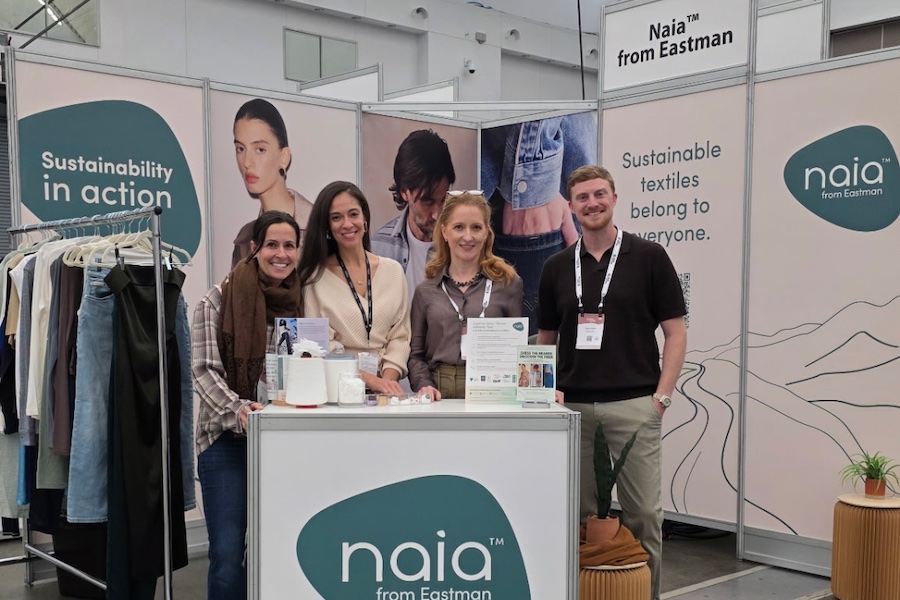
Utilizing recycled content, Naia™ is making it possible to achieve the most sustainable “Runway-Ready” styles ever, with stunning collections that turn heads and innovation that changes the game in the textiles industry. In a fast-moving world, where endless scrolling has become our default mode, beauty remains an indispensable value, both in fashion and in life, compelling us to pause and appreciate what truly matters. Eastman Naia™ sets a new and superior standard in this regard thanks to a process that changes the paradigm of circularity: Eastman’s carbon renewal technology. This technology breaks waste down into its molecular building blocks and recomposes them into high quality feedstock that can be used to create versatile, functional, traceable, biodegradable and compostable GRS-certified cellulosic fibers, ready to be transformed into new fashion collections without compromising style and comfort. The company introduces its new “Recycled and Runway Ready” creative expression at the Textile Exchange Conference, Booth 18, showcasing the process of transforming waste into beauty through a combination of photography and artificial intelligence (AI). Made with recycled materials, wonderful garments take shape, spanning from the most elegant and formal style to casual streetwear, while adapting to every fashion need under the sign of versatility. The images evoke a kind of movie magic, but there is, most of all, technology and innovation behind these striking results. With Eastman’s technology, there is no need to choose between responsible and beautiful because Naia™ Renew fibers can be used in countless applications to achieve fashion-forward looks.

Founded in 1920, Eastman is a global specialty materials company that produces a broad range of products found in items people use every day © 2024 Eastman


Mainstreaming circularity through brand collaborations

Providing authentic and clear information helps consumers make informed choices and build trust which is vital for the efforts of making circularity mainstream. This is why Naia™ works directly alongside its brand partners regarding in-store communication, to help them make their consumers aware that sustainability can be stylish, functional, and available for everyone.

External use

Eastman has the technology to make the textiles industry circular, and it requires collaboration with brands to make circular fashion possible. To make this a reality, Eastman has run two demonstration projects for recycling pre- and post-consumer apparel waste from Debrand and Patagonia. This is the true meaning of circularity, using discarded clothing to obtain fibers that will give rise to new fashion garments.

Caring for society, an important pillar of Eastman Naia™’s sustainability goals

Naia™ also collaborates with design and fashion universities in educational projects around the world delivering on the company’s commitment to promoting sustainability and supporting the next generation of fashion designers. The most recent ones involve the ESDI – Escola Superior de Disseny in Sabadell (Barcelona) and the BIFT – Beijing Institute of Fashion Technology. These initiatives allow emerging, talented, sustainability-minded designers to relate directly to solutions designed to solve fashion and society’s most pressing sustainability issues: responsible resource use, climate change mitigation, and mainstreaming circularity.

“Our primary goal has always been to make sustainable fashion accessible to everyone, and make that possible requires intense technologies and market knowledge,” says Carolina Sister Cohn, Global Marketing Leader for Textiles at Eastman, “but to make a difference, we need to reach as many people as possible, not just brands or consumers, but also the new generations who will be the decision makers of tomorrow. The creative images help us communicate a simple, yet fundamental concept: fashion can be Recycled and Runway Ready, and Naia™ makes it happen.”

Carolina Sister Cohn will also be in conversation with textile-to-textile recycling players Circ, Circulose and Syre. The selected panel is scheduled for Thursday October 31st at 3 pm PST and the discussion, titled “The Realities and Returns of Textile Innovation,” will explore the role and limitations of innovation in tackling sustainability challenges. The leading experts will further debate how innovation can drive widespread adoption of sustainable solutions while addressing economic viability. The event will provide a thorough analysis of how textile innovation and sustainability are reshaping the industry.

More News from Eastman

#Heimtextil 2026

Eastman Naia™ expands All-Night Comfort at Heimtextil 2026

New fill solutions and the debut of sleepwear highlight the versatility and performance of Naia™ Renew, its circular fiber, for home textile applications.

#Sustainability

Eastman Naia™ awarded top Canopy rating at Textile Exchange Conference 2025, advancing its sustainability 2025–2030 goals

At the Textile Exchange Conference in Lisbon, Eastman Naia™ was honored with its fourth consecutive “Dark Green Shirt” in Canopy’s Hot Button Report, an annual ranking of man-made cellulosic fiber producers based on forest conservation, sourcing risk, and supply chain transparency. The recognition confirms Naia™’s ongoing leadership in responsible sourcing and environmental stewardship, distinguishing it as one of the industry’s most trusted fiber platforms.

#Man-Made Fibers

Eastman Naia™ launches Sustainability Progress Report and 2025-2030 Sustainability Goals at Textile Exchange Conference, reaffirming commitment to circular innovation

At the Textile Exchange Conference 2025, Eastman Naia™ released its 2025 Sustainability Progress Report and announced its 2025–2030 Sustainability Goals, presenting a record of genuine progress and outlining a renewed roadmap for the years ahead. This announcement demonstrates Naia™’s long-standing commitment to driving an industry-wide shift toward sustainability through scalable, commercially viable material solutions.

#Yarn & Fiber

Eastman and Huafon Chemical to establish local cellulose acetate yarn manufacturing facility in China

Eastman (NYSE: EMN) today announced a formal strategic partnership with Huafon Chemical to establish a joint facility to produce cellulose acetate yarn. The facility will be dedicated to localized production and product innovation of Eastman Naia™ cellulose acetate filament yarns in China.

More News on Recycling / Circular Economy

#Recycling / Circular Economy

Reju announces site selection for first U.S. industrial sized facility regeneration hub in Rochester, New York

Reju, the textile-to-textile regeneration company, today announced it has selected the site for its first U.S.-based industrial facility marking a significant milestone in its efforts to scale globally. This future Regeneration Hub will be in Rochester, New York, reinforcing Reju’s commitment to the adoption of circular textile system across key regions worldwide.

#Business

Canopy introduces a first-of-its-kind $2 billion USD investment blueprint to decarbonize global materials supply chains

Today, the global, solutions-driven not-for-profit Canopy joined partners at Davos to introduce a new finance model designed to accelerate the growth of low-carbon materials and transform the paper, packaging, and textile supply chains. The event was anchored by a keynote speech from Sri A Revanth Reddy, Hon’ble Chief Minister of Telangana, with India set to host the first iteration of the new investment blueprint.

#Recycled_Fibers

Borealis invests EUR 49 million in Burghausen, Germany to accelerate design for circularity

Borealis announces a EUR 49 million strategic investment to scale up production of Borstar® Nextension polypropylene (PP) at its manufacturing site in Burghausen, Germany. This will expand commercial production of next-generation single-site polypropylene (ssPP) grades that deliver enhanced purity, processability, and performance - supporting customers in key sectors including packaging, healthcare, mobility, and fibers, to meet evolving market and regulatory demands.

#Recycling / Circular Economy

From local actions to industrial innovations: SOLSTICE shares mid-project results

Since its launch in May 2024, the SOLSTICE project is accelerating the transition from linear models to circular regional ecosystems in the textile industry, focusing on four key territories: Grenoble-Alpes Métropole (France), Berlin (Germany), Prato (Italy), and Catalonia (Spain). By mid-project, SOLSTICE has already revealed both regional disparities and promising solutions to strengthen textile repair, reuse, and recycling infrastructure.

Latest News

#Fabrics

MUNICH FABRIC START: Between Attitude and Sensuality

The future begins where we reimagine it. After seasons of restraint, Spring.Summer 27 marks a conscious counter-trend: optimism, sensuality, and creative freedom are replacing pragmatism and neutrality. Physical presence and individuality are regaining importance – as a response to uncertainty, exhaustion, and algorithmic predictability. The overarching theme of PLEASURE stands for fashion as an emotional space, as an expression of attitude and cultural reflection. Colours, surfaces, and materials become vehicles for self-confidence and joie de vivre.

#Denim

organIQ seek: smart alternative to potassium permanganate

CHT Group announces new technical findings within its organIQ seek platform that significantly advance the transition toward permanganate-free denim bleaching. Through extensive industrial testing and application research, CHT confirms that organIQ seek can now be used with remarkable effectiveness as a substitute for potassium permanganate in spray bleach, while remaining aligned with sustainability expectations and cost realities in the European market. At the COLOMBIATEX in Medellín as well as at the Exintex in Puebla and the Kingpins Show in Amsterdam the CHT Group will present organIQ seek as an alternative to potassium permanganate.

#Functional Fabrics

PERFORMANCE DAYS: Focus topic shifts to the beginning of the value chain

Following the last Focus Topic in October 2025, which placed Textile-to-Textile Recycling at its core, PERFORMANCE DAYS continues to drive the conversation around circularity – this time with an expanded and more upstream perspective. The upcoming Focus Topic, “Textile to Textile: The Role of Collectors and Sorters,” presented during the spring edition on March 18–19, will spotlight one of the most essential yet often overlooked components of a functioning circular textile system: the efficient collection and sorting of post-consumer textiles.

#Knitting & Hosiery

Proven performance, optimised costs – the new RE 6 EL

Nowadays textile companies increasingly need to produce small production runs and respond to market changes with instantaneous pattern changes in order to operate profitably – meaning they require machines that offer maximum flexibility, reliability and cost efficiency. KARL MAYER understands the challenges of the market and is launching its new RE 6 EL. The Raschel machine offers the core strengths of the classic RSE 6 EL and essentially the same performance parameters, but has been further cost-optimised largely due to local production advantages. This makes the newcomer an efficiency champion in production, especially when it comes to frequent pattern changes.

TOP