[pageLogInLogOut]

#Recycling / Circular Economy

The world’s first 100% “fiber-to-fiber” biorecycled clothing unveiled by multi-brand consortium

CARBIOS, (Euronext Growth Paris : ALCRB), a pioneer in the development and industrialization of biological technologies to reinvent the life cycle of plastic and textiles, and its “fiber-to-fiber” consortium partners On, Patagonia, PUMA, Salomon, and PVH Corp., parent company of Calvin Klein, unveil the world’s first enzymatically recycled polyester garment made from 100% textile waste using CARBIOS’ pioneering biorecycling technology. This technological feat contributes to advancing textile circularity when, today, the majority of recycled polyester is made from PET bottles, and only 1% of fibers are recycled into new fibers.

The collective achievement marks an important milestone for the consortium’s ultimate aim of demonstrating fiber-to-fiber closed loop using CARBIOS’ biorecycling process at an industrial scale, and marks an important step forward for the textile industry’s shift towards a circular economy.
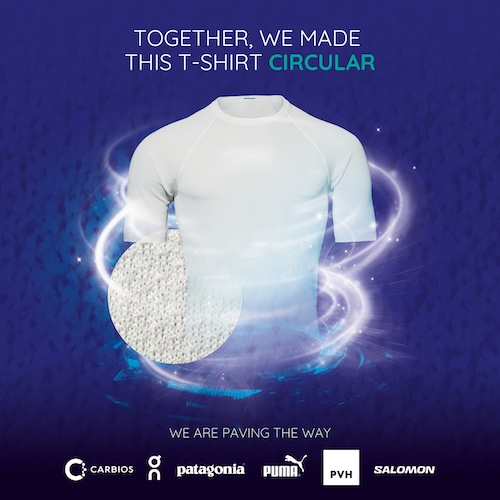
For the first time, a piece of clothing is made entirely from complex textile waste: mixed blends, treatments and dyes © 2024 CARBIOS


No ordinary t-shirt…

A plain, white T-shirt was a deliberate choice to showcase the technological achievement that made its production possible from mixed and colored textile waste. By using CARBIOS’ biorecycling technology, polyester is broken down using enzymes into its fundamental building blocks which are reformed to produce biorecycled polyester whose quality is on par with oil-based virgin polyester. Petroleum can now be replaced by textile waste as a raw material to produce polyester textiles, that will in turn become raw materials again, thus fueling a circular economy, with the added benefit of a lower carbon footprint and avoidance of landfill or incineration.

No ordinary journey…

The t-shirt’s production began with all consortium members (On, Patagonia, PUMA, PVH Corp. and Salomon) supplying rolls and production cutting scraps to CARBIOS in Clermont-Ferrand, France. This textile waste consisted of some mixed blends with cotton or elastane, as well as various treatments (such as durable water repellent) and dyes which render them complex to recycle using conventional methods. The collected waste was deconstructed into its original monomers, PTA[1] and MEG[2], using CARBIOS’ biorecycling technology at its pilot facility. The resulting monomers were then repolymerized, spun into yarn and woven into new fabric by external partners, demonstrating the seamless integration into existing manufacturing processes. The resulting sports t-shirt made from 100% textile waste meets the quality standards and sustainability objectives of the apparel brands present in the “fiber-to-fiber” consortium.
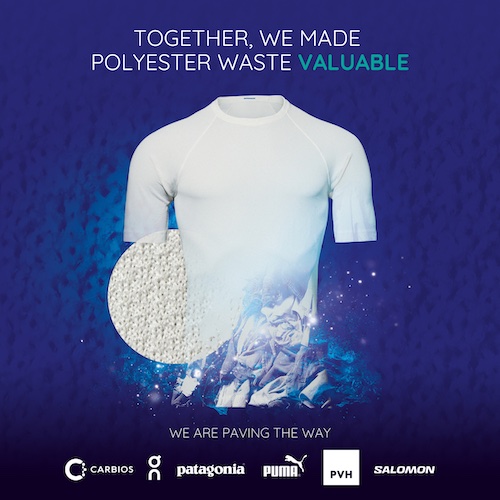
This 100% fiber-to-fiber t-shirt paves the way for true circularity in textiles © 2024 CARBIOS


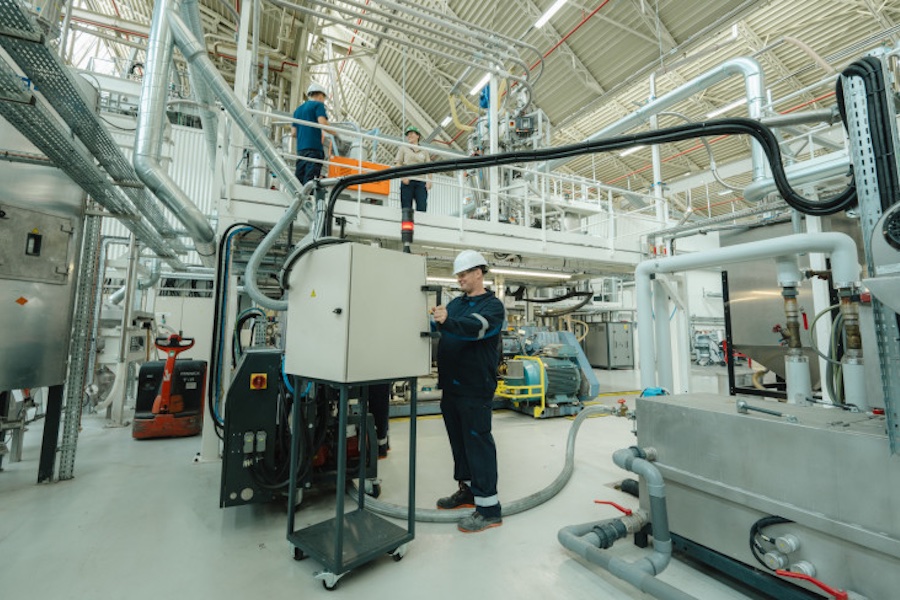
CARBIOS’ demonstration plant in Clermont-Ferrand, France, has been up and running since 2021, and its first commercial plant, the world’s first industrial-scale enzymatic PET recycling plant, is currently under construction in Longlaville, France. In addition, CARBIOS recently announced several letters of intent with PET producers in Asia and Europe, confirming global interest in its biorecycling technology and advancing the international roll-out of its licensing model.

"It may look like an ordinary t-shirt, but make no mistake, the technology behind it is extraordinary! To achieve “fiber-to-fiber” recycling is a technological feat. CARBIOS couldn’t have done it alone, so thanks to the collaboration with our consortium partners, we have overcome many technical hurdles together to produce the world’s first enzymatically recycled t-shirt made entirely from biorecycled fibers", stated CARBIOS  CEO Emmanuel Ladent.

Begüm Kürkçü, Director of Sustainabililty, On, said:"We know that fiber-to-fiber recycling is a crucial step to drive our industry towards circularity, which is why we have dedicated energy and investment to researching this area. Achieving the proof-of-concept and creating the first T-shirt made out of 100% biorecycled fibers is an important milestone. Our engagement with CARBIOS and the other consortium members is an important step towards enabling the industry to game-changing circular technologies at scale."

"PUMA’s wish is to have 100% of our polyester coming from textile waste. Today’s announcement is an important milestone towards achieving this and making our industry more circular. We now need to work together to make sure we can scale up this technology to make the largest possible impact. We’re excited to be part of this breakthrough and setting new standards for fiber-to-fiber recycling", said Anne-Laure Descours, Chief Sourcing Officer at PUMA.

Guillaume Meyzenq, Chief Product Officer Softgoods, Salomon, said: "This T-shirt is the first tangible result of our ‘fiber to fiber’ consortium with CARBIOS, overcoming textile challenges to create a garment from enzymatically recycled waste with the same quality as virgin fibers. It builds on Salomon’s commitment to material circularity, following Index - the first recyclable running shoe, and highlights our dedication to reducing factory waste and our engagement to reduce by 30% our carbon footprint by 2030. This project, in collaboration with footwear and apparel Brand partners, reflects our shared leadership and vision for a more sustainable footwear and textile industry."


[1] Purified Terephthalic Acid

[2] Monoethylene Glycol


More News from CARBIOS

#Recycled_Fibers

CARBIOS and Wankai sign strategic PET biorecycling pact

CARBIOS (Euronext Growth Paris: ALCRB) and Wankai New Materials (“Wankai”), a listed subsidiary of Zhink Group, the 3rd largest PET producer in China and 4th worldwide, announce the signing of the definitive agreement establishing a strategic partnership for the industrial rollout of CARBIOS’s PET biorecycling technology in Asia. The first milestone will be the construction of a PET biorecycling plant in China.

#Recycled_Fibers

CARBIOS and Wankai plan 1 million tonnes of PET biorecycling capacity in Asia

CARBIOS and Wankai New Materials, a subsidiary of Zhink Group, are committed to the large-scale deployment of CARBIOS’ PET biorecycling technology in Asia, with the first step being the construction of a PET biorecycling plant in China.

#Recycling / Circular Economy

CARBIOS presents its 2025 half-year results and confirms its objective to build a PET biorecycling plant, with a revised timeline

CARBIOS (Euronext Growth Paris: ALCRB), a pioneer in the development and industrialization of biological technologies aimed at reinventing the lifecycle of plastics and textiles, today announces its 2025 half-year results and confirms its objective to build a PET biorecycling plant in Longlaville, with a revised timeline.

#Recycling / Circular Economy

CARBIOS enters the r-PET market for tire textile filaments

CARBIOS (Euronext Growth Paris: ALCRB) announces the signing of a multi-year commercial agreement with Indorama Ventures, the global leader in PET production. This agreement covers the supply of biorecycled monomers from its Longlaville plant, which will be transformed into r-PET filaments by Indorama Ventures and then integrated by Michelin into the manufacturing of its tires.

More News on Recycling / Circular Economy

#Recycling / Circular Economy

Advanced Recycling Conference 2025 fuels innovation across key waste streams

The Advanced Recycling Conference (ARC) 2025 brought together nearly 220 experts from 28 countries to spotlight pioneering advancements and foster industry collaboration in recycling across diverse waste streams including plastics, textiles, automotive and other materials.

#Recycling / Circular Economy

ADVANSA launches ADVA®tex: A new step toward textile-to-textile recycling

ADVANSA has introduced ADVA®tex, a new filling fibre made entirely from recycled pre-consumer textile waste, positioning the material as a significant step forward in textile-to-textile (T2T) recycling. The fibre is designed for use in duvets, pillows, mattresses, and furniture applications and is available in three versions.

#Recycling / Circular Economy

European research project addresses textile waste through integrated recycling technologies

A major European research initiative coordinated by Fraunhofer UMSICHT has been launched to develop integrated solutions for textile waste recycling. The AUTOLOOP project aims to create a comprehensive system that could process 1.24 million tonnes of textile waste annually by 2050, whilst potentially creating over 130,000 green jobs across the EU. This project aims to develop, test and integrate automated sorting, tracing, and closed-loop recycling technologies for polyester-based textiles (NRT), addressing the pressing challenge of textile waste management.

Latest News

#Dyeing, Drying, Finishing

Navis TubeTex announces U.S. partnership with Icomatex

Navis TubeTex, a global leader in advanced dyeing and finishing machinery solutions, is pleased to announce a new partnership with Icomatex (www.icomatex.com), a respected European manufacturer of high-quality stenters and textile finishing equipment. Under this agreement, Navis TubeTex will exclusively represent the Icomatex stenter line in the United States.

#Knitting & Hosiery

KARL MAYER celebrates 35 years of EL pattern drive

KARL MAYER is celebrating an anniversary this year: on 30 November 1990, the first warp knitting machine with electronic guide bar control, the KS 4 EL, was delivered – another milestone for patterning. As early as 1980, the SU gearbox with the MRS42SU had initiated the transition from mechanical chains to digital data.

#Research & Development

The region of renewable raw materials: Central German Alliance for Bioplastics

The development of sustainable plastic solutions is rapidly gaining importance in light of global environ- mental pollution, dwindling fossil resources and ambitious climate protection targets. As part of the re- gional alliance RUBIO, which brings together 18 partners from central Germany and the Berlin-Branden- burg area, the bio-based and biodegradable plastic polybutylene succinate (PBS) was comprehensively investigated, starting with the raw material, through the manufacturing process, to industrial application.

#Textile processing

YKK receives ISPO Textrends Awards for circular innovations

YKK Corporation (Headquarters: Chiyoda-ku, Tokyo; President: Koichi Matsushima; hereafter, YKK) is pleased to announce that the ISPO Textrends judges have selected YKK's 3D Composite Puller as the Best Product in the Accessories category. They also selected YKK’s NATULON Plus® Fiber Sourced™ zipper with Recycled PET Open Parts as a Top 5 item in the same category. The competition, held twice a year in conjunction with the ISPO trade show, recognizes the most innovative performance textiles, components, and apparel.

TOP