[pageLogInLogOut]

#Recycling / Circular Economy

Large scale study from H&M Group and IKEA shows potential to transform the way we use recycled textiles

© 2021 H&M
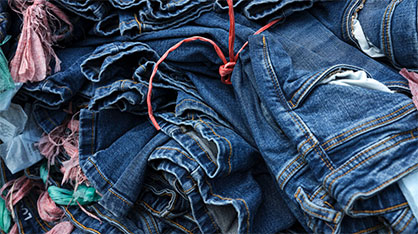
Through a broad industry collaboration, H&M Group and Inter IKEA have been able to create a large-scale databank to understand potentials and challenges with recycled textile from a chemical contamination perspective. H&M Group and Inter IKEA Group will now use these findings to increase knowledge around chemical content in recycled textiles and to impact legislation around circular economy.

To reach both companies’ goals to only use 100% recycled or other sustainably sourced materials by 2030(1), a key step is to find clean and reliable sources of recyclable materials.
© 2021 H&M
© 2021 H&M


To tackle these industrywide challenges, H&M Group and Inter IKEA Group initiated a large-scale study in 2019, looking at chemical content in recycled textiles. The aim of the study has been to strategically increase knowledge, and overcome challenges to exchange data, and stimulate chemical transparency across the industry. Collaboration is essential to enable real change within the textile industry, and during the autumn of 2020, more brands joined the study as contributors. With all involved companies’ size and presence, there is a great opportunity to lead the way. Even though the study is now finalized, a lot of work still needs to be done.

With industry collaboration, we can overcome common challenges on our way to transform to a circular business. This study has enabled us to share data through a digital platform, creating transparency and knowledge sharing, as well as creating facts to support us in taking our next steps on our journey to only use recycled and renewable materials.

Mirjam Luc, Project leader for Recycled Textiles at IKEA of Sweden

Mirjam Luc, Project leader for Recycled Textiles at IKEA of Sweden © 2021 H&M<br />
Mirjam Luc, Project leader for Recycled Textiles at IKEA of Sweden © 2021 H&M


Post-consumer cotton, wool, and polyester waste sourced from different regions of the world were tested, resulting in a total of 70,080 data points. 2.5% of the data points showed undesirable detections, but less than 1% of the data points exceeded AFIRM RSL(2) limits. Post-consumer polyester samples had the widest variety of substances detected. In post-consumer wool samples almost all samples contained at least one substance that failed against AFIRM RSL limits. Tackling the presence of legacy chemicals and hazardous chemicals in recycled materials will be key in realizing circularity within the fashion and textile industry.

To achieve fully circular and future-proof products, legacy chemicals must be avoided from start. Only through industry collaboration and a transparent, harmonized hazard assessment methodology for all chemicals and materials – can we be proactive and secure safe and sustainable products for a toxic-free textile future.

Linn Farhadi, Project Manager for Recycled Textiles at H&M Group

Linn Farhadi, Project Manager for Recycled Textiles at H&M Group © 2021 H&M


H&M Group and IKEA will use the findings of the study to support public policy to enable usage of recycled textiles, which are safe to use. The results will also be used to advocate for establishing an acknowledged and harmonised hazard assessment methodology for chemicals used in production. This ensures that brands can assess the best available chemicals from a safety and recyclability perspective. Any chemicals hampering recycling and material recovery should be restricted.

It’s great to see companies working together to gain increased knowledge about the chemical content of recycled textiles. We hope that studies like these will result in cleaner material flows and also motivate legislators to speed up the work with phasing out hazardous substances in products

Theresa Kjell, Senior Policy Advisor at ChemSec

1) IKEA aim to use only renewable or recycled materials by 2030.

2) AFIRM Restricted Substances List (Apparel and Footwear International RSL Management (AFIRM) Group)




More News from TEXDATA International

#Recycling / Circular Economy

textile.4U publishes special edition “Top 100 Textile Recycling Companies 2025”

With a comprehensive 176-page special edition, textile.4U is dedicating its latest issue entirely to one of the most dynamic and influential topics in today’s textile industry: textile recycling. The new issue, published exclusively in high-quality print, presents the Top 100 textile recycling companies researched and selected by TexData – organizations that already play a key role in the transition to circular textiles or are expected to have a significant impact in the near future.

#Recycling / Circular Economy

Responsible Textile Recovery Act of 2024 signed by Governor

Senator Josh Newman (D-Fullerton) is proud to announce that Senate Bill 707 (SB 707), the Responsible Textile Recovery Act of 2024, has been signed into law by the Governor of California, Gavin Newsom. This groundbreaking legislation establishes the country’s first Extended Producer Responsibility (EPR) textile recycling program, marking a significant step forward in the state’s efforts to combat waste and promote sustainability.

#Textiles & Apparel / Garment

Modtissimo promotes sustainability with 28 coordinates in the Green Circle

Modtissimo is proving more and more to be a textile and clothing show that delivers the latest innovations in the area of sustainability, with the iTechStyle Green Circle being the main showcase for companies' creations. In this 60+4 edition, taking place on 12 and 13 September, 28 coordinates will be exhibited in a section organised by CITEVE and curated by Paulo Gomes.

#Europe

The EU and Egypt team up to mobilise private sector investments at Investment Conference and sign a Memorandum of Understanding underpinning €1 billion in macro-financial assistance for Egypt

At the EU-Egypt Investment Conference, co-organised by the EU and the Government of Egypt on 29-30 June, the EU and Egypt are teaming up to intensify private sector investments in Egypt. They are also signing a Memorandum of Understanding (MoU) for the disbursement to Egypt of up to €1 billion in Macro-Financial Assistance.

More News on Recycling / Circular Economy

#Recycled_Fibers

Reju announces site selection for French Regeneration Hub in Lacq advancing Europe’s circular textile infrastructure

Reju, the textile-to-textile regeneration company based in France, announces the site selection for an industrial sized Regeneration Hub, in Lacq, in the Pyrénées-Atlantiques, on the Induslacq platform. Reju, a Technip Energies owned company, is deepening its roots in France through the development of this new Regeneration Hub.

#Technical Textiles

Covestro showcases monomaterial concept in autonomous SUE People Mover

UE | STUDIOS has unveiled the fully autonomous electric minibus “Self-driving Urban E-Shuttle” (SUE), placing strong emphasis on sustainable material design. Developed within a project funded by the Federal Ministry for Economic Affairs and Energy (BMWE) and the European Union, the vehicle will begin public road testing this year. At the core of the concept is the consistent use of recyclable monomaterials to improve circularity at end of life.

#Recycled_Fibers

Circ announces New Fiber Club partners to accelerate commercial adoption of recycled textiles

Circ®, a global leader in textile‑to‑textile recycling, announced the scaling of its Fiber Club initiative. Building on the success of the inaugural program, Circ is bringing together a new group of brand partners: the lifestyle brand Madewell (under J.Crew Group), sustainable fashion brand Reformation, and European retailer C&A, alongside supply chain partners Lenzing and Linz Textil.

#Recycling / Circular Economy

Circulose restarts commercial-scale production at Ortviken plant in Sundsvall

Circulose today announced the restart of its commercial-scale production plant at Ortviken in Sundsvall, Sweden, marking a significant step in scaling next-generation materials for the global fashion industry. The company plans to resume production of CIRCULOSE®, a recycled pulp made entirely from discarded cotton textiles, in the fourth quarter of 2026.

Latest News

#Raw Materials

Esquel Group adds two new extra-long staple cotton varieties approved

Esquel Group’s Xinjiang Research & Development Center has successfully developed two new Sea Island cotton (Extra-Long-Staple cotton, ELS cotton) varieties named “Yuan Loong 37” and “Yuan Loong 42,” which have been officially approved and granted registration numbers. Both varieties have also obtained Plant Variety Rights certificates, marking another significant breakthrough for the Group in cotton breeding and commercial application.

#Weaving

Itema America acquires Palmetto Loom Reed, strengthening local manufacturing and service in the U.S.

Itema America, the U.S. subsidiary of Italy-based Itema Group, has acquired – through an Assets Purchase Agreement – Palmetto Loom Reed, a Greenville, South Carolina-based manufacturer of weaving reeds and one of the last remaining domestic producers of these precision components in the United States.

#Functional Fabrics

lululemon introduces Unrestricted Power™ — A new sensation for strength training

lululemon (NASDAQ: LULU) has unveiled Unrestricted Power™, a new innovation platform engineered for heavy lifts and demanding gym sessions. The assortment, which launches in North America, is backed by thousands of hours of research and development, providing secure support without compromising comfort and mobility, enabling a distraction-free fit built to match every move.

#Raw Materials

Aid by Trade Foundation reaches new milestones in supply chain transparency

The Aid by Trade Foundation (AbTF) is reaching new milestones as it leads the way towards greater physical traceability for Cotton made in Africa® (CmiA) cotton. With around 700 suppliers and producers in a total of 25 countries, the Aid by Trade Foundation has reached a new record number of partners who can trace CmiA cotton from the product back to its origin. This is more than double the previous year’s figure.

TOP