[pageLogInLogOut]

#Recycling / Circular Economy

trinamiX expands its portfolio for plastics and textile identification with new handheld NIR spectrometer “trinamiX PAL Two”
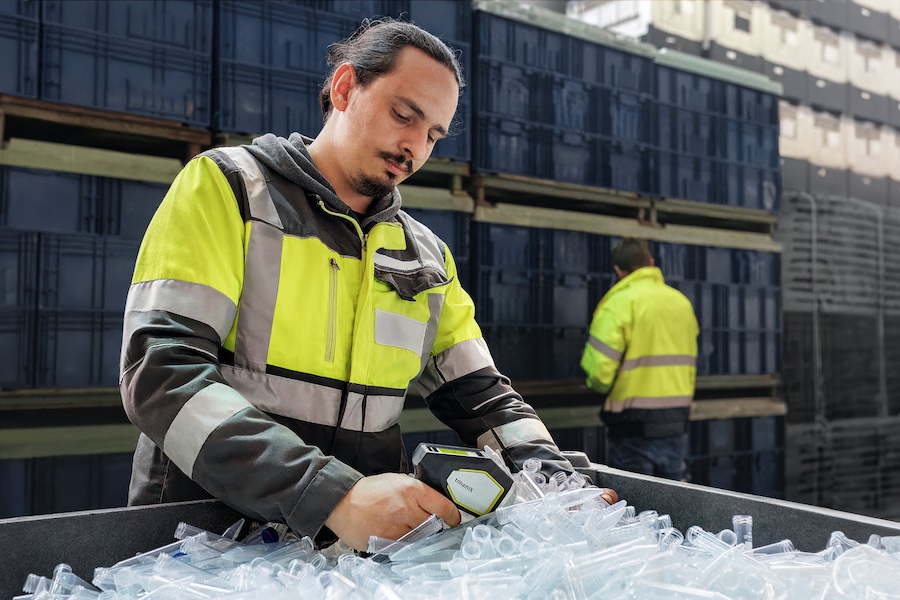
trinamiX GmbH, a leading provider of mobile spectroscopy solutions and subsidiary of BASF, will participate in the Plastics Recycling Show Europe (PRSE) 2025, taking place in Amsterdam, Netherlands. The company will showcase its versatile technology for identifying various plastics and textiles, which plays a crucial role in enhancing the recycling process.
On-the-spot identification of plastics with trinamiX Mobile NIR Spectroscopy Solutions<br />
© 2025 trinamiX GmbH
On-the-spot identification of plastics with trinamiX Mobile NIR Spectroscopy Solutions © 2025 trinamiX GmbH


Their solutions facilitate the design of sortable plastic packaging, ensure quality control for incoming and outgoing materials, and promote cleaner sorting methods that improve recycling efficiency. A highlight of the event will be the presentation of the new handheld spectrometer, trinamiX PAL Two. Attendees are invited to visit trinamiX at booth #E134 to experience the company’s Mobile NIR Spectroscopy Solutions firsthand on April 1-2, 2025.

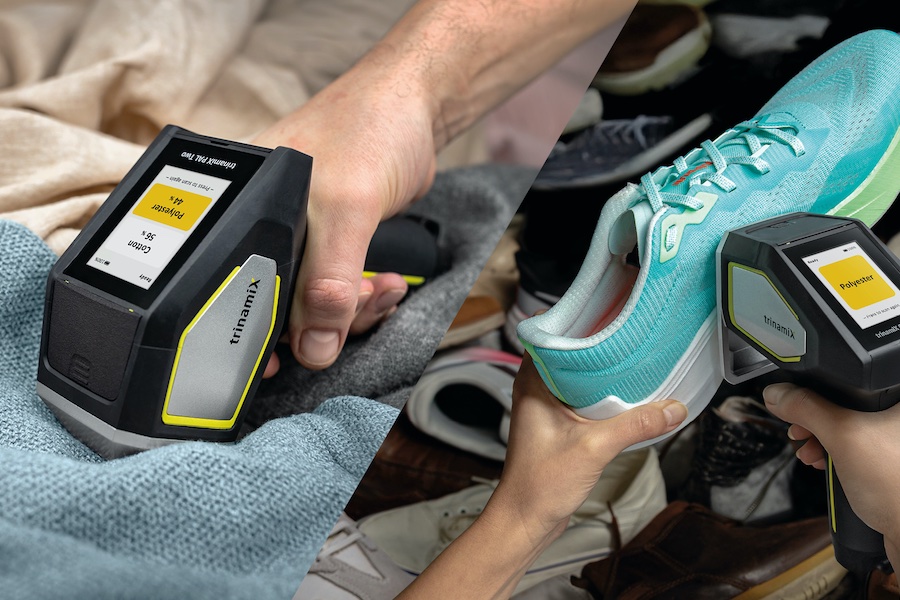
trinamiX provides a user-friendly solution for the quick identification of plastics and textiles with just the push of a button. This system features a robust, portable NIR spectrometer, accompanied by an app that leverages sophisticated cloud-based data analysis, along with a customer portal for managing results, downloading reports, and exporting data. The solution boasts the capability to accurately identify over 30 different types of plastics, including common consumer plastics such as HDPE, LDPE, PP, PET, PS, and PVC, as well as engineering plastics like PA, ABS, PC, and PLA. Additionally, it can quantify blends of polyethylene (PE) and polypropylene (PP).

In the realm of textile identification, the solution can detect a diverse array of fiber materials including acrylic, cotton, elastane, polyamide (with subclasses PA 6 and PA 6.6), polyester, polypropylene, silk, viscose, and wool. It also has the capability to analyze textiles composed of multiple materials.

To meet the specific needs of recyclers, trinamiX offers a flexible solution that encompasses various configurations. Users can choose between a compact handheld device for quick on-the-go checks or a semi-automated setup that can be seamlessly integrated into a sorting table, allowing for automatically triggered scans for enhanced efficiency.
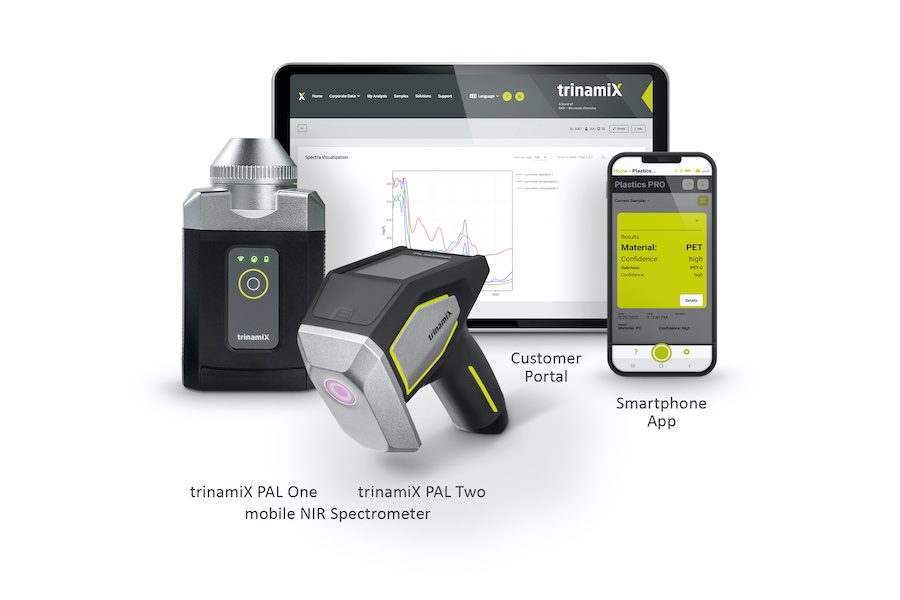
Handheld NIR-spectrometers and cloud-based data analysis for on-the-spot plastics identification from trinamiX © 2025 trinamiX GmbH


Hardware portfolio expansion: trinamiX PAL Two spectrometer

trinamiX will unveil the newest addition to its Mobile NIR Spectroscopy Solutions at PRSE: the handheld spectrometer trinamiX PAL Two. Attendees can look forward to live demonstrations of this new device. Designed with ergonomics in mind, trinamiX PAL Two allows for single-handed operation, making it user-friendly and convenient. Additionally, it includes a built-in display that presents measurement results directly on the device, enhancing usability and accessibility for users.

Design for recyclability – ensuring NIR detectability

Increasingly stringent regulations, such as the “Packaging & Packaging Waste Regulation” in the European Union, introduce new requirements for packaging design, the use of recyclates in plastic packaging, and specifications for reusable systems. To enable efficient plastic recycling, materials must be accurately identified and sorted. As the sorting process relies on NIR technology, all material must be “NIR detectable”. The design of the packaging plays a crucial role for this parameter. Features like color, labels, additives and more can impact a packages’ ability to be identified. With trinamiX, brands can assess the impact of these features on the NIR detectability early in the design process. By designing packaging with recyclability in mind, manufacturers not only comply with regulatory requirements but also support sustainability efforts.

Hard-to-differentiate plastics and textiles: multi-material films, PE/PP, compostable plastics and PA 6/PA 6.6

Hard-to-differentiate plastics and textiles, such as multi-material films and blends of polyethylene (PE) and polypropylene (PP), pose significant challenges in recycling due to their mixed compositions. Compostable plastics, while environmentally friendly, can complicate sorting processes, especially when they resemble conventional plastics. Polyamides like PA 6 and PA 6.6 are often difficult to separate and recycle, further complicating waste management efforts. The sophisticated models of trinamiX Mobile NIR Spectroscopy Solution have been trained to identify all those materials, helping to close the loop and improve recyclability.

Mobile quality control along the manufacturing and recycling process

Quality management in plastic production and recycling facilities is essential for producing high-quality products. A key element for efficient recycling of plastics is the sorting of mixed plastic waste into pure waste streams, as impurities can compromise the quality and integrity of the recycled products. From checking incoming materials to approving bales of sorted plastics or textiles, trinamiX makes quality control simple and easy. The solution also supports non-conformance management and the efficient management of complaints, reducing the risk of costly errors and delays. trinamiX not only enable companies to perform spot checks, but also to comprehensively document incoming and outgoing material flows, visualize and analyze them, thus creating comprehensive transparency for manufacturers and recyclers of plastics.

More information: https://trinamixsensing.com/plasticsorting


More News from BASF Aktiengesellschaft
Performance Chemicals for Textiles Europe

#Research & Development

How innovations drive BASF’s success

“Innovation has always been part of BASF’s DNA. Especially in these volatile times, it is crucial to leverage our innovative strength to develop competitive solutions that differentiate us as a company in our markets and give us a competitive edge,” said Dr. Stephan Kothrade, Member of the Board of Executive Directors of BASF and Chief Technology Officer, at the company’s Research Press Briefing held today. To achieve this, BASF implemented its “Winning Ways” strategy about a year ago with the clear goal of becoming the preferred chemical company to enable its customers’ green transformation.

#Nonwovens

Turning diaper waste into new value: BASF, Essity and TU Wien pioneer circular solutions

BASF, one of the world’s leading chemical companies and manufacturer of superabsorbent polymers (SAP), and Essity, a global leading hygiene and health company, joined forces together with the Technical University of Wien to revolutionize recycling of absorbent hygiene products (AHP).

#Textiles & Apparel / Garment

BASF at SIMAC 2025: Recycling meets Performance – PU solutions for the future of footwear

BASF is presenting new materials, concepts and recycling methods for polyurethanes in footwear at SIMAC Tanning Tech. The leading international trade fair will take place from September 23-25 in Milan, Italy. We will showcase our unique and integrated toolbox of Elastopan® (PU) and thermoplastic polyurethanes Elastollan® and Infinergy®. Together with our partners and customers we bring innovative products to the market offering utmost lightness paired with mechanical performance and automated processing.

#Textile chemistry

BASF strengthens liquid enzyme portfolio for the laundry and cleaning industry

By expanding its product portfolio for liquid enzymes, BASF is further strengthening its position as an innovation leader and provider of essential ingredients for the home care and I&I industry.

More News on Recycling / Circular Economy

#Recycling / Circular Economy

Reju announces site selection for first U.S. industrial sized facility regeneration hub in Rochester, New York

Reju, the textile-to-textile regeneration company, today announced it has selected the site for its first U.S.-based industrial facility marking a significant milestone in its efforts to scale globally. This future Regeneration Hub will be in Rochester, New York, reinforcing Reju’s commitment to the adoption of circular textile system across key regions worldwide.

#Business

Canopy introduces a first-of-its-kind $2 billion USD investment blueprint to decarbonize global materials supply chains

Today, the global, solutions-driven not-for-profit Canopy joined partners at Davos to introduce a new finance model designed to accelerate the growth of low-carbon materials and transform the paper, packaging, and textile supply chains. The event was anchored by a keynote speech from Sri A Revanth Reddy, Hon’ble Chief Minister of Telangana, with India set to host the first iteration of the new investment blueprint.

#Recycled_Fibers

Borealis invests EUR 49 million in Burghausen, Germany to accelerate design for circularity

Borealis announces a EUR 49 million strategic investment to scale up production of Borstar® Nextension polypropylene (PP) at its manufacturing site in Burghausen, Germany. This will expand commercial production of next-generation single-site polypropylene (ssPP) grades that deliver enhanced purity, processability, and performance - supporting customers in key sectors including packaging, healthcare, mobility, and fibers, to meet evolving market and regulatory demands.

#Recycling / Circular Economy

From local actions to industrial innovations: SOLSTICE shares mid-project results

Since its launch in May 2024, the SOLSTICE project is accelerating the transition from linear models to circular regional ecosystems in the textile industry, focusing on four key territories: Grenoble-Alpes Métropole (France), Berlin (Germany), Prato (Italy), and Catalonia (Spain). By mid-project, SOLSTICE has already revealed both regional disparities and promising solutions to strengthen textile repair, reuse, and recycling infrastructure.

Latest News

#Fabrics

MUNICH FABRIC START: Between Attitude and Sensuality

The future begins where we reimagine it. After seasons of restraint, Spring.Summer 27 marks a conscious counter-trend: optimism, sensuality, and creative freedom are replacing pragmatism and neutrality. Physical presence and individuality are regaining importance – as a response to uncertainty, exhaustion, and algorithmic predictability. The overarching theme of PLEASURE stands for fashion as an emotional space, as an expression of attitude and cultural reflection. Colours, surfaces, and materials become vehicles for self-confidence and joie de vivre.

#Denim

organIQ seek: smart alternative to potassium permanganate

CHT Group announces new technical findings within its organIQ seek platform that significantly advance the transition toward permanganate-free denim bleaching. Through extensive industrial testing and application research, CHT confirms that organIQ seek can now be used with remarkable effectiveness as a substitute for potassium permanganate in spray bleach, while remaining aligned with sustainability expectations and cost realities in the European market. At the COLOMBIATEX in Medellín as well as at the Exintex in Puebla and the Kingpins Show in Amsterdam the CHT Group will present organIQ seek as an alternative to potassium permanganate.

#Functional Fabrics

PERFORMANCE DAYS: Focus topic shifts to the beginning of the value chain

Following the last Focus Topic in October 2025, which placed Textile-to-Textile Recycling at its core, PERFORMANCE DAYS continues to drive the conversation around circularity – this time with an expanded and more upstream perspective. The upcoming Focus Topic, “Textile to Textile: The Role of Collectors and Sorters,” presented during the spring edition on March 18–19, will spotlight one of the most essential yet often overlooked components of a functioning circular textile system: the efficient collection and sorting of post-consumer textiles.

#Knitting & Hosiery

Proven performance, optimised costs – the new RE 6 EL

Nowadays textile companies increasingly need to produce small production runs and respond to market changes with instantaneous pattern changes in order to operate profitably – meaning they require machines that offer maximum flexibility, reliability and cost efficiency. KARL MAYER understands the challenges of the market and is launching its new RE 6 EL. The Raschel machine offers the core strengths of the classic RSE 6 EL and essentially the same performance parameters, but has been further cost-optimised largely due to local production advantages. This makes the newcomer an efficiency champion in production, especially when it comes to frequent pattern changes.

TOP