[pageLogInLogOut]

#Recycled Fibers

© 2025

EREMA Group partners with Australian technology pioneer BlockTexx®
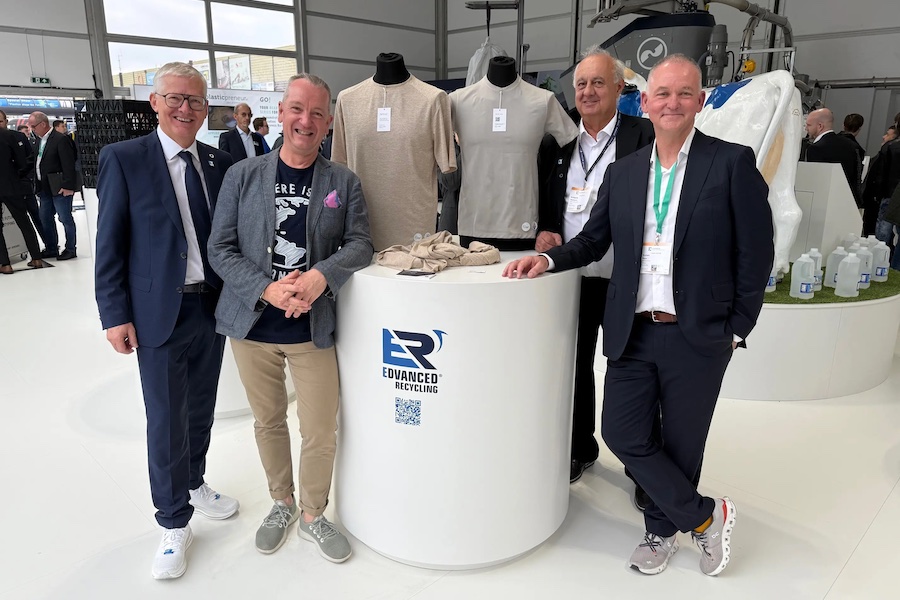
From left: Manfred Hackl (EREMA Group), Graham Ross (BlockTexx®), Wolfgang Hermann (EREMA Group), and Adrian Jones (BlockTexx®) next to T-shirts made from 100% recycled polyester. © 2025 EREMA
At K show in Düsseldorf, the world’s leading trade fair for plastics and rubber, EREMA Group announced a strategic investment in clean technology company BlockTexx®. The Australian pioneer has developed a process that separates polyester and cellulose from blended textiles. By combining both companies’ technologies, the partnership aims to scale post-consumer textile-to-textile recycling to industrial levels.


Through the strategic collaboration the EREMA Group emphasizes its commitment to returning polyester to the apparel production cycle and scaling up textile-to-textile recycling. “The PET fibre industry is three times the size of the PET bottle industry. We have been investing in the research and development of textile and fibre recycling for several years. With the technology we already provide for PET fibre recycling, our next step is to aim for full-scale industrial textile recycling. We consider BlockTexx® a key partner in this. Their technology paves the way for used textiles to re-enter the production cycle,” said Manfred Hackl, CEO of EREMA Group.

BlockTexx®‘s process separates polyester and cellulose from post-consumer textiles and clothing, providing the polyester for EREMA’s technology. The INTAREMA® FibrePro:IV system will process the polyester into recycled pellets suitable for new garment production. “Our thermomechanical recycling system is a core element for textile recycling,” said Wolfgang Hermann, Business Development Manager for Fibres & Textiles at EREMA Group. “However, full-scale textile recycling requires a combination of technologies, with BlockTexx® unlocking the solution for processing polyester-blended textiles.“

Industrial-scale expansion

BlockTexx® operates its first plant in Australia with a processing capacity of 10,000 tonnes per year, with plans for a second plant of 50,000 tonnes per year. Scaling up requires a strong investment partner. “Blended textiles like cotton-polyester account for over 60 per cent of global apparel production but are notoriously difficult to recycle due to fibre incompatibility and chemical contamination”, says Adrian Jones, co-founder of BlockTexx®. EREMA Group’s investment brings not only capital but also deep recycling expertise, proven technology and infrastructure. From the very beginning, it felt like a true partnership, Jones notes: “Both companies share the same intellectual curiosity and EREMA Group was committed to this journey from day one.”
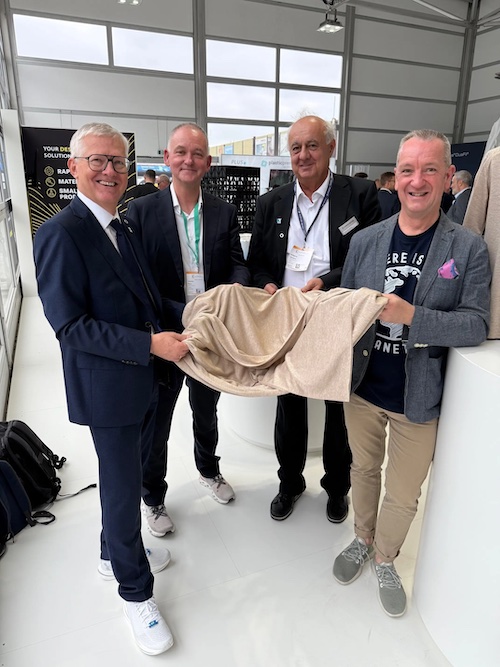
The same representatives  holding the new fabric made from 100% recycled polyester at the Edvanced Recycling Center, where EREMA demonstrates live recycling and products made of recyclate during the K show. © 2025 EREMA
The same representatives holding the new fabric made from 100% recycled polyester at the Edvanced Recycling Center, where EREMA demonstrates live recycling and products made of recyclate during the K show. © 2025 EREMA


Textile industry faces recycling challenges

According to global non-profit Textile Exchange 75 million tonnes of synthetic fibres were produced in 2023, with polyester being the most common, accounting for 57 per cent of total fibre production. Recycling rates for polyester are estimated at only 1 per cent. “Currently, nearly all the recycled polyester in the clothing you see in retail stores is derived from PET plastic bottles” says Graham Ross, co-founder of BlockTexx®. As per Textile Exchange, recycled fibres constituted 7.7 per cent of the global fibre market in 2023, with 7 per cent being recycled polyester from waste PET bottles. Hackl emphasizes: “The goal must be to ensure that rPET from bottles is returned to new bottles. This investment is not only positive for the textile industry, but also for the plastics industry. By keeping rPET in the bottle-to-bottle loop, we can stabilize supply and prices for the market.”

With the EU recently adopting binding legislation that will make textile producers responsible for the collection, sorting and recycling of textile waste through mandatory Extended Producer Responsibility (EPR) schemes, the sector is set for change. As these rules come into force over the coming years, the demand for post-consumer textile recycling solutions is expected to grow significantly. “The EU legislation could fundamentally transform the sector. While most textile production takes place in Asia, Europe is a major consumer of fashion. This legislation will therefore have a significant global impact”, Ross notes.

Setting new standards for circularity

By combining mechanical processing, chemical separation, and fibre regeneration, the partnership establishes a model that sets new industrial standards for circularity. “Twenty-five years ago, people could not imagine bottle-to-bottle recycling. Today it is standard. I believe the same will happen for textile-to-textile recycling”, says Hackl. “The textile industry has been slow to recognize the importance of recycling, often citing difficulties as an excuse. Now there are no more excuses. Textile-to-textile recycling will become a reality at industrial-scale through the collaboration between EREMA and BlockTexx®,” adds Jones.

More News from EREMA

More News on Recycled Fibers

#Recycled Fibers

UNIFI celebrates recycled and circular Innovation with ninth annual REPREVE® Champions of Sustainability Awards

Unifi, Inc. (NYSE: UFI), the makers of REPREVE® and one of the world’s leading innovators in recycled and synthetic yarns, today announced the winners of its ninth annual REPREVE Champions of Sustainability Awards, recognizing brands and mills that are advancing circularity and responsible manufacturing across the global textile industry.

#Recycled Fibers

RE&UP partners with Madewell and ISKO on textile-to-textile denim capsule

RE&UP Recycling Technologies is accelerating the shift toward a closed-loop textile economy through a collaboration with American denim brand Madewell and global fabric manufacturer ISKO. By transforming approximately 20,000 pairs of post-consumer jeans into recycled feedstock for a textile-to-textile denim capsule, RE&UP demonstrates the commercial viability of circular systems in the denim sector.

#Recycled Fibers

Syre and JEPLAN Announce Strategic Partnership to Accelerate Textile-to-Textile Recycling

JEPLAN, INC. the Japanese pioneer developing and operating chemical recycling technologies for circularity in packaging and textiles, and Syre, the textile impact company on a mission to hyperscale textile-to-textile recycling, announced today a strategic partnership. Together, the companies aim to extensively accelerate the timeline towards commercialization of next generation textile-to-textile polyester recycling technology.

#Recycling / Circular Economy

Reju secures €135 Million in Dutch NIKI Funding for industrial-scale textile-to-textile regeneration hub at Chemelot Industrial Park, the Netherlands

Reju™, the progressive textile-to-textile regeneration company, has been awarded €135 million in funding under the Netherlands’ Nationale Investeringsregeling Klimaatprojecten Industrie (NIKI) program. The funding will support Reju’s planned industrial-scale Regeneration Hub at Chemelot Industrial Park in Sittard-Geleen, covering both the investment phase and ongoing operations, and represents a critical milestone on the path toward final investment decision.

Latest News

#Techtextil 2026

SAHM Winding Solutions and Vandewiele Automation present integrated automation solution for winding processes

For the first time at the Techtextil trade fair in Frankfurt am Main, Germany (21 - 26 April), SAHM Winding Solutions (Hallo 12.0. / Booth 95) and Vandewiele Automation will be showcasing their combined automation expertise for industrial winding processes. Under the motto “Combining Automation. Maximizing Flow”, the two companies will demonstrate how automated package handling and robot-assisted yarn knotting can be integrated into a continuous production flow.

#Man-Made Fibers

Teijin Frontier announces new Stretch Polyester yarn offering exceptional compatibility with high-performance Polyester materials

Teijin Frontier Co., Ltd. announced today that it has developed a new stretch polyester yarn that offers new opportunities to create comfortable, all- polyester fabrics for sports and outdoor wear. The new polyester yarn demonstrates exceptional compatibility with high-performance polyester materials. Further, Teijin Frontier’s proprietary polymer design and spinning technology impart excellent elasticity to the new yarn. In turn, this yarn adds stretchability and recovery to the advanced functionality and excellent texture of high-performance polyester materials.

#Man-Made Fibers

Lenzing commissions 14 MW power‑to‑heat facility, strengthening grid stability and heat management

The Lenzing Group has successfully commissioned a new power‑to‑heat (P2H) facility with an electrical capacity of 14 megawatts. The installation converts renewable electricity directly into process heat, is fully integrated into the existing heat network at the industrial site, and represents a key building block for a fossil‑free heat supply. As project partner, VERBUND was responsible for the energy‑market integration and will operate the facility for balancing energy marketing, enabling it to respond flexibly to short‑term fluctuations in the power grid.

#Raw Materials

Kraig Biocraft reaches next step in production growth

Kraig Biocraft Laboratories, Inc. (OTCQB: KBLB) (“the Company”, “Kraig Labs”, or “Kraig’s”), a world leader in spider silk technology*, today announced that it has produced more than 1.3 metric tons of recombinant spider silk cocoons in a single month. This is a new world record and shatters the Company’s previous production record by a factor of five. Today marks a pivotal step forward in the transition of spider silk from laboratory innovation to an industrial-scale material platform.

TOP