[pageLogInLogOut]

#Raw Materials

Kraig Biocraft Laboratories unveils groundbreaking scientific achievement based on caddisfly silk proteins
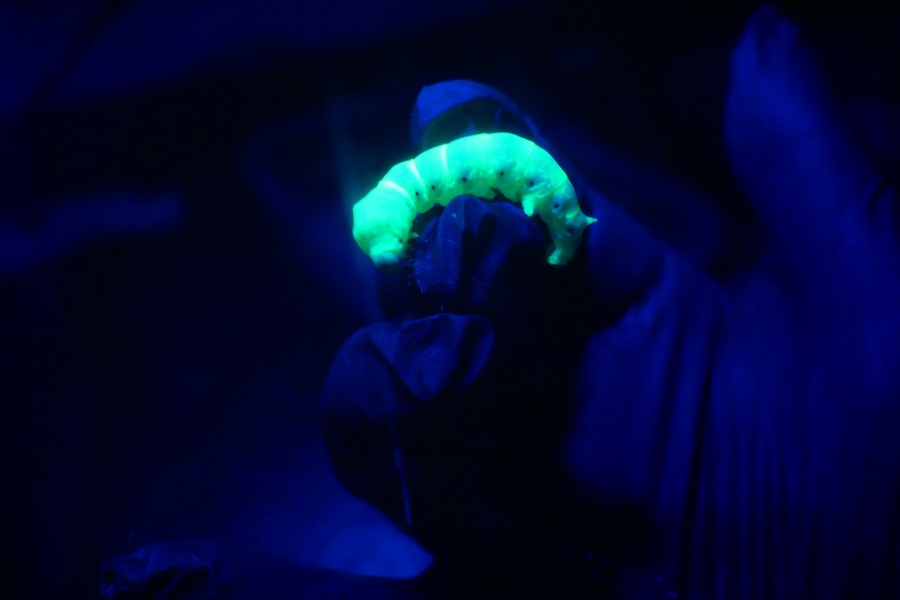
Kraig Biocraft Laboratories, a leading developer of spider silk-based fibers, proudly announces the successful creation of new novel silk, build upon the silk proteins of the remarkable caddisfly. This breakthrough marks a new frontier in the field of engineered fibers and underscores the Company’s commitment to pioneering innovations in biotechnology.
Successfully creates transgenic based on underwater adhesive properties of Caddisfly © 2025 Kraig  Labs
Successfully creates transgenic based on underwater adhesive properties of Caddisfly © 2025 Kraig Labs


Caddisflies (known in the Pacific Northwest as “Periwinkles”) are known for their extraordinary ability to spin silk underwater, which they use to construct protective cases in aquatic environments. By leveraging the unique mechanical and chemical attributes of caddisfly silk proteins, Kraig Labs seeks to engineer materials with unprecedented functionality. This new silk offers the potential for increased durability when submerged in water. Possible applications for this new silk are vast, with exciting potentials for medical adhesives, biomedical textiles, performance apparel, and next-generation fiber technologies.

“This achievement demonstrates our ability to extend beyond spider silk proteins and explore the broader possibilities of silk engineering,” said CEO and Founder of Kraig Labs, Kim Thompson. “By tapping into the evolutionary diversity of silk-producing organisms, we’re expanding the toolkit for creating super fibers that meet the demands of tomorrow’s industries.” 

The introduction of caddisfly-based transgenic fiber represents a critical milestone in the Company’s vision to create new super materials blending the physical and chemical properties of various silk proteins. The result is an ever-growing portfolio of high-performance materials designed to redefine the standards of strength, elasticity, and functionality. These new fibers will leverage the Company’s propriety silkworm-based production system to bring these materials to market.

“Incorporating the unique and incredible adhesive properties of caddisfly silk protein has been a key part of the R&D roadmap I laid out when founding Kraig Labs,” Thompson continued. “Unveiling this pivotal scientific milestone, our first caddisfly-based transgenic, marks not only a significant leap forward for the Company’s business model but also a deeply gratifying achievement for me personally and for our team.”

This breakthrough would not have been possible without the dedication and ingenuity of the Company’s scientific team. Their relentless pursuit of excellence and creative problem-solving have once again positioned Kraig Labs at the forefront of biotechnological innovation.

“Our team’s success with this caddisfly-inspired material is a testament to the power of combining cutting-edge science with bold vision,” added the Company’s COO, Jon Rice. “We are excited about the potential this fiber holds and the new opportunities it creates across multiple sectors.”

Kraig Labs is committed to pushing the boundaries of creativity and science in silk protein engineering. The Company has filed a provisional utility patent application for this exciting new technology. By exploring and integrating the diverse properties of silk from various species, the Company will continue to lead the charge in developing sustainable, high-performance materials that address real-world challenges.
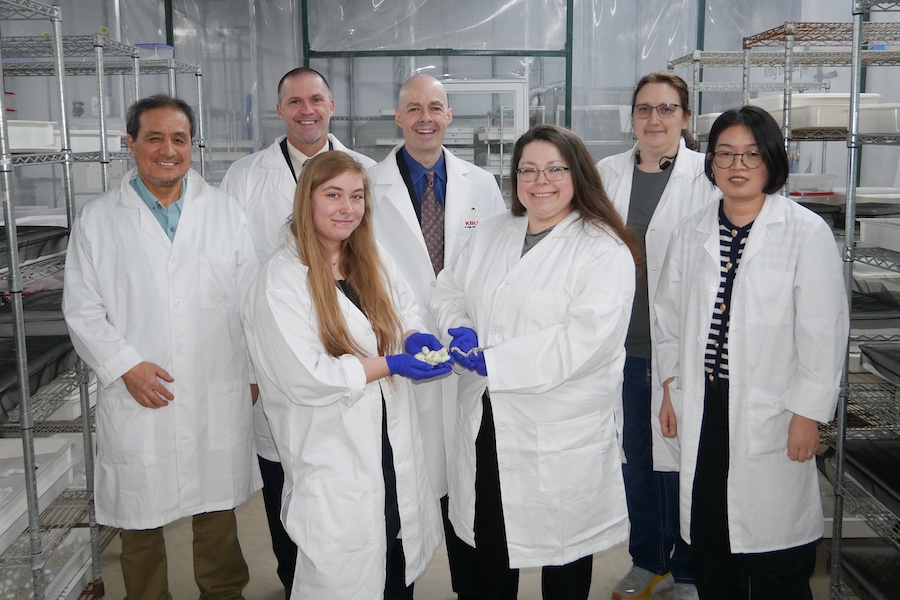
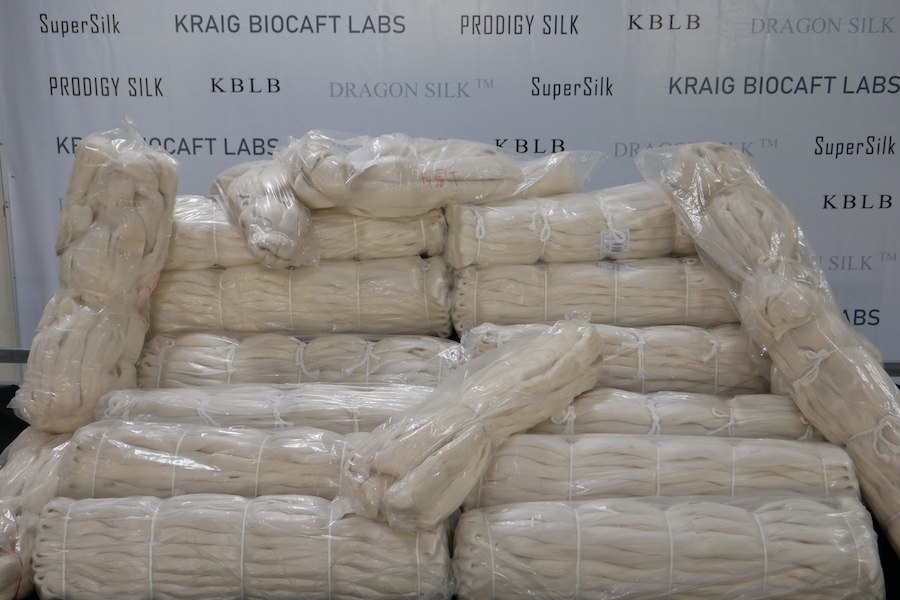
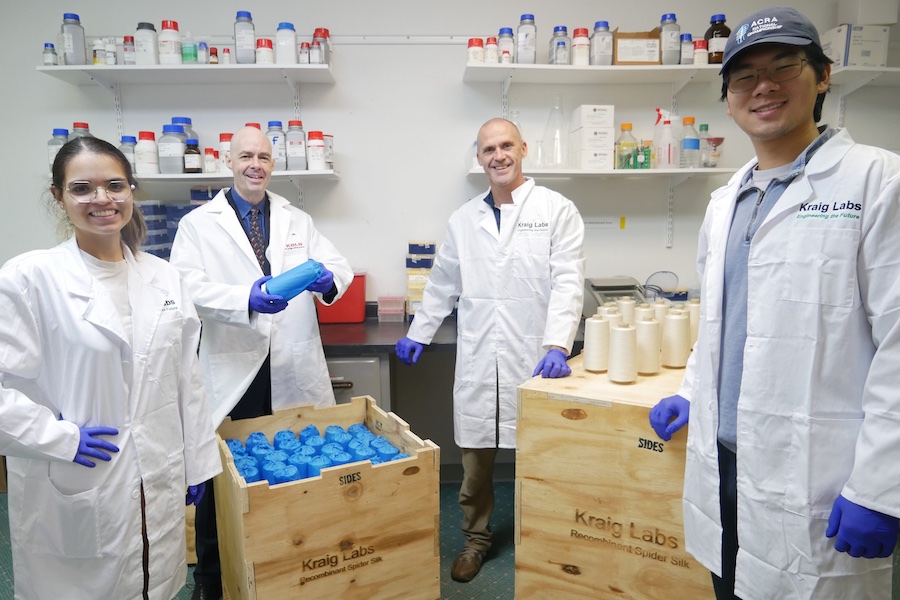
Kraig 's scientific team © 2025 Kraig Labs


More News from Kraig Biocraft Laboratories, Inc.

#Raw Materials

2026 production plan set for a record 10 metric tons of recombinant spider silk cocoon per month

Kraig Biocraft Laboratories, Inc. (OTCQB: KBLB) (“the Company”, “Kraig Labs”, or “Kraig’s”), a world leader in spider silk technology*, today announced its 2026 production plan that will drive explosive growth and establish a new global benchmark for spider silk manufacturing.

#Man-Made Fibers

Kraig Biocraft Laboratories takes possession of three strategic mulberry fields advancing massive spider silk production ramp-up

Kraig Biocraft Laboratories, Inc. (OTCQB: KBLB) (“the Company”, “Kraig Labs”, or “Kraig’s”), a world leader in spider silk technology*, today announced that it has taken possession of three critical mulberry fields for which it previously secured usage rights. The Company has now integrated this new feedstock capacity directly into the ramp-up of its current spider silk production.

#Man-Made Fibers

Kraig Biocraft Laboratories successfully completes production cycle, delivering over one million bam-1 alpha hybrid eggs for deployment

Kraig Biocraft Laboratories, Inc. (OTCQB: KBLB) (“Company” or “Kraig Labs”), a world leader in spider silk technology*, today announced the successful completion of its most recent production cycle, yielding more than one million BAM-1 Alpha hybrid eggs. These eggs are now staged for release over the next quarter and will serve as the next wave of recombinant spider silk production.

#Man-Made Fibers

Kraig Biocraft Laboratories launches significant hiring initiative to support expanded spider silk production footprint in Southeast Asia

Kraig Biocraft Laboratories, Inc. (OTCQB: KBLB) (“Company” or “Kraig Labs”), a world leader in spider silk technology*, announces the launch of a key hiring initiative at its production operations in Southeast Asia. This expansion of the Company’s production workforce is driven by rapidly increasing throughput, an expanded operational footprint, and preparations for the opening of its newest production center, now in active development.

More News on Raw Materials

#Raw Materials

New study shows low environmental impact by Cotton made in Africa Organic Cotton from Tanzania

Today, the Aid by Trade Foundation (AbTF) is announcing the results of a comprehensive life-cycle analysis (LCA) for cotton produced in Tanzania under the Cotton made in Africa Organic (CmiA Organic) standard. The study emphasises the small ecological footprint of CmiA Organic verified cotton. This can largely be traced back to the absence of synthetic pesticides, artificial fertilisers, and artificial irrigation. Consequently, CmiA Organic cotton can help the textile industry meet regulatory requirements as well as science-based targets. The results also show that the consequences of climate change threaten the livelihoods of these cotton farmers, even though the type of agriculture they practise barely contributes to climate change.

#Raw Materials

Better Cotton Initiative strengthens regenerative focus in standard update

The Better Cotton Initiative (BCI) has strengthened the regenerative focus of its field-level standard with the launch of a new version of its Principles & Criteria (P&C), which marks the next step in the organisation’s journey to becoming a regenerative standards system.

#Raw Materials

Global production expected to decline in 2026/27 as policy shifts and weak demand reshape trade

Early projections for the 2026/27 season indicate that global cotton lint production will decline by 4% to 24.9 million tonnes, while world consumption is expected to remain stable at approximately 25 million tonnes, according to the April 2026 issue of Cotton This Month.

#Raw Materials

Textile Exchange publishes cotton Life Cycle Assessment study to strengthen impact data

Textile Exchange has published the first in a series of seven Life Cycle Assessment (LCA) studies designed to improve the quality and robustness of environmental impact data for raw material production across the fashion, textile, and apparel industry. The first LCA study focuses on cotton and addresses critical data gaps and methodology variability through new high-quality data across key producing countries. The study includes organic, regenerative, recycled, and country averages for conventional cotton production systems, providing a clearer picture of the associated environmental impact.

Latest News

#Man-Made Fibers

Selenis and Kintra Fibers partner to scale 100% bio-based synthetic fiber technology

Selenis, a leading global specialty polyester manufacturer, today announced a strategic manufacturing partnership with materials science company Kintra Fibers to scale Kintra’s patented fiber-grade PBS resin - a 100% bio-based and biodegradable material designed for textile applications.

#Functional Fabrics

PERFORMANCE DAYS proves its relevance as the industry’s key meeting point

Held on March 18–19, 2026, PERFORMANCE DAYS once again confirmed its position as a leading international platform for functional textiles. A total of 3.366 trade visitors and around 560 exhibitors gathered in Munich, with the event already kicking off successfully on DAY 0, which received highly positive feedback for its interactive format. Despite challenging conditions caused by the public transport strike in Munich, the event saw strong attendance and a consistently high level of activity across both exhibition days.

#Recycling / Circular Economy

Reju secures €135 Million in Dutch NIKI Funding for industrial-scale textile-to-textile regeneration hub at Chemelot Industrial Park, the Netherlands

Reju™, the progressive textile-to-textile regeneration company, has been awarded €135 million in funding under the Netherlands’ Nationale Investeringsregeling Klimaatprojecten Industrie (NIKI) program. The funding will support Reju’s planned industrial-scale Regeneration Hub at Chemelot Industrial Park in Sittard-Geleen, covering both the investment phase and ongoing operations, and represents a critical milestone on the path toward final investment decision.

#Techtextil 2026

TTL showcases nonwoven and needlefelt solutions at Techtextil 2026

Technische Textilien Lörrach GmbH & Co. KG (TTL), part of the Yanpai Group, will present its latest nonwoven and needlefelt solutions for industrial applications at Techtextil 2026 in Frankfurt.

TOP